As an Amazon Associate, we earn from qualifying purchases. This post contains affiliate links — if you buy through them, we may earn a small commission at no extra cost to you.
Buy the wrong aerator for clay and you can finish the afternoon with ground harder than you started with. That is the risk with the Landzie AeroCore on clay soil. The tool is sound; the prep is what decides whether it works, and clay is less forgiving than loam when the prep is wrong.
If you searched for the “Aero Core Duo,” the tool behind the name is Landzie’s AeroCore rolling lawn aerator — a single drum with seven hollow tines, built to pull plugs out of the ground. There is no published clay-soil trial of this tool, no maker test and no independent one, so the honest way to judge it is the design: hollow tines that remove soil instead of shoving it aside, and a weight that only works when the ground is soft enough to let them in.
What the AeroCore Actually Is
The AeroCore is a push roller, not a step-on fork and not a machine. Seven replaceable stainless steel tines with beveled tips sit around a drum, and as you push, the tines punch in, pull a plug of soil, and eject it behind you. The Amazon listing puts the weight just under 39 pounds, and the working path is 12 inches wide per pass.
Two details matter on clay. First, the tines are hollow, so each pass removes soil instead of compressing it — the difference between core aeration and spike aeration, and the reason a core tool is the right starting point for clay. Second, the tines are replaceable and thread in, so a bent or dulled tine is a spare part, not a new tool.
What it is not: a powered aerator. There is no engine, no weight tray, and no way to add downforce beyond your own push. On soft ground that is a feature — it stays light enough to steer. On hard clay it is the limit you have to plan around.
Why Clay Is the Hardest Test for a Manual Aerator
Clay has two moods, and both fight a hand tool. Bone dry, it sets like brick: hollow tines skate across the surface or stop an inch down, and pushing harder just wears you out. Soaking wet, it turns to putty: the tines punch in fine, then clog, smear, and stop ejecting plugs.
The window that works is moist, not muddy — the kind of ground where a screwdriver pushes in a few inches with steady pressure. That is not a quirk of this tool. Every manual core aerator has the same window, and the rental machines only widen it a little. The mistake is treating aeration day like mowing day, something you do whenever the weekend allows, instead of waiting for the soil to be ready.
How It Holds Up on Clay
On moist clay, the AeroCore does the job it was built for. The beveled tips cut rather than push, the 39 pounds is enough weight to drive seven tines into softened ground without added sand, and the rolling motion covers ground far faster than stepping on a fork aerator one plug at a time. For a small-to-mid-size clay lawn that gets aerated every fall, it is a reasonable buy.
On dry clay, it struggles. The tines will not reach useful depth, and the plugs that do come out are shallow and crumbly. On soggy clay, it clogs — the hollow tines pack with wet soil and stop ejecting, which means stopping to clear them. And on clay that has been compacted for years, one pass changes very little. Core aeration improves clay over seasons, not afternoons: the plugs break down, roots follow the holes deeper, and compost topdressing does the long work of changing the soil itself.
The 12-inch path is the other honest limit. On a 5,000-square-foot clay lawn, that is a lot of passes, and a second pass at right angles doubles it again. The tool earns its keep on lawns you can cover in an hour or two, not on a half-acre of heavy clay.
| Tool | How it works | Best for clay | Watch out for |
|---|---|---|---|
| Landzie AeroCore rolling aerator | 7 hollow tines on a rolling drum; pulls plugs | Small-to-mid clay lawns, moist soil | Clogs in mud; shallow in dry clay |
| Landzie 42-inch fork aerator | 3 hollow tines, step-on; pulls plugs one spot at a time | Tight spots and patch work | Slow across a whole lawn |
| Powered core aerator rental | Engine-driven, many tines; deep plugs fast | Large or severely compacted clay | Rental cost, transport, half-day job |
| Spike or solid-tine roller | Solid tines poke holes without removing soil | Not recommended for clay | Compresses clay around each hole |
The Picks
Best overall: Landzie AeroCore Rolling Lawn Aerator. Seven hollow stainless tines, beveled tips, and a rolling drum that pulls real plugs. For a clay lawn you aerate yourself each fall, it is the right shape of tool — provided you water first.
Landzie AeroCore Rolling Lawn Aerator
Seven hollow tines that pull real plugs from clay — when the soil is moist first.
Runner-up: Landzie 42-inch fork aerator. Three beveled hollow tines on a long handle, worked with a foot bar. It pulls the same kind of plug, one spot at a time, and it reaches corners and narrow strips the roller cannot. The trade-off is speed: across a whole lawn, stepping is slow work.
Landzie 42-Inch Hollow Tine Fork Aerator
Same hollow-tine plugs as the roller, in the spots the roller cannot reach.
Not recommended for clay: spike aerators. Solid tines poke holes without removing soil, and on clay the soil they push aside packs tighter around each hole. A spike roller can leave a clay lawn more compacted than it found it — the one tool in this category that works against its own purpose.
Getting It to Work on Clay
Water deeply the day before. Soak the lawn until a screwdriver pushes in a few inches with steady pressure, then wait until the surface is moist, not muddy. Watering the morning of the job works too, if the soil drains enough by afternoon.
Mow first, and mark what is shallow. Cut the grass short so you can see the plugs, and flag sprinkler heads and shallow lines before you roll over them.
Roll twice, in two directions. A second pass at right angles doubles the holes and catches the strips the first pass missed. On clay, coverage matters more than depth on any single pass.
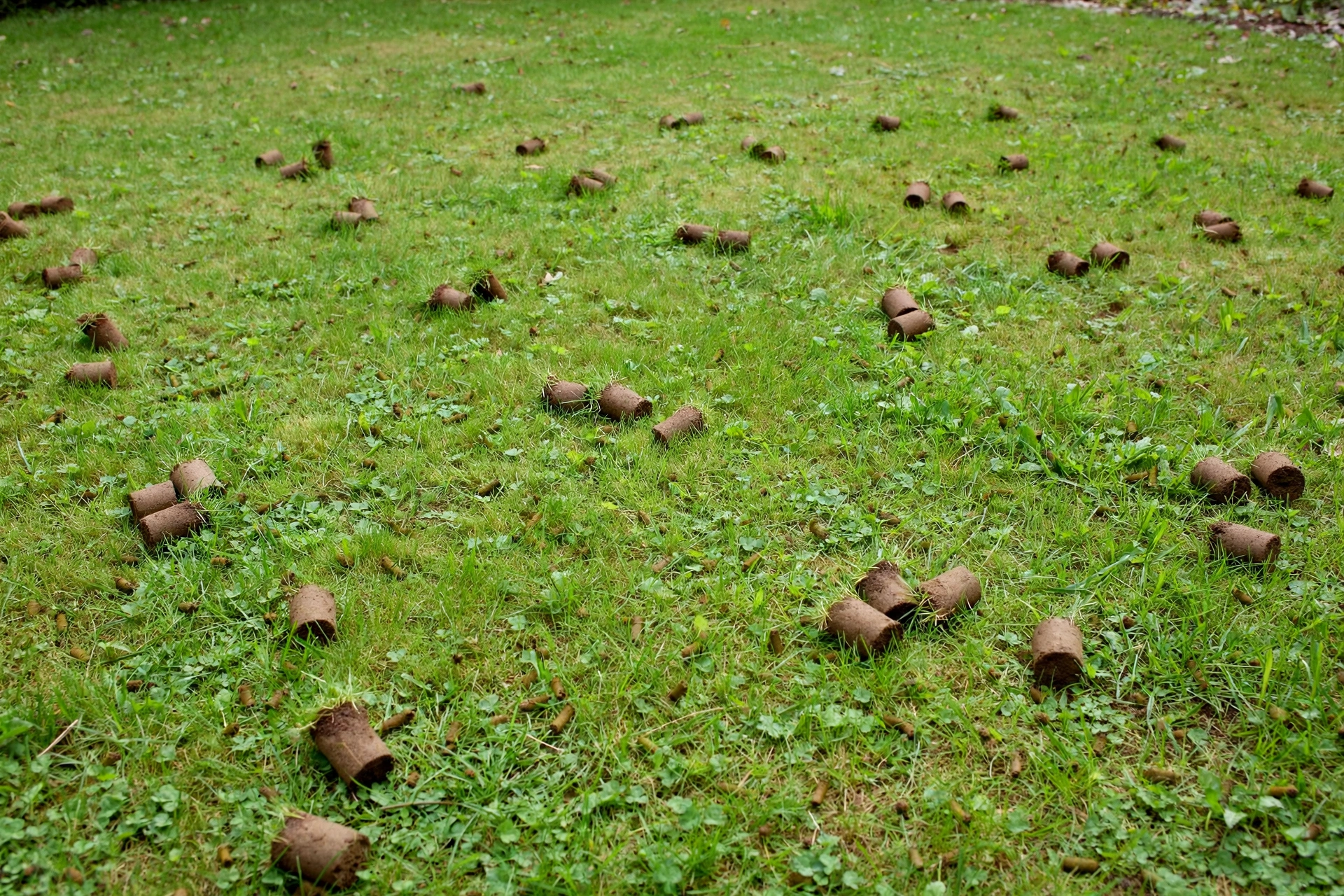
Leave the plugs. They look messy for a week, then break down and return to the lawn. Raking them up throws away the soil you just loosened.
Topdress with compost if you want the clay to change. Aeration opens the holes; compost worked into them is what loosens clay over seasons. Skip the compost and the holes close up again without changing the soil underneath. If you are deciding between aerating and dethatching first, our dethatch-or-aerate guide sorts out the order, and our tow-behind aerator setup guide covers the powered route for bigger lawns.
When to Rent Instead
Rent a powered core aerator when the lawn is large, the clay is severely compacted, or a screwdriver still will not enter the ground a day after watering. The rental pulls deeper plugs across a wider path in a fraction of the time, and one good rental pass can do what a manual roller would take a weekend to match. Buy the Landzie for the upkeep passes in the years after, not for the rescue job.
Bottom Line
The AeroCore works on clay soil — on moist clay, with realistic expectations, and every fall, not once. Water the day before, roll twice, leave the plugs, and it will pull real cores from ground that defeats a spike aerator. Skip it if your clay is dry as brick and you will not water first, or if the lawn is big enough that a 12-inch path turns the job into a weekend. In those cases the rental is the honest buy, and the Landzie is the tool you pick up for the seasons after.