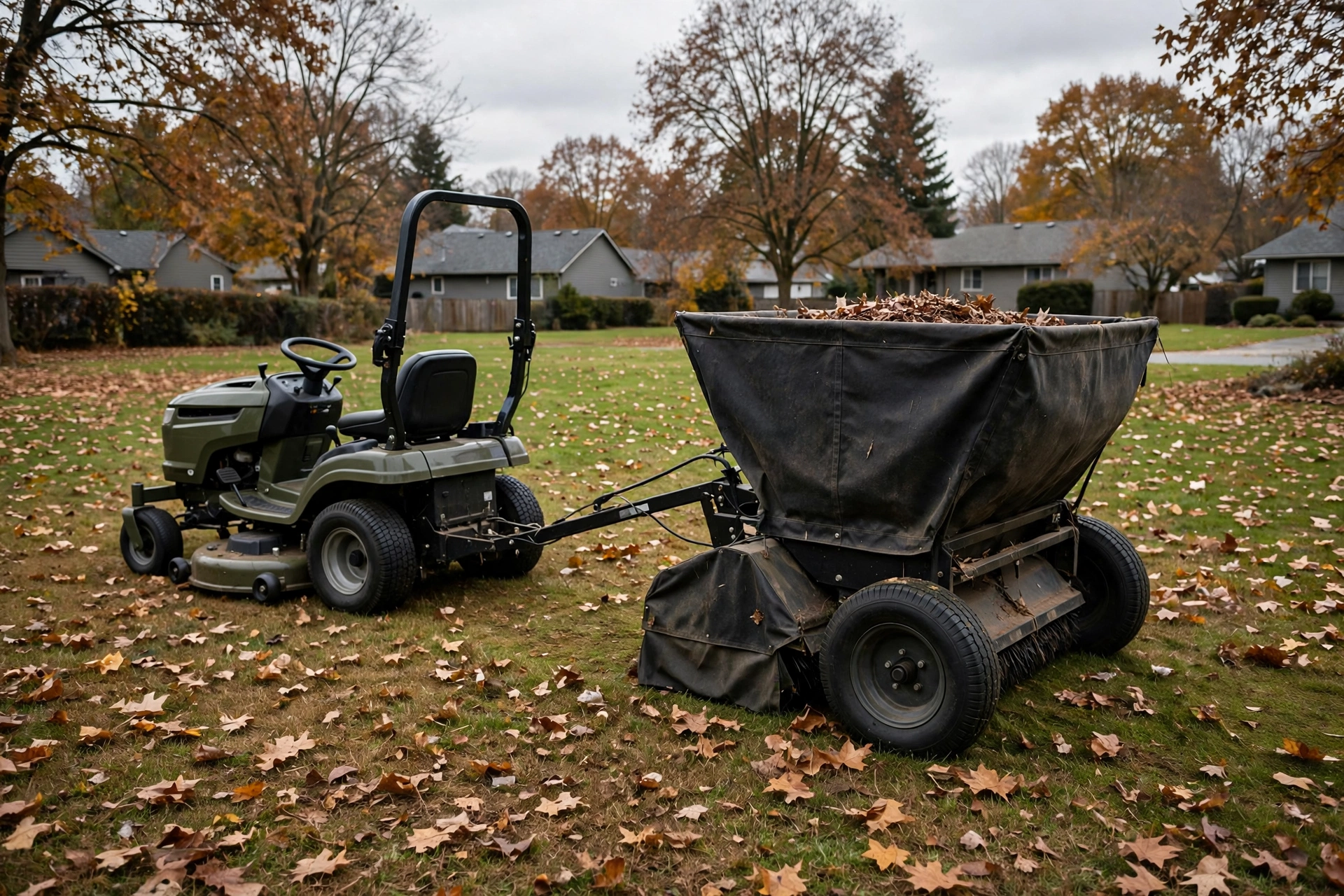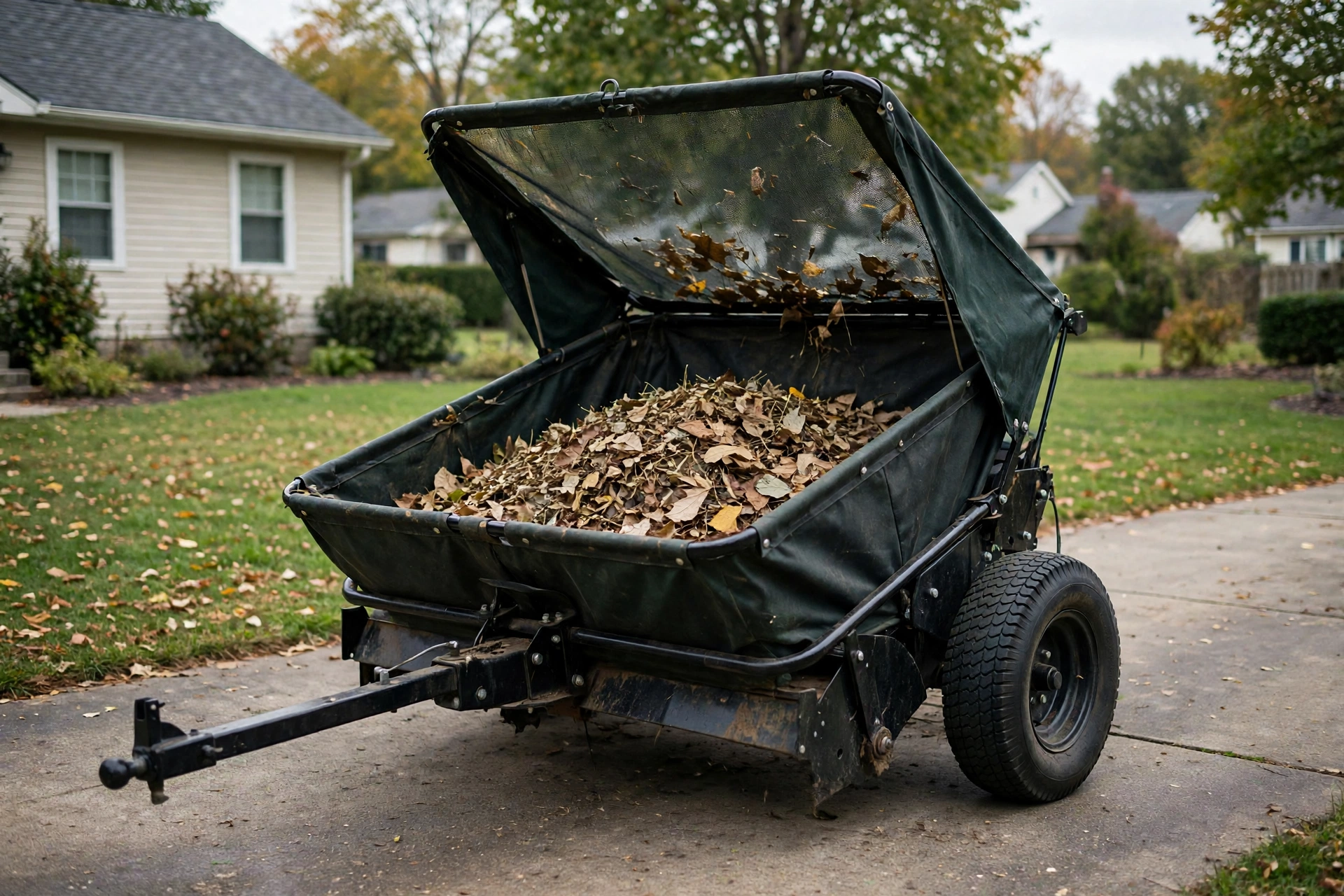
Your tractor can pull any sweeper on the lot. That is the trap: the hitch fits, the price looks fair, and you only learn the sweeper was the wrong one when the bag fills on the first pass and the brushes leave a trail of leaves behind you. A tow-behind sweeper is really two purchases in one — the width that decides how fast you finish, and the bag that decides how often you stop — and the spec sheet tells you both, if you know which numbers to read.
This guide reads those three numbers — width, hopper size, and brush speed — in plain terms, so you can match a sweeper to your lawn instead of your budget. For the picks themselves, see our Agri-Fab vs. Ohio Steel vs. Brinly head-to-head, and for the setup that keeps any sweeper from clogging, see how to use a tow-behind sweeper without clogging it.
Start With Your Lawn, Not the Spec Sheet
Before any number matters, answer three questions about the yard. How big is the open grass — a quarter acre of lawn, or a half acre with room to run? How many trees drop leaves on it, and how heavy is the drop? And how much of the lawn is broken up by beds, trees, and a winding drive?
A big open lawn rewards width. A lawn cut into pieces rewards light weight and tight turning. A heavy leaf drop rewards bag size above everything else. Keep your answers in mind as you read the three numbers below, because the right sweeper for a half-acre of open grass is the wrong sweeper for a quarter-acre maze of beds.
Width: How Much Ground Each Pass Covers
Width is the simplest number on the sheet: the sweep path in inches. Common tow-behind widths run 42 to 50 inches. On a long, straight pass, a 50-inch sweeper covers about 14 percent more ground than a 44-inch one, which adds up to real time saved across a half-acre of open lawn.
But width only pays when you can run straight. Around beds, trees, and curves, a wide sweeper is harder to turn and more likely to clip a bed edge or a low branch. A 42-inch sweeper turns tighter and follows a winding drive more easily. As a rule: if most of your lawn is open grass you can cross in long passes, buy the widest sweeper that fits your storage. If your lawn is mostly turns, buy the narrowest one that still clears the leaf load.
Width also has a storage cost. A 50-inch sweeper needs a wider spot in the garage than a 42-inch one, and the difference matters in a shed that already holds a mower and a snowblower. Some models fold down for storage — worth asking about if space is tight.
Hopper Size: How Often You Stop to Dump
Hopper size is measured in cubic feet, and it is the number most buyers underweight. Tow-behind hoppers commonly run 20 to 28 cubic feet. That gap sounds small until you are standing in the yard emptying the bag: a 28-cubic-foot bag holds about 40 percent more than a 20-cubic-foot one, which means roughly a quarter fewer stops on a heavy leaf day.
Two details matter as much as the raw number. The first is how the bag fills. A flow-through bag fills from the back forward, using the whole bag before leaves start spilling at the opening. A bag that piles leaves at the front quits early, so its rated capacity overstates what it actually holds on the job. The second is how it empties. A dump handle or pull rope that works from the tractor seat turns a stop into ten seconds. A bag you have to climb off and wrestle turns every stop into a chore, and you will feel that by the third dump.
Match the hopper to the leaf load. A light leaf fall on a small lawn is fine with 20 cubic feet. A heavy drop under mature oaks or maples wants the biggest bag you can buy, because every dump is a break in the rhythm of the job.
Brush Speed: Whether One Pass Is Enough
Brush speed is the number that decides whether leaves come up on the first pass or need a second one. It is usually stated as a brush-to-wheel ratio — how many times the brushes spin for each turn of the wheels. A 5:1 ratio means the brushes spin five times per wheel turn; a 5.6:1 ratio spins faster still.
What that means on the lawn: faster brushes flick up matted leaves, pine needles, and pine cones that slower brushes roll over. If your main debris is dry, loose leaves on short grass, a 5:1 ratio is plenty. If you sweep pine needles, wet-packed leaves, or the thatch left after dethatching, the faster ratio earns its keep — it is the difference between one pass and going back over the same ground.
Brush height is the partner setting, and it matters just as much as the ratio. Ohio Steel’s manual puts it plainly: set the brushes so they reach about half an inch down into the grass. Brushes set too high skim over the debris; brushes set too low drag, wear fast, and push leaves into a ridge instead of into the bag. Set the height once, on the lawn, before the first real pass — not in the driveway.
The Hitch and the Speed Limit
Two numbers on the manual page deserve a read before you buy. The first is the towing speed limit: Ohio Steel’s manual caps towing at 6 miles per hour. Faster than that and the brushes skip, the bag bounces, and leaves blow out before they reach the hopper. A sweeper is a slow tool, and the tractor’s lowest gear is usually the right one.
The second is the hitch. Most tow-behind sweepers use a standard pin hitch that fits a riding mower or lawn tractor, and some offer an offset hitch that lets the sweeper run to one side of the tractor — handy for sweeping along a bed or a fence without driving the tractor over it. Check that the hitch matches your tractor before you buy, and check that the sweeper’s weight is one you can hook up and unhook alone: the difference between 68 pounds and 92 pounds is the difference between a one-person job and a two-person one.
What to Check Before You Buy
Run through this list on the listing page, not after the box arrives:
- Width against your lawn: open ground favors 44 to 50 inches; a lawn full of turns favors 42.
- Hopper against your leaf load: heavy drops under mature trees want 26 cubic feet or more, and a flow-through bag that fills back to front.
- Brush ratio against your debris: dry leaves are fine at 5:1; pine needles, cones, and matted leaves want faster.
- Dump from the seat: a handle or pull rope you can work without climbing off the tractor.
- Weight you can handle: 68 pounds hooks up easily alone; 92 pounds is a two-hand lift.
- Storage: measure the garage spot, and check whether the sweeper folds down.
- Availability: check the listing shows the sweeper in stock — some popular models sell out in leaf season and come back weeks later.
Push vs. Tow-Behind: The Quick Check
If you do not own a riding mower or lawn tractor, a tow-behind sweeper is the wrong purchase — it has nothing to hitch to. A push sweeper is the honest choice for a small, flat lawn with light, dry leaf fall: the Earthwise LSW70021, for example, is a 21-inch push sweeper that weighs 14 pounds and suits exactly that job. But a push sweeper is a walking tool with a small bag, and on anything bigger than a small flat lawn it turns leaf cleanup back into a long walk. Our pine-needle sweeper roundup covers the push side, and our Agri-Fab 45-0492 review and Ohio Steel 50SWP26 review go deeper on the two tow-behinds most people end up choosing between.
Bottom Line
Buy the bag first, the brushes second, and the width third. The biggest hopper you can afford decides how often you stop; fast brushes decide whether one pass is enough; width only pays on open ground where you can run straight. For most riding-mower lawns that order points to the same answer as our head-to-head: the Agri-Fab 45-0492, with its 28-cubic-foot bag and fast brushes. Set the brushes half an inch into the grass, keep the tractor under 6 miles per hour, and let the sweeper do the walking.