“What are the best trees for privacy?” is the question that arrives every spring, usually right after a neighbor’s new deck appears or a road gets busier.
The honest answer is a ranked short list, because the right tree depends on how fast cover is needed and how much winter screening matters.
Five trees cover nearly every version of this question. All five are evergreen or near-evergreen in effect, widely available, and documented growers — the differences are speed, width, and cold tolerance.
The Ranked Answer
1. Thuja ‘Green Giant’ arborvitae. The default recommendation for most yards: 3 to 5 feet of growth per year once established, 30 to 40 feet tall, 12 to 18 feet wide, hardy in Zones 5 to 8.
2. Leyland cypress. The fastest option here, often 3 to 4 feet per year, reaching 60 to 70 feet tall in Zones 6 to 10. That height is also its liability in a small yard.
3. Eastern red cedar. A native juniper growing 1 to 2 feet per year to 40 to 50 feet, hardy across Zones 2 to 9. Slower, tougher, and better for wildlife than anything else on this list.
4. American holly and Foster holly. Dense, broadleaf evergreen screening at 1 to 2 feet per year, typically 15 to 30 feet tall in Zones 6 to 9, with the tightest visual block of the five.
5. Norway and Colorado spruce. The cold-climate answer, hardy to Zone 2 or 3, growing about 1 to 2 feet per year to 40 to 60 feet. They need room — a mature spruce spread runs 20 to 30 feet wide.
Speed vs. Winter Cover
Every tree on this list holds its foliage in winter, which is the point of the question. A fast deciduous tree screens a patio from May to October and nothing in January.
Speed still matters, because a screen planted at 6 feet tall that grows 3 feet a year closes a sightline in two seasons. The fuller speed comparison lives in best fast-growing privacy trees.
Stand at the window that needs screening in February, when branches elsewhere are bare, and the evergreen requirement stops being abstract. That sightline is the one to plant for.
Matching the Tree to the Yard
Small yards rule out Leyland cypress and spruce on width alone. Narrower arborvitae cultivars and hollies fit where a 25-foot spread never will — see privacy trees for small yards.
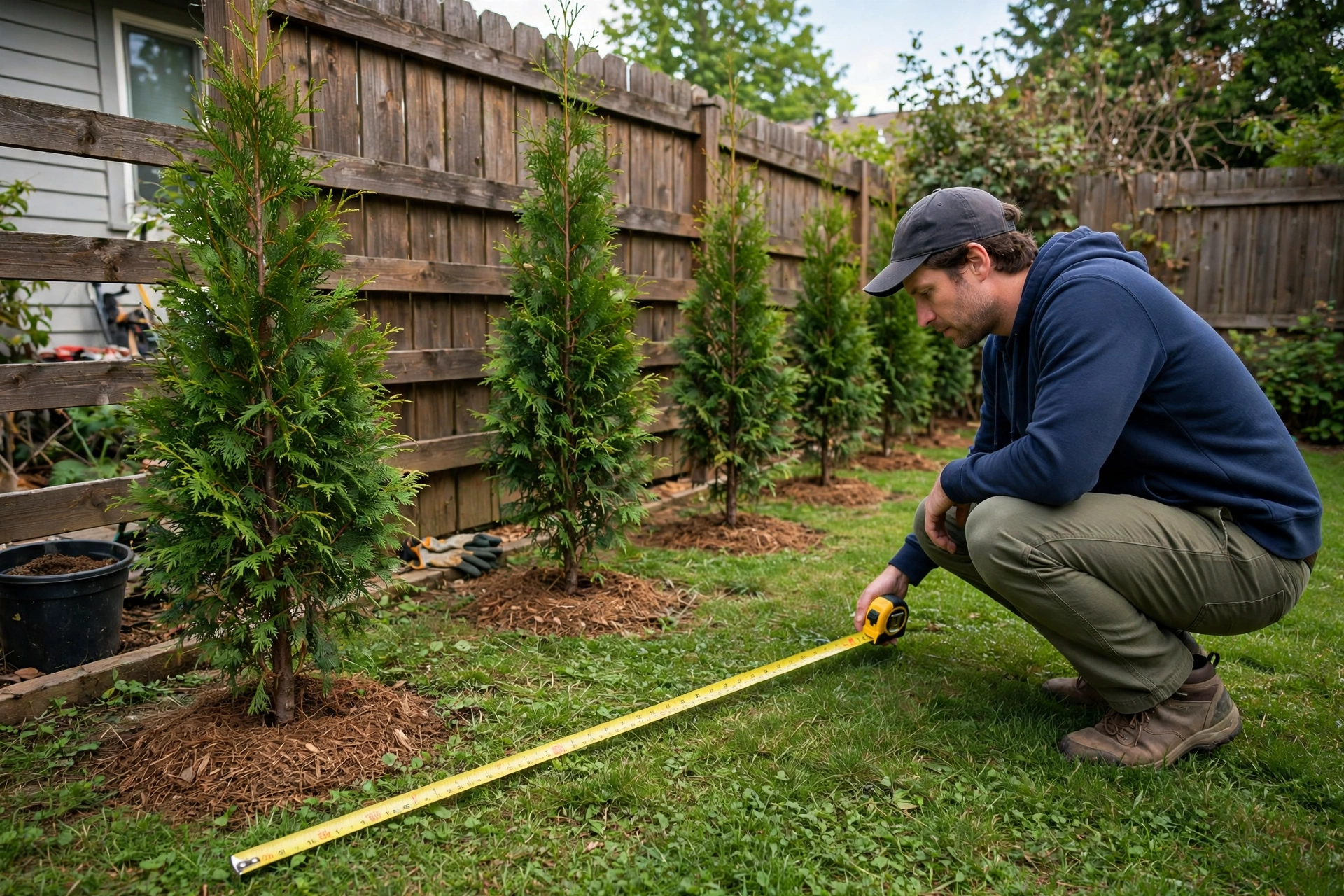
Spacing decides whether a row becomes a wall or a row of lollipops. Most screening arborvitae go in 5 to 6 feet apart on center; the full arithmetic is in how far apart to plant privacy trees.
Deer pressure changes the ranking in much of the country. Leyland cypress and red cedar are browsed less than standard arborvitae, although ‘Green Giant’ is notably more deer-resistant than ‘Emerald Green’.
Arborvitae or Leyland Cypress?
These two get compared more than any other pair, because both are fast and both are sold everywhere. ‘Green Giant’ keeps a narrower, denser form and tolerates Zone 5 winters that can burn Leyland cypress.
Leyland cypress grows faster and cheaper per foot of height, then outgrows small properties and is prone to canker diseases in humid climates. The head-to-head is in arborvitae vs. Leyland cypress for privacy.
The Recommendation
Plant ‘Green Giant’ arborvitae. It grows 3 to 5 feet a year, holds dense winter cover in Zones 5 to 8, and fits a typical suburban lot without swallowing it.
Move to Leyland cypress only where the lot is large and the winters are Zone 6 or warmer, and to spruce where the cold, not the clock, is the constraint. Those are the exceptions; ‘Green Giant’ is the answer for most readers asking this question.