Disclosure: This post contains affiliate links. If you buy through them, Landscape & Leisure may earn a commission at no extra cost to you.
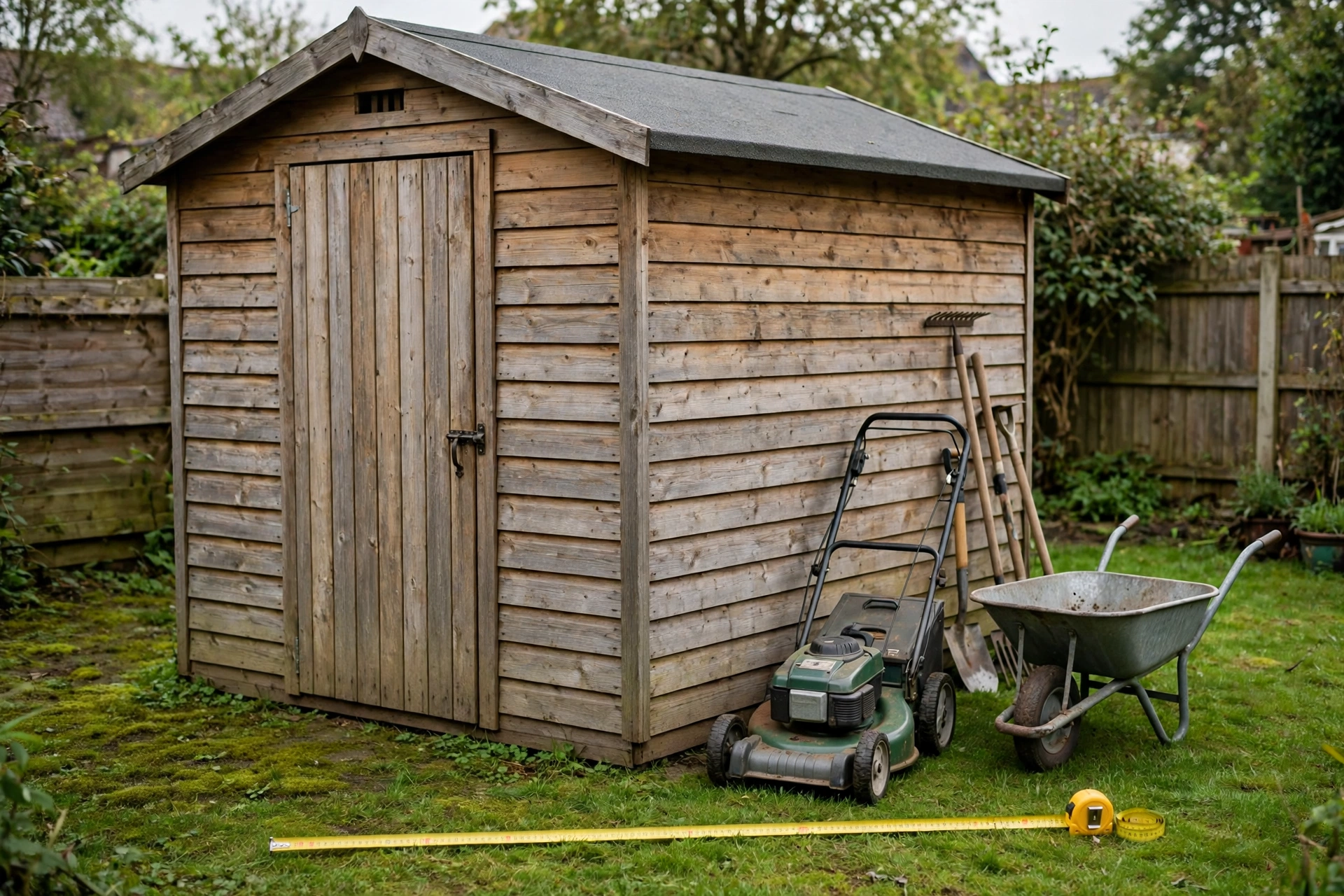
64 square feet of floor is what a riding mower, a walk-behind mower, and a wheelbarrow actually take once you can still walk between them. That is an 8-by-10 shed with the walls used for tools, and it is the size most yards should start from.
Guess smaller and the penalty is concrete: a second shed, a rented storage unit, or a mower spending winter under a tarp. Shed sizing goes wrong because buyers add up equipment footprints and forget the walkway, the door swing, and the gear that arrives next year.
The math here uses standard equipment footprints, stated once, so you can run your own inventory against them. Measure your mower deck width before trusting any of it, since a 54-inch deck changes the door you need.
The footprints that decide the size
| Item | Floor footprint | Space it really needs | Storage note |
|---|---|---|---|
| Riding mower, 42-inch deck | About 6 x 3.5 feet | 21 sq ft, plus door clearance | Needs a double door or a wide single door |
| Walk-behind mower | About 3.5 x 2 feet | 7 sq ft | Handle folds on most models, cutting height, not floor space |
| Wheelbarrow | About 5 x 2.5 feet flat | 4 sq ft stood on end | Stand it nose-up against a wall |
| Long-handled tools, 10 pieces | 0 sq ft on the floor | A 4-foot run of wall | Wall hooks keep them off the floor entirely |
| Walkway down the middle | 2 feet wide | 16 to 20 sq ft in most sheds | Skip it and you will climb over the mower |
Run your own inventory
Start with the biggest item. A riding mower at roughly 21 square feet is the anchor, and everything else arranges around it. No riding mower means the walk-behind at 7 square feet anchors instead, and the whole calculation drops a size.
Add the rolling gear. A wheelbarrow stood on end takes about 4 square feet, a spreader about 3, and a pair of sawhorses stacked flat about 4. Bikes are the quiet budget-breaker at roughly 6 square feet each when they stand on the floor, or near zero hung from ceiling hooks.
Reserve the walkway. A 2-foot path from door to back wall is 16 to 20 square feet that holds nothing, and it is not wasted. Without it, every tool at the back requires moving the mower, and a shed you have to unload to use is a shed you stop using.
Add a quarter for what is coming. A typical inventory of a riding mower, a walk-behind, a wheelbarrow, and wall tools totals about 32 square feet of gear plus 18 of walkway, which is 50 square feet spoken for. In an 8-by-10 shed with 80 square feet of nominal floor, that leaves working room, while a 6-by-8 at 48 square feet is already full on delivery day.
Match the total to a size
Tools only, no mower: 4 x 6 or 5 x 8. Hand tools, a walk-behind with a folding handle, and bags of fertilizer fit here if the walls carry the long handles. This is the one case where the small shed is the right shed.
Walk-behind mower plus yard gear: 6 x 8 or 7 x 7. The mower, wheelbarrow, spreader, and seasonal bins fit with a short walkway. Add a snow blower, which takes about 8 square feet, and this size is full.
Riding mower plus the usual gear: 8 x 10. This is the default recommendation for a suburban yard, because the mower parks on one side, the walk-behind and wheelbarrow take the other, and the back wall holds bins without blocking the door.
Riding mower plus a workbench or a second machine: 10 x 12. A bench eats a full wall at 2 feet deep, and a zero-turn mower runs wider than a lawn tractor at the same deck size. Buy this size when a bench or an ATV is already in the yard, not as a someday guess.
Small overflow, like cushions and hand tools, often belongs in a deck box instead of a bigger shed, and our guide to what size deck box you need covers that math. Patio furniture you plan to store inside for winter counts against shed space too, so check its folded size against the sets in our best outdoor furniture sets under $2,000 guide before assuming it fits.
Two sheds that fit the 8-by-10 math
The Lifetime 8 x 10 shed gives you 71.7 square feet of interior floor space, which is the honest number to plan against rather than the 80 on the box. Its walls and roof are steel-reinforced HDPE, and the floor is slip-resistant, which matters when you roll a wet mower in during a storm.
Lifetime Outdoor Storage Shed, 8 x 10 Feet
71.7 square feet of interior floor with steel-reinforced walls and roof.
The Suncast Tremont at the same 8-by-10 footprint lists 547 cubic feet of volume, with a floor included and lockable double doors. Double doors are the feature to copy whichever brand you choose, because a riding mower through a single narrow door is a daily wrestling match.
Suncast 8 x 10 Tremont Storage Shed
547 cubic feet, floor included, and lockable double doors for mower access.
The mistake that costs twice
Most homeowners buy for the inventory they have in April and forget the inventory they will own by October, after the leaf blower, the pressure washer, and the patio cushions arrive. A shed runs full about 30 percent sooner than the spring math suggests.
Do this instead: tape the shed outline on the driveway, park every piece of gear inside the tape, and walk the path you left yourself. Ten minutes with tape settles the size question better than any showroom visit.
Bottom line
Buy the 8-by-10 if a riding mower is in your inventory, the 6-by-8 for a walk-behind yard, and the 10-by-12 only when a bench or second machine is already sitting in the garage. Size to the taped outline on your driveway, not to the price tag on the smallest box.