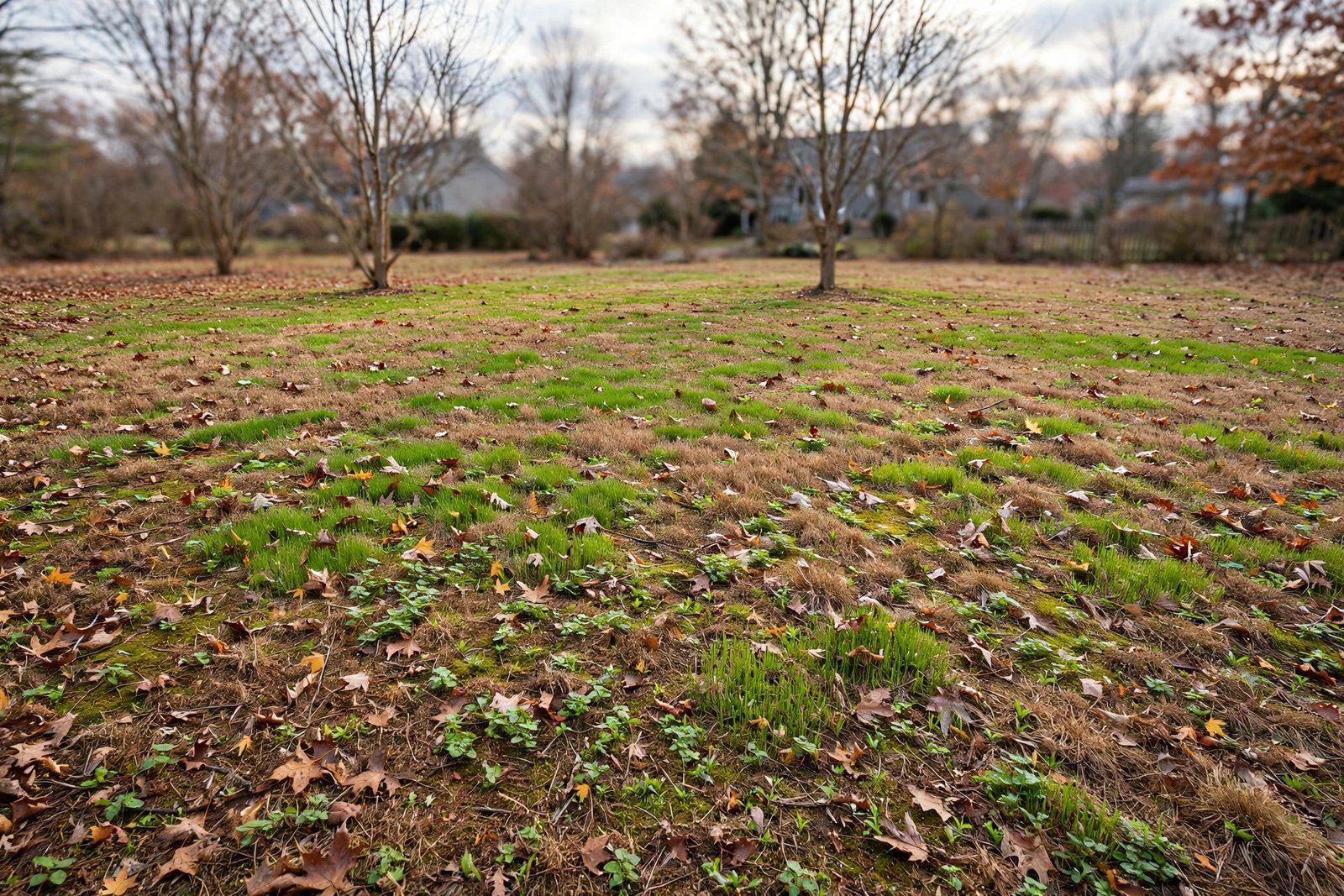
When bermuda grass goes brown for winter, ryegrass seed can give you a green lawn until spring. The question is how much seed to buy — and three university sources do not give the same answer. That is not a mistake. They are answering for different lawns and different places.
This calculator does not pick one number for you. Type in your lawn size and what kind of lawn you have, and it shows each source’s amount side by side, so you can see why they differ and choose with your eyes open.
One caution first: this tool is for bermuda lawns only. The sources say overseeding is generally not recommended for home lawns, and that centipedegrass, St. Augustinegrass, and zoysiagrass are not suited to it. If your lawn is one of those, this calculator is not for you.
Timing note, plainly: this post publishes in early November. For most readers, the fall overseeding window has already passed — Arizona’s window is October, and South Carolina’s is early to late October. Use this tool to plan for next fall, unless you are on the southern edge and your own soil and night temperatures still match the indicators below.
Try the calculator
What do I type?
Your lawn’s area in square feet, then pick the description that fits your lawn. Established means a bermuda lawn that is already growing well. Thin or bare means patches, bare spots, or a slope you need to hold over winter. New means no permanent grass is planted yet and you want winter cover until spring planting.
What does this number mean?
Each result line is one source’s rate multiplied by your area. Pounds of seed = rate (pounds per 1,000 square feet) times area divided by 1,000. A range means that source gives a range, not a single rate — the low end buys a thinner stand, the high end buys faster, denser cover.
What do I do next?
Pick the source that fits your goal, buy that amount, and sow half the seed walking one way and half walking the other way, so the cover comes up even. Water lightly several times a day until the seed sprouts, then ease back. In spring, mow the ryegrass down to about an inch and stop feeding it by mid-to-late January, so the bermuda can take back over.
Worked examples
Example 1: A 5,000-square-foot established lawn, Clemson rate of 5 pounds per 1,000 square feet: 5 times 5 equals 25 pounds of seed.
Example 2: A 5,000-square-foot thin lawn, Arizona rate of 12 to 15 pounds per 1,000 square feet: 12 times 5 equals 60 pounds, and 15 times 5 equals 75 pounds — a range of 60 to 75 pounds.
Example 3: A 10,000-square-foot established lawn, Georgia rate of 5 to 10 pounds per 1,000 square feet: 5 times 10 equals 50 pounds, and 10 times 10 equals 100 pounds — a range of 50 to 100 pounds. At 10 pounds you get a fast fall stand; at 5 pounds the lawn stays thin until spring.
Seed rates by source
| Lawn condition | Clemson | Georgia (UGA) | Arizona |
|---|---|---|---|
| Established bermuda lawn | 5 lb per 1,000 sq ft | 5–10 lb per 1,000 sq ft | 12–15 lb per 1,000 sq ft |
| Thin or bare area, erosion control | 10 lb per 1,000 sq ft | 5–10 lb per 1,000 sq ft, top of range for fast cover | 12–15 lb per 1,000 sq ft |
| New lawn, no permanent grass yet | 10 lb per 1,000 sq ft | 5–10 lb per 1,000 sq ft | Not covered by this source |
Why the numbers differ
Clemson picks the low rate on purpose for an established home lawn: 5 pounds gives green cover without a thick stand that fights the bermuda in spring. Arizona picks the high rate for a dense winter lawn in the low desert, where bermuda is fully dormant and the winter lawn is the lawn from October through May. Georgia sits between them and ties the rate to the look you want: 10 pounds for a fast fall stand, 5 pounds for a thinner lawn that may not fill in until spring.
A note on a figure you may see elsewhere: some lists credit Georgia with 8 to 10 pounds for lawns. Both Georgia pages checked for this calculator say lawns 5 to 10 pounds, and 8 to 12 pounds for sports fields and golf courses. This calculator uses 5 to 10 for lawns.
When to seed, by source
Arizona: October, when days are 80 to 85 degrees and nights are about 55 degrees. Clemson: about 30 days before first frost, when days are near 70 degrees and nights are usually above 50 degrees — early October in Upstate South Carolina, late October in the Midlands and Coastal regions. Georgia: when soil is about 75 degrees at 4 inches deep, nights are in the 50s, midday temperatures are in the mid-70s, or 2 to 4 weeks before the average first killing frost.
Getting ready, and the spring changeover
Before seeding, stop feeding the bermuda with nitrogen about 30 days out, raise the mowing height for two weeks, then mow low just before seeding. Sow half the seed one way and half the other way. Water 3 to 4 times a day for 7 to 10 days in Arizona’s guidance, or lightly 2 to 3 times a day until germination in Clemson’s, until seedlings emerge.
Annual ryegrass is cheaper, lighter green, coarser, and dies out faster in spring. Perennial ryegrass is deeper green, finer, tougher against disease, and lingers longer into spring — which can become a nuisance, especially in shade. In spring, lower the mowing height, stop feeding the ryegrass by mid-to-late January, and let the lawn run a little dry to stress the rye while the bermuda greens up.
What this calculator does not do
This tells you how much seed a bermuda lawn needs if you overseed — not whether you should overseed, and not when to seed for your address. It does not cover St. Augustinegrass, zoysiagrass, or centipedegrass lawns, and it does not cover golf courses or sports fields, whose rates are a different job. It does not adjust for shade, soil, or watering, because no source checked here gives an adjustment for those. If you are unsure of your lawn’s condition, use the established-lawn figure and expect a thinner stand, rather than guessing upward.
Sources
University of Arizona Extension — Overseeding Winter Grasses into Bermudagrass Turf (Kopec and Umeda, az1683, October 2015), fetched in full Nov 2, 2026: https://extension.arizona.edu/publication/overseeding-winter-grasses-bermudagrass-turf
Clemson Cooperative Extension, HGIC — Overseeding With Ryegrass (originally published 06/99, last updated 9/24), fetched in full Nov 2, 2026: http://hgic.clemson.edu/factsheet/overseeding-with-ryegrass/
UGA Cooperative Extension, CAES Field Report — Fall turfgrass interseeding and overseeding: not one in the same (Clint Waltz, published 2013-09-19, updated 2025-05-28), fetched in full Nov 2, 2026: https://fieldreport.caes.uga.edu/news/fall-turfgrass-interseeding-and-overseeding-not-one-in-the-same/
UGA Cooperative Extension — Managing Overseeded Grasses in Georgia (Jeremy Kichler, Colquitt County, 2021), fetched in full Nov 2, 2026: https://site.extension.uga.edu/colquitthomeowners/2021/11/managing-overseeded-grasses-in-georgia/
Related reading on this site: Bermudagrass Establishment Calculator, Warm-Season Fertilizer Rate Calculator, Grass Seed Calculator.