Landscape & Leisure is reader-supported. When you buy through links on our site, including Botanical Interests seed links, we may earn a commission at no extra cost to you. Prices change, so click through to confirm current pricing.
Your bean plants are either climbing or they are not — and that one difference decides how much structure you build, how long you pick, and how often you sow. If your beans sprawl across the bed, tangle into each other, and finish all at once, you probably grew the wrong habit for the space you have. Here is how to tell which habit fits, and which varieties to buy for each.
For the full variety list behind this comparison, see our snap pea and green bean roundup. For the sowing rhythm that keeps either habit producing, see our succession planting guide.
The Diagnosis: Which Habit Is This?
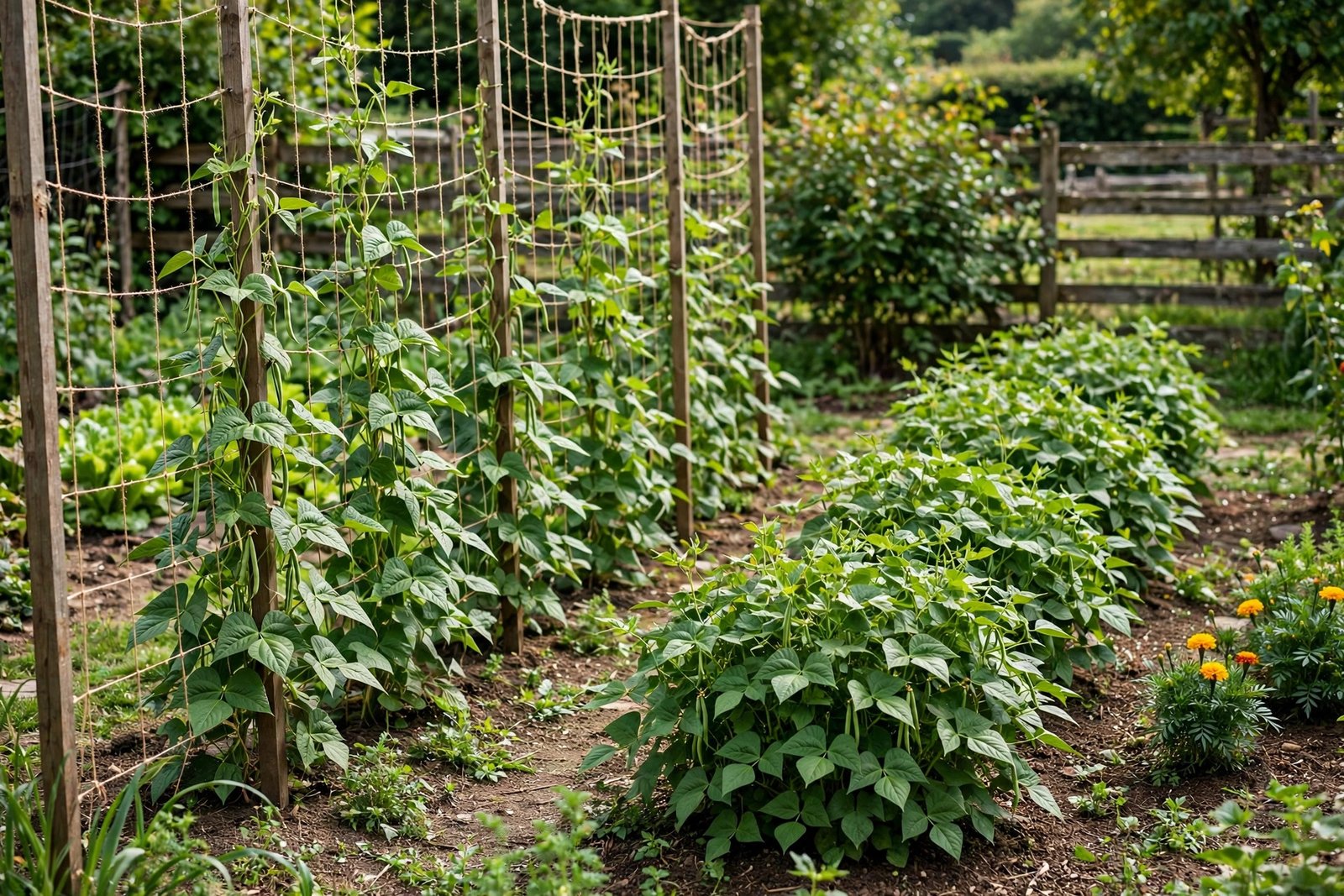
Symptom: vines climbing everything nearby. That is a pole bean — or a tall pea — doing what it was bred to do. Pole beans are vines. They need a teepee, trellis, or poles, and they repay the structure with a long picking season. Kentucky Wonder, the pole bean in this comparison, matures in 63 days and keeps producing as long as pods are picked regularly.
Symptom: compact plants, one big flush, then little. That is a bush bean. Bush beans grow 16 to 18 inches tall, need no staking, and produce most of their crop over 2 to 3 weeks. The fix is not more fertilizer. It is repeat sowings every 7 to 14 days, which is why bush beans and succession planting belong together.
Symptom: short vines that still want a little support. Some peas sit between the two habits. Sugar Daddy snap pea reaches only 24 to 30 inches and Cascadia snap pea is self-supporting at 30 inches — a short fence or low trellis helps harvesting but neither needs a tall structure. If your “bean problem” is actually a pea problem, start with the roundup and match the vine height to the support you already own.
Pole Beans vs. Bush Beans, Side by Side
| Factor | Pole beans | Bush beans |
|---|---|---|
| Support | Teepee, trellis, or poles — required | None — plants stand on their own |
| Harvest pattern | Long season, picked regularly | Most of the crop in 2–3 weeks |
| Sowing rhythm | One sowing, long harvest | Repeat sowings every 7–14 days |
| Space | Vertical — small footprint, tall structure | Horizontal — more bed, no height |
| Picking effort | Standing height, easy to spot pods | Bending and searching in foliage |
| Best for | Small beds, long season, trellis already owned | Containers, no structure, freezing a batch |
The Pole Bean Case
Choose pole beans when the bed is small and the season is long. A teepee takes a 4-foot circle and turns it into a picking wall. Kentucky Wonder’s packet sows up to 20 feet of row or two 4-foot teepees, with seeds every 6 inches, and the 7- to 9-inch pods hang where they are easy to see and pick. The costs are real: build the structure before sowing, since a pole bean without support tangles on the ground, and pick often — pods left to size up turn stringy, and unpicked pods slow new flowers.
Kentucky Wonder Pole Bean Seeds
7- to 9-inch pods in 63 days, on a trellis that turns a small bed into a long harvest.
The Bush Bean Case
Choose bush beans when you want no structure, a container crop, or a single batch for the freezer. Blue Lake 274 produces round 6-inch pods on 16- to 18-inch plants, all at once, and the pods freeze well. The honest trade-off is the calendar: one sowing is one flush. Without repeat sowings, bush beans give a glut and a gap. With repeat sowings every 7 to 14 days, they give a steady supply with the least work per sowing — no trellis to build, no vines to train.
Blue Lake 274 Bush Bean Seeds
Round 6-inch pods on 16- to 18-inch plants — a heavy, freezable crop with no staking.
Jade earns its card as the bush bean that fixes the bush bean’s weakest point: pods touching damp soil. Its upright plants hold long, straight, stringless pods high, avoiding tip rot, and the plants tolerate heat and cold better than many bean types. If your bush beans have rotted at the tips in wet summers, Jade is the variety to try before blaming the soil.
Jade Bush Bean Seeds
Long, straight, stringless pods held high off the soil, on heat- and cold-tolerant bush plants.
Which Habit Fits Your Garden?
Pick pole beans if: the bed is small, a trellis or teepee is already in place or easy to build, and you want to pick a little, often, all season. One sowing, one structure, a long harvest.
Pick bush beans if: the garden is containers or a bed with no structure, you want a batch for freezing, or you prefer repeat sowings to trellis work. Sow little and often, and the gap never opens.
Grow both if: the bed allows it. A teepee of Kentucky Wonder for the long season plus short rows of Blue Lake 274 or Jade sown every two weeks gives a standing harvest and a succession harvest from the same garden. That combination is the lowest-risk way to learn which habit you actually enjoy picking.
Common Mistakes With Each Habit
Pole beans sown with no support ready. Vines find the nearest plant and climb it. Put the teepee or trellis in before sowing, not after the vines are already reaching.
Bush beans sown once, then disappointment. A single sowing is a single flush. The fix is calendar, not variety: repeat every 7 to 14 days until 80 days before the average first fall frost.
Picking too late for the type. Snap beans are ready when the pod snaps cleanly in half. Filet beans like Jade and French Filet need picking while still slender — French Filet pods are only a quarter inch wide at their best. Oversized pods are stringy, seedy, and they slow new flowers on both habits.
Sowing either habit into cold soil. Beans need soil at least 65°F, ideally 70° to 85°F. Both pole and bush beans rot in cold, wet soil, and transplanting rarely helps — bean seedlings resent root disturbance. Direct sow, warm soil, every time.
Aftercare: What Success Looks Like
Success for pole beans is a teepee covered in flowers with pods hanging at picking height, picked every two to three days. Success for bush beans is a short row that finishes, gets pulled, and is replaced by the next sowing the same week. In both cases, the sign to watch is new flowers: if flowering stops, picking stopped first. Resume picking, hold the stem while snapping pods, and the plants usually resume. If a wave fails outright — cold soil, a heat spike above 90°F, or a pulled vine — re-sow a fast variety like Contender, which matures in 50 days, rather than nursing a stalled row. For the wider vegetable plan around the bean bed, our beginner vegetable seed roundup puts beans in context with the other first crops.