This site contains product affiliate links. We may receive a commission if you make a purchase after clicking on one of these links.
The squash went soft in December. The onions sprouted in January. The garlic shriveled by February, and you did everything right in the garden. The garden wasn’t the problem. Storage was — and storage fails in predictable ways, which means it can be fixed in predictable ways.
Here is the short version: squash, onions, and garlic do not want the same room. They want three different climates, and the single biggest storage mistake is putting them all in the same one. The second mistake is skipping the cure. Get those two things right and a fall harvest feeds you into spring.
Why stored crops fail
When a stored crop goes bad, the cause is usually one of four things, in this order.
Wrong temperature. Too warm and the crop keeps living fast — sprouting, softening, using itself up. Too cold and squash chilling-injures below 50°F, developing pits and rot that show up weeks later. The numbers are not close calls: squash wants 50–55°F, onions and garlic want 32–40°F. One room cannot do both.
Wrong humidity. Damp air rots onions from the neck down and grows mold on garlic. Dry air shrivels squash and pulls moisture out of everything. Onions and garlic want dry air, around 65–70 percent humidity. Squash wants it a little damper, 50–75 percent, but never wet.
Skipped curing. Curing heals the small nicks from harvest and thickens skins into armor. A squash put away uncured rots from a scratch you could barely see. An onion put away with a soft neck rots from the top down. Curing takes days, and it pays for months.
Bad neighbors. Apples give off ethylene gas as they ripen, and ethylene pushes other produce to ripen — and then spoil — faster. Keep apples away from stored vegetables, full stop. One basket of apples in the same small room can shorten the life of everything else in it.
If your stored crop failed last year, run down that list before you blame the variety. Most storage failures are climate failures, and climate is the part you control.
Cure first, store second
Curing is the step between harvest and storage, and it is the step people skip because the harvest already feels finished. It isn’t.
Winter squash: most types cure at 80–85°F with good airflow for about ten days. The warmth hardens the rind and heals scratches. The exceptions matter: acorn, sweet dumpling, and delicata do not benefit from curing — wipe them clean and move them straight to storage, and hold them near 50°F rather than warmer. For every other squash, do not let cured fruit drop below 50°F afterward. Cold after curing undoes the good the curing did.
Onions and garlic: dry them in a warm, airy, shaded place for two to three weeks, until the necks are tight and dry and the outer skins feel papery. Then trim the roots and tops, or braid the tops if the variety braids well. A neck that still feels soft or damp is not ready. Put it away damp and it will tell you in January, with mold.
What to store: only sound, undamaged produce. A squash with a deep cut, an onion with a bruised shoulder, a garlic head that came apart in your hands — those go in the kitchen basket, not the storage shelf. One rotting fruit in a pile spreads the rot to its neighbors, and squash stored touching each other is how a single bad spot becomes a shelf of bad spots.
Each crop’s own climate
Sort the harvest into groups by temperature and humidity, not by crop family. The table below carries the targets extension sources agree on: University of Missouri Extension for squash, Iowa State Extension for onions and garlic.
| Crop | Cure first | Store at | Humidity | How long |
|---|---|---|---|---|
| Winter squash & pumpkins | 80–85°F, ~10 days (skip acorn, delicata) | 50–55°F | 50–75% | 3–6 months by type |
| Onions | 2–3 weeks, warm and airy, necks tight | 32–40°F | 65–70% | 4–8 months |
| Garlic | 2–3 weeks, warm and airy, skins papery | 32–40°F | 65–70% | 5–8 months |
Read the table as two rooms, not one. Squash gets the cool room — a spare bedroom with the vent closed, a closet on an outside wall, an unheated pantry that never freezes. Onions and garlic get the cold room — an unheated basement corner, a garage that stays above freezing, a spare refrigerator if the harvest is small.
The longest keepers among squash tend to be the thick-skinned maxima types: hubbard, buttercup, kabocha. Butternut keeps well too, and acorn, for all its popularity, is a shorter keeper — eat the acorns first, and let the hubbards wait. The variety you plant is a storage decision you made in spring, and next spring’s seed order is the place to fix it if last winter’s squash gave out early.
How to set the shelf
Squash in a single layer, stems on. Set each fruit on a shelf or a slatted surface, not touching its neighbors, stem attached. Illinois Extension’s guidance is a single layer so rot can’t travel fruit to fruit, and never stacked more than two deep. Check the shelf once a month. A squash that yields to a thumb press or shows a soft spot comes inside and gets eaten this week.
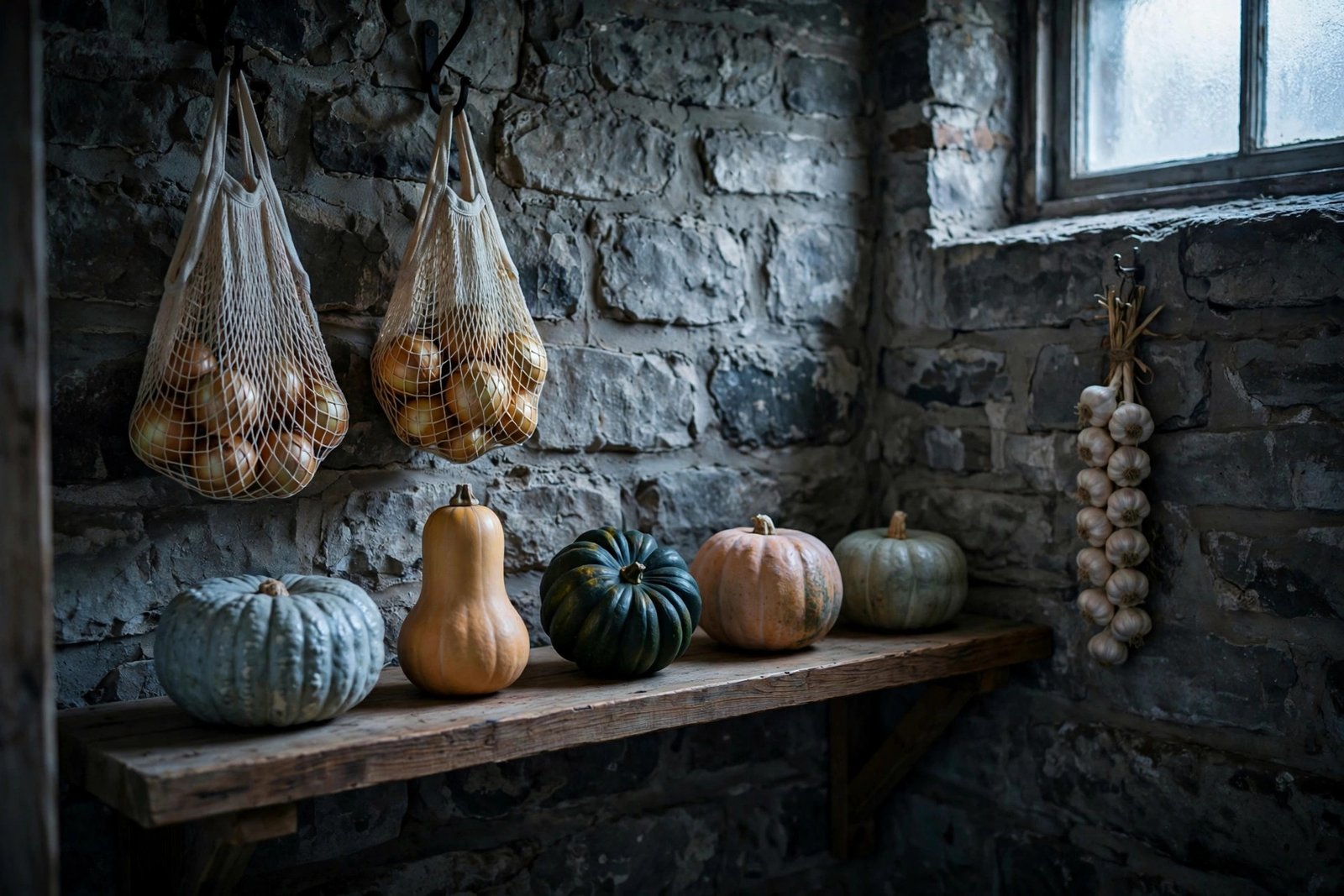
Onions and garlic in air. Mesh bags, braids, or shallow crates — anything that lets air move around every bulb. Hang mesh bags from hooks or spread bulbs in a single layer in a crate. Do not seal them in plastic, and do not pile them deep. The whole point is airflow, and a sealed bag is a damp bag.
Reusable Hanging Mesh Storage Bags, 2-Pack
Hangable, ventilated net bags that keep onions and garlic in moving air instead of sealed in a damp bin.
Keep the light off and the apples out. Darkness slows sprouting. A dark corner beats a sunny shelf for every crop on this list. And the apples live somewhere else entirely — a different room if you can manage it, because ethylene drifts.
Check monthly, eat the wounded first. The monthly check is the whole maintenance routine. Anything soft, sprouting, or spotted gets eaten now or composted, and it does not go back on the shelf. Storage is not a vault you seal in November and open in March. It is a pantry you visit.
One more sorting decision, for garlic growers: set aside your biggest, best heads for planting before you store the rest. The seed garlic you plant this fall is next summer’s harvest, and the heads you eat are the ones that didn’t make the cut. If the timing question is still open, is it too late to plant garlic in late October settles it.
The January pantry
This is the payoff, and it is the part nobody writes about: a January kitchen that still runs on the garden. The squash on the shelf becomes soup. The onions in the mesh bag become the base of everything. The garlic braid by the wall gets shorter, one head at a time, and every meal tastes a little like October.
Start with the squash that won’t wait. How to roast acorn squash over a fire pit is the short keeper’s best ending, and butternut squash soup over a fire pit is what the long keepers are for, deep into winter. If you are still deciding what to grow next year with storage in mind, summer squash vs. winter squash lays out which types are built for keeping and which are built for eating now.
Cure it, sort it by climate, check it monthly, and eat the wounded first. Do that, and the garden’s last job of the year — feeding you through the dark months — is the one it does best.