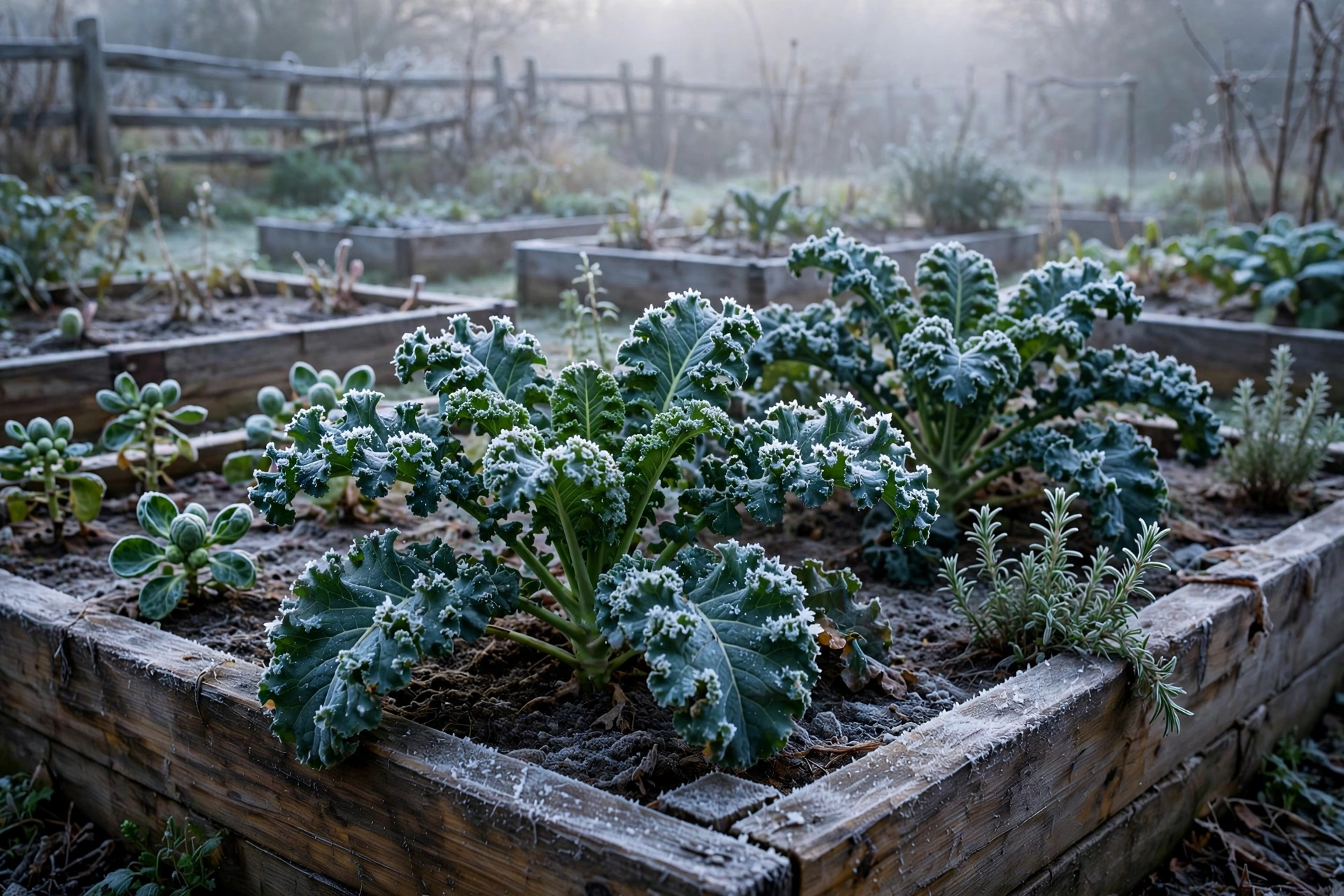
You walk out the morning after the first frost and the garden tells two stories at once: the peppers are black and limp, and the kale looks like nothing happened. The question is not whether frost came — it is which plants were built for it.
This table sorts the common fall vegetables by how much cold each group takes, from the ones you harvest before any frost to the ones that taste better after several freezes. Every figure comes from South Dakota State University Extension’s fall frost-tolerance guide, with a spring-planting companion note from Illinois Extension kept separate below.
Fall frost tolerance at maturity
The table covers fall frost tolerance at maturity — not spring planting dates, not variety-level hardiness, and not microclimate differences. Temperatures are in degrees Fahrenheit.
| Crop | Frost tolerance | What to do | Source |
|---|---|---|---|
| Beans, sweet corn, mature potato tops, pepper, eggplant, cucumbers, summer squash, melons, sweet potatoes | None — protect or harvest before even a light frost | Harvest first. Sweet potatoes come out before soil temperatures drop below 50°F. Pumpkins and winter squash may take a very light frost — SDSU notes pumpkins can stand 35°F nights when days reach 70°F or more — but protect them if you can. | SDSU Extension |
| Tomatoes, muskmelon, pumpkins | None, but they ripen after picking | Pick tomatoes once they are at least mature green, muskmelon when it slips easily from the vine, and pumpkins once they start to turn color. Pumpkins picked this way keep less well than ones that colored on a healthy vine. | SDSU Extension |
| Beets, carrot, lettuce, onion, garlic, chives, parsley, peas, radish, rhubarb, spinach, Swiss chard | Light frost, 28–32°F | Leave standing through a light frost; harvest before a hard freeze. | SDSU Extension |
| Broccoli, cauliflower (26°F), Chinese cabbage, cabbage, kale, kohlrabi, turnip | Moderate freezes, 24–28°F | Leave standing. Cauliflower also appears in SDSU’s light-frost list — see the note below. | SDSU Extension |
| Parsnips, salsify, Brussels sprouts | Best after several moderate freezes, 24–28°F | Wait for several moderate freezes for best quality. Brussels sprouts are often best after a light freeze, and root crops develop more sugars when soil temperature drops below 40°F. | SDSU Extension |
| Horseradish | After several severe freezes, under 24°F | Leave in the ground overwinter, mulched. | SDSU Extension |
Two entries that need a footnote
Cauliflower shows up twice in the SDSU guide: once among the light-frost crops, and again among the hardy cole crops at 26°F. The table lists it in the hardy row with the 26°F figure, and flags the dual listing here rather than quietly picking one.
Potatoes look contradictory across the two sources, but the contexts differ. SDSU’s fall framing gives mature potato tops no frost tolerance at all. Illinois Extension’s spring framing lists potato among its very hardy vegetables, planted March 25 to April 10 — that is seed pieces going into cold spring soil, not mature tops facing a fall frost. The table follows the SDSU fall framing; the Illinois spring windows sit in the companion note below, not merged into the frost table.
If frost is forecast tonight
Harvest the no-tolerance group first — beans, sweet corn, peppers, eggplant, cucumbers, squash, melons, and sweet potatoes — or protect them, and leave the light-frost and hardy groups standing. If you do not know your area’s first frost date yet, our Minnesota frost dates by zone guide answers it. And once frost has finished the tender crops, it is also the moment to decide which perennials to divide now and which to leave alone — see should you divide perennials in fall.
A separate note: spring planting windows
Illinois Extension groups vegetables a different way for spring planting, and these windows are not fall tolerance ratings. Very hardy vegetables — onions, peas, potato, turnip, broccoli, and rhubarb — are planted March 25 to April 10. Frost-tolerant vegetables — beet, carrot, radish, cabbage plants, onion plants, and cauliflower — are planted April 10 to 25. Read them as a planting calendar, not as a second frost table.
Bottom line
When frost is in the forecast, harvest the tender group first and leave the hardy group standing. The kale, the Brussels sprouts, and the parsnips will be better for the cold — and the peppers were never going to survive it anyway.
Sources
South Dakota State University Extension, “Fall Frost Tolerance of Common Vegetables” (Rhoda Burrows) — https://extension.sdstate.edu/fall-frost-tolerance-common-vegetables — fetched November 4, 2026.
University of Illinois Extension, “Time Your Vegetable Plantings by Cold Hardiness” (Rhonda Ferree, 2018) — https://extension.illinois.edu/blogs/ilriverhort/2018-03-26-time-your-vegetable-plantings-cold-hardiness — fetched November 4, 2026.