The grill is hot, the pork chops are on, and everyone at the table is asking if they are done yet. This is the moment a thermometer earns its keep: one number, read in the thickest part of the meat, settles the question for good.
Every figure in this table is a safe minimum internal temperature from FoodSafety.gov, the U.S. Department of Agriculture’s food-safety site. These are safety minimums — the temperatures that kill the germs that cause food poisoning — not flavor or doneness targets. A steak can be safely cooked past 145°F and still be a fine steak; it just cannot be safely served below it.
Safe minimum internal temperatures
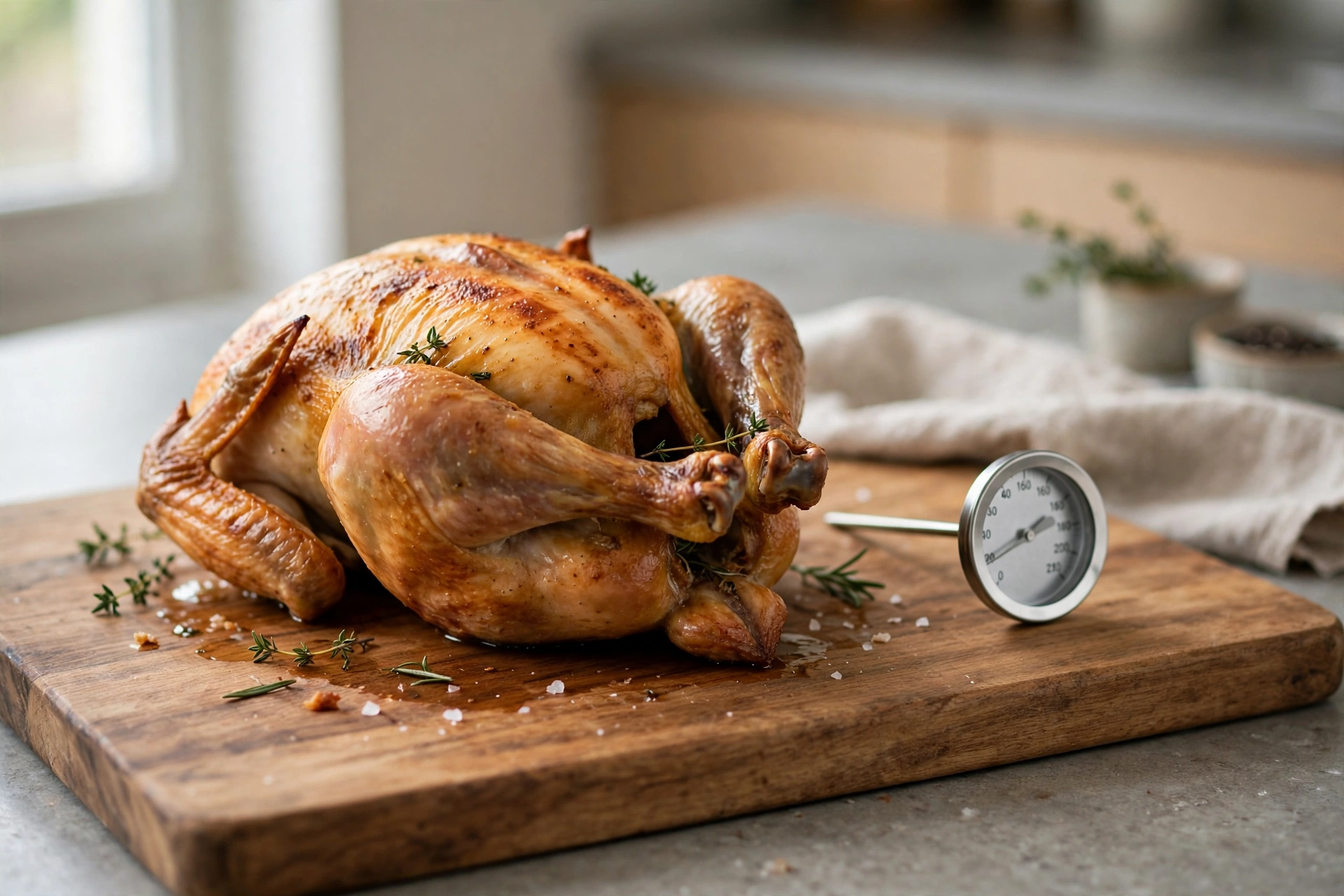
Check the temperature with a food thermometer in the thickest part of the meat, away from bone, fat, and gristle. Where the table lists a rest time, let the meat stand that long after it comes off the heat — the inside keeps cooking, and the rest is part of reaching a safe temperature.
| Food | Cut or type | Safe minimum | Rest time and notes | Source |
|---|---|---|---|---|
| Beef, bison, veal, goat, and lamb | Steaks, roasts, chops | 145°F (63°C) | Rest 3 minutes | FoodSafety.gov |
| Beef, bison, veal, goat, and lamb | Ground meat and sausage | 160°F (71°C) | No rest time listed | FoodSafety.gov |
| Casseroles | Meat and meatless | 165°F (74°C) | No rest time listed | FoodSafety.gov |
| Chicken, turkey, and other poultry | All: whole bird, breasts, legs, thighs, wings, ground poultry, giblets, sausage, and stuffing inside poultry | 165°F (74°C) | No rest time listed | FoodSafety.gov |
| Eggs | Raw eggs | Cook until yolk and white are firm | No temperature given — firmness is the cue | FoodSafety.gov |
| Eggs | Egg dishes (such as frittata, quiche) | 160°F (71°C) | No rest time listed | FoodSafety.gov |
| Eggs | Casseroles containing meat and poultry | 165°F (74°C) | No rest time listed | FoodSafety.gov |
| Ham | Raw ham | 145°F (63°C) | Rest 3 minutes | FoodSafety.gov |
| Ham | Precooked ham (to reheat) | 165°F (74°C) | Reheat cooked hams packaged in USDA-inspected plants to 140°F (60°C) | FoodSafety.gov |
| Leftovers | Any type | 165°F (74°C) | No rest time listed | FoodSafety.gov |
| Pork | Steaks, roasts, chops | 145°F (63°C) | Rest 3 minutes | FoodSafety.gov |
| Pork | Ground meat and sausage | 160°F (71°C) | No rest time listed | FoodSafety.gov |
| Rabbit and venison | Wild or farm-raised | 160°F (71°C) | No rest time listed | FoodSafety.gov |
| Seafood | Fish (whole or filet), such as salmon, tuna, tilapia, pollock, bass, cod, catfish, trout | 145°F (63°C) | Or cook until flesh is no longer translucent and separates easily with a fork | FoodSafety.gov |
| Seafood | Shrimp, lobster, crab, and scallops | Cook until flesh is pearly or white, and opaque | No temperature given — color and opacity are the cues | FoodSafety.gov |
| Seafood | Clams, oysters, mussels | Cook until shells open during cooking | No temperature given — open shells are the cue | FoodSafety.gov |
How to read the rest times
Rest time matters only for certain meats — steaks, roasts, and chops of beef, pork, lamb, and their kin, plus raw ham. During those three minutes the innermost parts keep cooking, which is how the meat finishes reaching a safe temperature all the way through. Ground meat, poultry, and casseroles carry no rest time in the chart: they are done when the thermometer reads the number, and the number is higher to begin with.
Ground meat is the one to take seriously. A whole steak only needs its outside seared and its center brought to temperature; ground meat mixes everything together, so the whole batch has to reach 160°F. That is why the ground row sits fifteen degrees above the steak row for the same animal (and don’t be shy about checking more than one spot in a pan of sausage).
Where these numbers show up in the kitchen
The two numbers you will reach for most often are 145°F and 165°F. Pork chops are done at 145°F after a three-minute rest — that is the target in our grilled pork chops with apples and sage. Chicken is the other end of the scale: every part of the bird, whole or ground, needs 165°F, which is the target in our cider-braised chicken thighs. Learn those two, and the rest of the table is a quick check rather than a memorization test.
Bottom line
Keep a thermometer by the stove and trust it over the clock, the color, or the crowd at the table asking if dinner is ready. The numbers above are the line — hit them, rest the cuts that need resting, and serve with confidence.
Sources
FoodSafety.gov (U.S. Department of Agriculture, Food Safety and Inspection Service), “Cook to a Safe Minimum Internal Temperature” — https://www.foodsafety.gov/food-safety-charts/safe-minimum-internal-temperatures — chart updated November 21, 2024; fetched November 5, 2026.