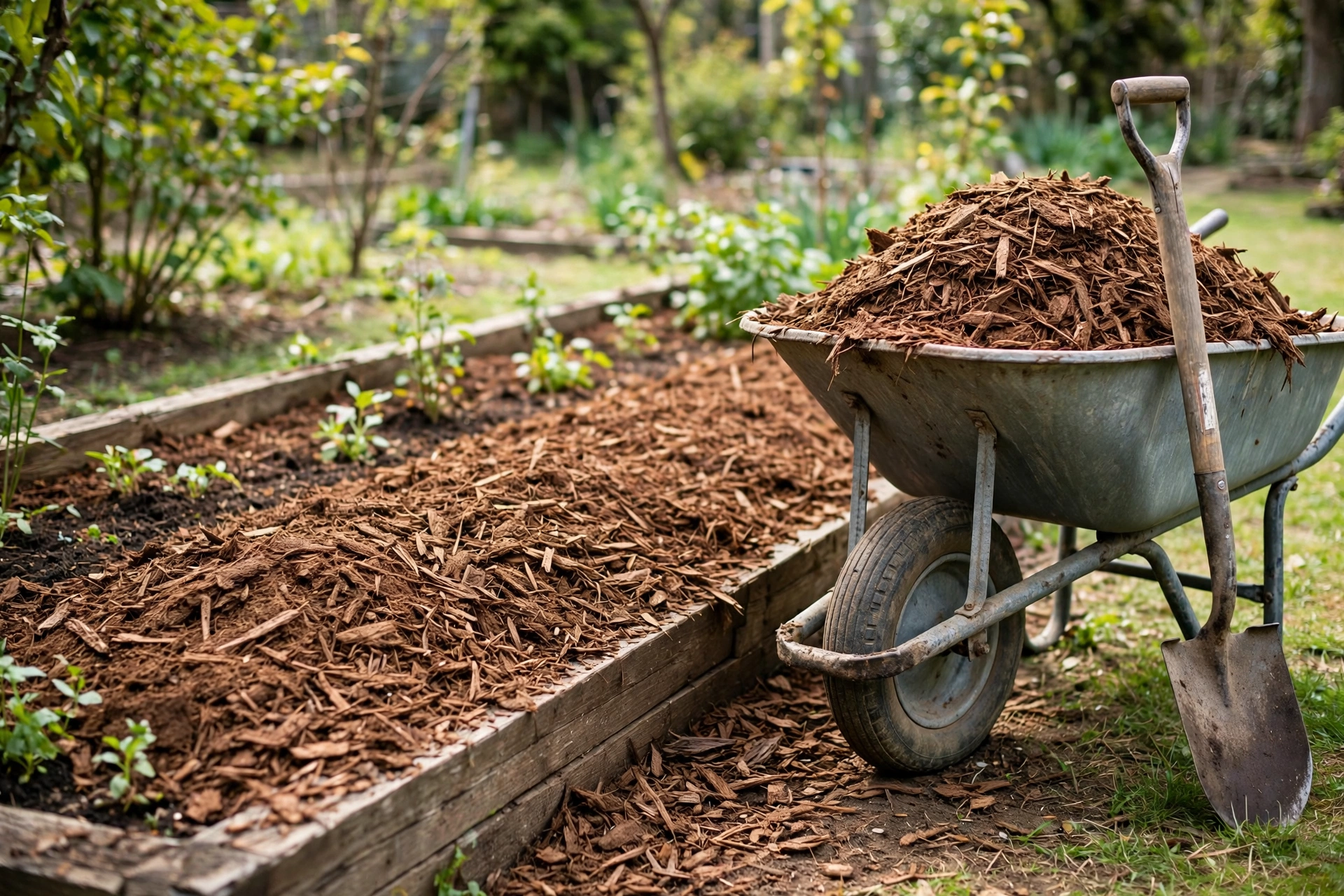
The mulch pile at the garden center comes in two sizes — bags and a dump truck — and the wrong guess leaves you either short a bed or staring at a mountain of extra bark. Both mistakes cost the same trip back, so it pays to do the arithmetic before you load up.
How much mulch your beds actually need — in bags or cubic yards — at the depth that suppresses weeds without smothering roots. Type in the size of the bed and how deep you want the mulch, and the calculator works out the volume, the bag count, and how far one cubic yard will stretch.
How much mulch do you need?
Length times width, in feet. A bed 10 feet long and 5 feet wide is 50 square feet.
3 inches is the depth to aim for — deep enough to hold weeds down, shallow enough to let roots breathe.
Bags are commonly sold in 2- or 3-cubic-foot sizes — check the bag and type what it says.
Only if you have several beds the same size — the calculator adds them up for you.
Without JavaScript, the tables and worked examples below give the same answers by hand.
What to type in
Start with the area, which is the one number people usually guess at. Measure the bed’s length and width in feet and multiply them together — a bed 12 feet long and 4 feet wide is 48 square feet. For a round bed, measure from the center to the edge, then multiply 3.14 by that number times itself, which gives the area in square feet.
Depth is the number that decides everything else, and 3 inches is the depth to type in unless you have a reason not to. Bag size is whatever the bag you are buying says — 2 cubic feet is the common size, but check, because bags come in other sizes too. If you leave the bag size blank, the calculator gives you cubic yards only and asks for the bag size when you want a bag count.
What the answer means
The calculator gives you three numbers, and each one answers a different question at the garden center. Cubic feet is the raw volume — the amount of mulch itself. Cubic yards is the same volume in the unit bulk suppliers sell by, so it is the number to quote when you order a truckload. The bag count is the number of bags to put in the cart, rounded up, because you cannot buy part of a bag and a bed half-covered is a bed you have to revisit.
It also tells you how many square feet one cubic yard covers at the depth you entered, which is the quickest sanity check on the order: at 3 inches deep, one cubic yard covers 108 square feet, so a 200-square-foot bed needs about two cubic yards. Once you have the cubic yards, compare the per-cubic-foot cost of bags against bulk from your supplier — that comparison, not the bag count alone, is what decides which way to buy.
How deep should mulch go?
Two to three inches is the depth to aim for, and it is the depth that does the two jobs mulch exists for: it holds moisture in the soil and keeps weeds from getting light. Thinner than 2 inches, and weeds push through before the season is out. Deeper than 3 inches, and problems start to develop — deep mulch holds too much moisture, invites insects and rodents, and can keep water from reaching the roots at all.
Coarse shredded hardwood mulch is the one exception, and it can go as deep as 4 inches. Nothing goes deeper than that. And whatever the depth, keep the mulch pulled back from the trunk or the stems — at least 3 inches of bare ground around the base of the plant. Mulch piled against bark, the shape everyone calls a mulch volcano, keeps the bark wet until it rots, and the roots that grow up into the pile die in the first dry spell.
Two more things before you spread it. If you are mulching with fresh woodchips, let them sit and age for a few months first, because fresh chips pull nitrogen out of the soil while they start breaking down, and your plants pay for it. And measure what is already on the bed before you add more: the total depth, old mulch plus new, should stay under 3 inches, so a bed that still holds 2 inches of last year’s mulch only needs 1 inch more.
How the math works
The calculator takes your bed’s area in square feet, turns your depth from inches into feet, and multiplies the two together — that gives the volume in cubic feet. Then it divides by 27 for cubic yards, since one cubic yard holds 27 cubic feet, and divides by your bag size for the bag count, rounding up.
The inches-to-feet step is the only fiddly part, so here is the conversion for the depths you will actually use.
Depth in inches, turned into feet
| Depth | In feet |
|---|---|
| 1 inch | 0.083 ft |
| 1.5 inches | 0.125 ft |
| 2 inches | 0.166 ft |
| 2.5 inches | 0.208 ft |
| 3 inches | 0.25 ft |
| 3.5 inches | 0.291 ft |
| 4 inches | 0.333 ft |
Worked examples
A 100-square-foot bed at 3 inches deep: 100 times 0.25 feet is 25 cubic feet. Divide by 27 and that is 0.93 cubic yards. Divide by a 2-cubic-foot bag size and you get 12.5, so 13 bags.
A 265-square-foot perennial bed freshened with 1.5 inches of mulch: 265 times 0.125 feet is 33.125 cubic feet. That is 17 bags of 2 cubic feet, and 1.23 cubic yards.
A 500-square-foot bed refreshed with 1.5 inches: 500 times 0.125 feet is 62.5 cubic feet. That is 2.31 cubic yards, or 32 bags of 2 cubic feet.
How much mulch for common bed sizes
Find your bed’s size and your depth, and read across for the volume, the cubic yards, and the bags.
| Bed size | Depth | Cubic feet | Cubic yards | Bags (2 cu ft) |
|---|---|---|---|---|
| 50 sq ft | 2 in | 8.33 | 0.31 | 5 |
| 50 sq ft | 3 in | 12.50 | 0.46 | 7 |
| 100 sq ft | 2 in | 16.67 | 0.62 | 9 |
| 100 sq ft | 3 in | 25.00 | 0.93 | 13 |
| 250 sq ft | 2 in | 41.67 | 1.54 | 21 |
| 250 sq ft | 3 in | 62.50 | 2.31 | 32 |
| 500 sq ft | 2 in | 83.33 | 3.09 | 42 |
| 500 sq ft | 3 in | 125.00 | 4.63 | 63 |
| 1,000 sq ft | 2 in | 166.67 | 6.17 | 84 |
| 1,000 sq ft | 3 in | 250.00 | 9.26 | 125 |
The volume is the same for any mulch at a given depth, so the numbers above hold whether you are spreading bark, wood chips, or pine straw. What changes is which material suits the bed — our pine needle mulch vs. bark mulch guide works through that choice, and if you have a pile of pine needles to use up, how to compost pine needles faster covers turning them into something the beds will take. Pine straw has its own arithmetic, too — see the pine straw coverage calculator if that is what you are spreading.
What this calculator won’t tell you
This tells you how much mulch your beds need at the depth you choose — not how often to water, and it does not know your weather, your soil, or how much mulch is already sitting on the bed, so measure that first and count it toward the 3-inch total. It also adds nothing for settling, because mulch settles after you spread it and no honest number exists for how much; the volume it reports is the exact loose-fill volume, nothing more. Measure the bed, use 3 inches, and buy what the calculator says — that is the whole job.
Sources
Iowa State University Extension and Outreach, “How to Determine the Amount of Mulch Needed for a Garden Bed” — https://yardandgarden.extension.iastate.edu/how-to/how-determine-amount-mulch-needed-garden-bed — fetched November 13, 2026. Governs the volume formula, the depth-conversion table, the bag math, and the worked example.
University of New Hampshire Cooperative Extension, “How to Mulch Trees and Shrubs” — https://extension.unh.edu/blog/2018/05/how-mulch-trees-shrubs — fetched November 13, 2026. Governs the 2-to-3-inch depth and the 3-inch trunk clearance.
University of Georgia Cooperative Extension, “Mulch plants, but not too much” — https://fieldreport.caes.uga.edu/news/mulch-plants-but-not-too-much/ — fetched November 13, 2026. Governs the 2-to-3-inch depth, the trunk clearance, and the fresh-woodchip aging note.
Rutgers Cooperative Extension, “Problems With Over-Mulching Trees and Shrubs” (FS099) — https://extension.rutgers.edu/fs099 — fetched in full November 13, 2026. Governs the total-depth rule: measure the mulch already on the bed and count it toward the 3-inch total.