Your cart holds six bales and the bed out back is bigger than it looked. The choice is simple — buy too few and you are back at the garden center tomorrow, buy too many and a stack of straw sits in the driveway all winter. Measure the bed, pick how deep you are laying it, and this calculator gives you the bale count.
How much pine straw do you need?
Length times width, in feet. Measure each bed separately and add them up.
New beds and bare ground get the full 3 inches. Beds that already have a thin layer get 2 inches. A yearly refresh on top of good cover takes 1 inch.
Bales usually run 25 to 50 pounds. Check the tag on the bale you are buying — the weight varies by seller.
JavaScript is off, so the calculator above will not run — the tables and worked examples below give you the same answers.
How the math works
Three numbers decide it. First, the size of your beds in square feet. Second, how deep you are laying the straw — deeper takes more straw per square foot. Third, how much one of your bales weighs.
The calculator multiplies your bed area by the rate for your depth to get the total pounds of straw. Then it divides that total by your bale weight and rounds up, because you cannot buy part of a bale. The leftover is the extra straw that comes with rounding up to whole bales.
Depth matters more than most people expect. A new 3-inch layer takes half a pound of straw per square foot. A 2-inch layer in beds takes 0.40 pounds per square foot. A 1-inch yearly top-up takes 0.17 pounds per square foot — that last figure is derived from the 3-inch figure, not stated on its own.
Worked examples
A 100-square-foot bed, new 3-inch layer, 40-pound bales: 100 × 0.50 = 50 pounds of straw, and 50 ÷ 40 = 1.25, so 2 bales. The second bale leaves 30 pounds spare for thin spots.
A 100-square-foot bed, 2-inch layer, 40-pound bales: 100 × 0.40 = 40 pounds, and 40 ÷ 40 = 1, so exactly 1 bale.
A 500-square-foot bed, 1-inch top-up, 40-pound bales: 500 × 0.17 = 85 pounds, and 85 ÷ 40 = 2.13, so 3 bales. The 0.17 rate is derived from the 3-inch figure.
How much straw per square foot?
| Application | Rate | What it is based on |
|---|---|---|
| 3-inch new application | 0.50 lb per sq ft | Stated directly by Texas A&M AgriLife Extension |
| 2-inch beds | 0.40 lb per sq ft | Texas A&M Figure 2: a 40-lb bale covers about 100 sq ft |
| 1-inch annual top-up | 0.17 lb per sq ft | Derived from TAMU’s 3-inch figure (0.50 ÷ 3 = 0.17) |
How much does one bale cover?
Read across for your bale weight, down for your depth. The 1-inch column is derived from the 3-inch figure, as above.
| Bale weight | 1-inch top-up | 2-inch beds | 3-inch new |
|---|---|---|---|
| 25-lb bale | 147 sq ft | 62.5 sq ft | 50 sq ft |
| 40-lb bale | 235 sq ft | 100 sq ft | 80 sq ft |
| 50-lb bale | 294 sq ft | 125 sq ft | 100 sq ft |
Two things in that table catch people out. First, the 2-inch column does not come from scaling the 3-inch rate down — it comes from the 40-pound bale covering about 100 square feet, which works out heavier per inch than a straight scale would suggest. Second, never size a job from the size of a compressed bale: a 40-pound bale squeezes down to roughly 5 cubic feet, but 100 square feet at 3 inches needs 25 cubic feet of fluffed straw, so volume math would tell you to buy five times too much.
How deep should pine straw go?
Two inches in beds keeps weeds down. Around young trees, go 3 inches. Under older, established trees, 4 to 6 inches is the guidance — this calculator does not offer that depth as a mode, because no published rate covers it. As a planning estimate only, add 0.17 pounds per square foot for each inch past 3 inches, derived from the 3-inch figure: at 4 inches that is about 0.67 pounds per square foot, or about 67 pounds for a 100-square-foot area; at 6 inches, about 1.01 pounds per square foot, or about 101 pounds for 100 square feet.
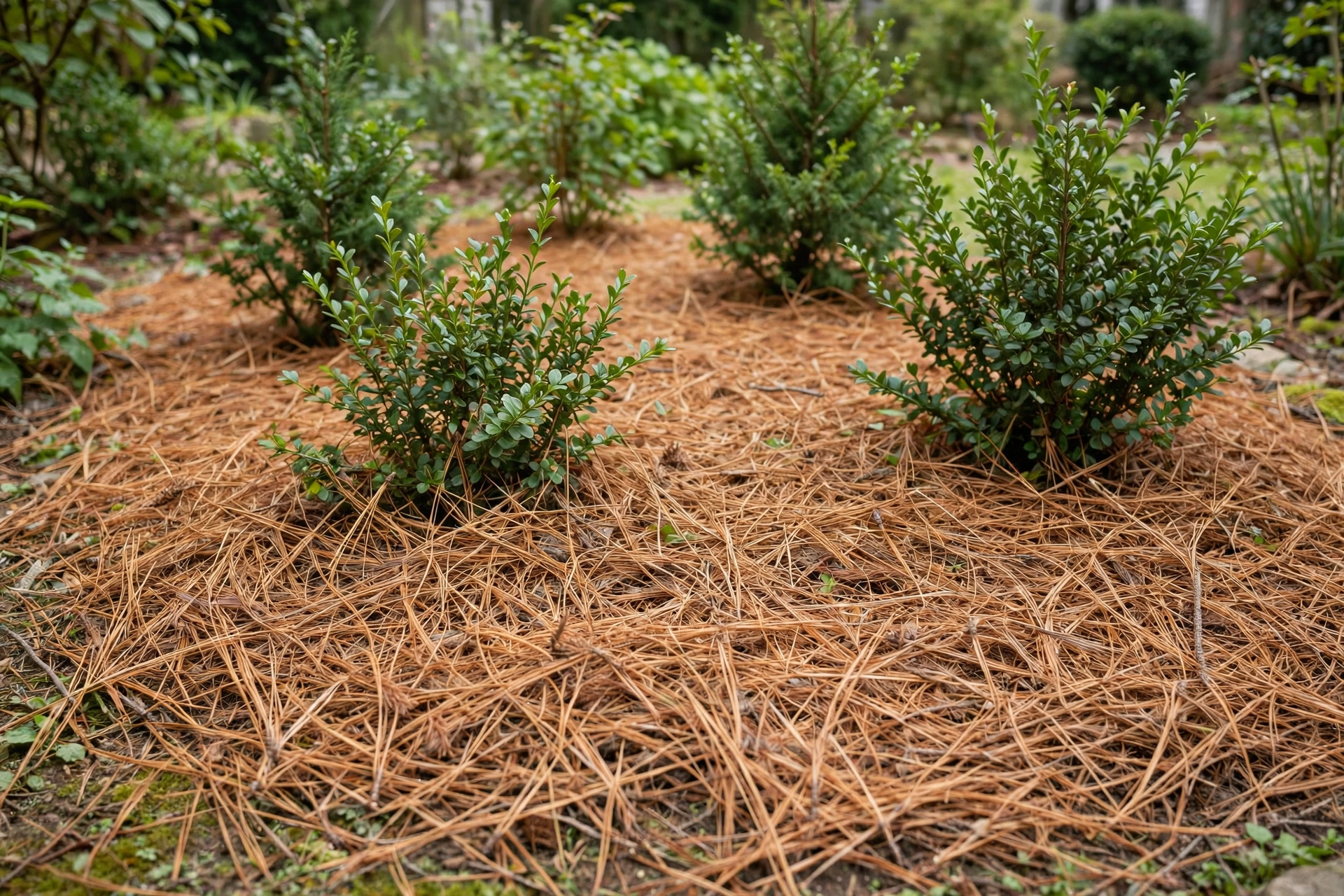
Pine straw is a steady mulch for slopes and beds — the needles knit together and stay put instead of washing away. Expect to top it up once or twice a year as it breaks down and settles.
What to watch when you spread it
Fresh straw settles fast. Three inches laid down becomes about 1.5 inches once it packs, so do not be surprised when the bed looks thinner a week later — that is the layer doing what it does, and the yearly top-up restores it.
Keep the straw pulled back 2 to 3 inches from tree trunks and 6 to 12 inches from the house foundation. Piling mulch against a trunk holds moisture where it rots bark, and straw against siding invites damp and pests.
If your beds are full of fallen needles already, start by clearing them — our guide to removing pine needles from rocks, gravel, and flower beds covers the tools that actually work. For what pine straw does once it is down, see how to use pine straw in garden beds. Leftover straw and old needles need a home too — how to dispose of pine needles walks through bagging, composting, and curbside pickup. And if the needles came from your own trees, a tow-behind lawn sweeper gathers them far faster than a rake.
Where these numbers come from
The rates come from Texas A&M AgriLife Extension publication B-6145, “Producing Pine Straw in East Texas Forests” (Taylor & Foster, 2004): half a pound of straw per square foot for a 3-inch new application, and a 40-pound bale covering about 100 square feet. The depth guidance — 2 inches in beds, 3 inches around young trees, 4 to 6 inches under older trees, replenish once or twice a year, and the trunk and foundation clearances — comes from the LSU AgCenter’s “Proper Mulching” (Dan Gill).
This calculator tells you how much straw your beds need at the depth you pick — it does not set your watering schedule, know your soil, or judge whether pine straw is the right mulch for a particular bed.
Sources
Texas A&M AgriLife Extension — “Producing Pine Straw in East Texas Forests,” B-6145 (Taylor & Foster, 1/04), fetched in full Nov 10, 2026: https://www.researchgate.net/publication/26904646_Producing_Pine_Straw_in_East_Texas_Forests
LSU AgCenter — “Proper Mulching” (Dan Gill), fetched in full Nov 10, 2026: https://www.lsuagcenter.com/topics/lawn_garden/ornamentals/landscaping/proper-mulching