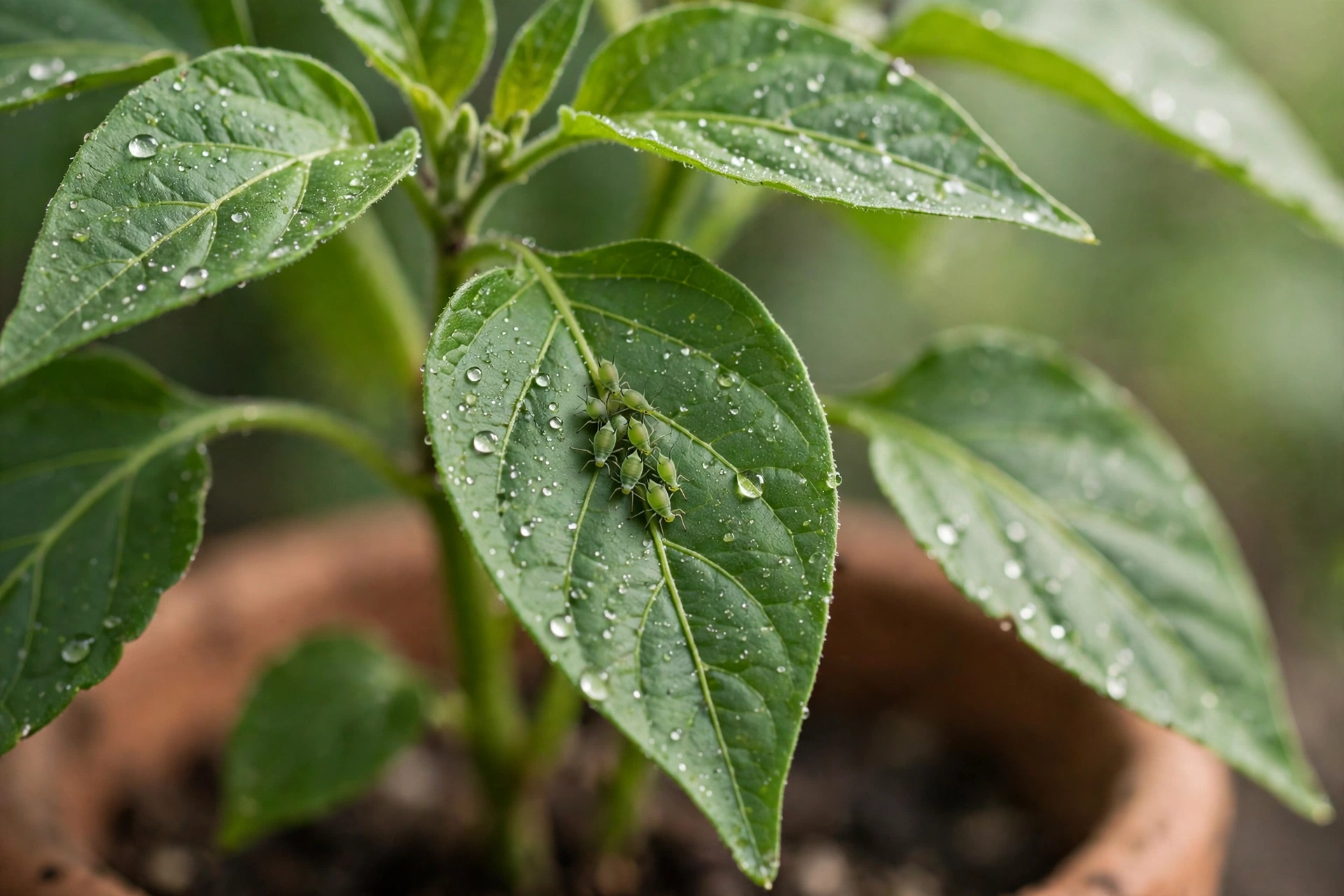
The stems feel sticky under your fingers, the newest growth is curling instead of opening, and when you turn a leaf over, the underside is crowded with tiny green insects. That is an aphid problem, and the two sprays every gardener reaches for — neem oil and insecticidal soap — look interchangeable on the shelf. They are not, and the difference that matters is how fast each one works, and how long it keeps working after the spray dries.
First, make sure it is aphids
Aphids are small, pear-shaped, and soft, usually green or black, and they gather in clusters on new growth and the undersides of leaves. The sticky film on the stems is honeydew, the sugary waste aphids leave behind, and curled or yellowing new leaves are the plant’s answer to a colony feeding on it. If the insects are waxy white bumps that do not move, or cottony tufts in the leaf joints, you are looking at scale or mealybugs instead, and the treatment changes. Our guide to aphids vs scale vs mealybugs on houseplants shows how to tell the three apart before you spray anything.
How insecticidal soap works
Insecticidal soap is potassium salts of fatty acids in water, and it kills by contact alone. When the spray hits an aphid, it breaks down the insect’s soft outer body, and the aphid dries out and dies within hours. There is no poison left behind: the soap breaks down within hours of drying, so an aphid that arrives the next day is untouched, and so is a ladybug that walks across a dry leaf.
That speed is the soap’s whole case. It is the spray to reach for when aphids are already covering a plant and you want them gone today, especially on herbs or vegetables you plan to eat soon, since soap is approved for organic gardening and can be used up to the day of harvest. The cost is repetition: reapply every 4 to 7 days until the aphids are gone, because every spray only kills the aphids it touches, and expect two or three rounds on a real infestation.
How neem oil works
Neem oil is a plant oil pressed from neem tree seeds, and the ready-to-use bottles sold for gardens are clarified hydrophobic extract of neem oil. It works in two ways at once: the oil smothers the aphids it coats, and its active compound, azadirachtin, disrupts how aphids feed, molt, and lay eggs. That second action is why neem oil also kills eggs, larvae, and adults, where soap only kills what it touches while wet.
The trade-off is time. Neem oil is not a knockdown spray, so you will not see aphids drop the afternoon you use it, and the azadirachtin breaks down quickly in sunlight, with a half-life of about 1 to 2.5 days on leaves. University of California pest notes put it plainly: oils kill only the aphids present on the day they are sprayed. Reapply every 7 to 14 days for prevention, or every 4 to 7 days while an infestation is active, and count on the population falling over two or three rounds rather than in one afternoon. The bonus is that the same bottle is a fungicide, so it also treats powdery mildew on the same plant.
Neem oil vs insecticidal soap, side by side
| Insecticidal soap | Neem oil | |
|---|---|---|
| How it kills | Breaks down the aphid’s soft body on contact | Smothers aphids and disrupts feeding, molting, and egg-laying |
| Speed | Hours — aphids die the same day | Days — the population falls over repeat sprays |
| What it kills | Only the aphids the spray touches while wet | Eggs, larvae, and adults, plus powdery mildew |
| Repeat schedule | Every 4 to 7 days until aphids are gone | Every 7 to 14 days; every 4 to 7 days during an active infestation |
| After it dries | Nothing left — no residue, no protection | Short-lived residue that keeps disrupting feeding for a few days |
| Watch out for | Leaf burn in hot sun or above 85 degrees | Leaf burn in heat or direct sun; avoid spraying open flowers |
Which one fits your situation
Reach for soap when the aphids are already everywhere. A heavy colony on a few pots, a plant you want to harvest this week, or a first spray where you need to see results today — soap is the faster tool, and it leaves nothing behind to worry about.
Reach for neem oil when the aphids keep coming back. A pot that gets hit every few weeks, a plant that also shows powdery mildew, or a collection where you would rather spray once a week than chase every aphid by hand — neem oil’s longer action and egg-killing reach suit a recurring problem better.
Use both, in that order, when one spray is not enough. Soap first, to knock the colony down fast, then neem oil on the repeat schedule to catch the eggs and the aphids that hatch after the soap has dried. That sequence is the most reliable way to clear a stubborn infestation on a potted plant.
How to apply either one so it works
Coat the undersides first. Aphids cluster under leaves and on new growth tips, so hold the leaf up and spray from below before you cover the tops. A spray that only hits the upper leaf surface misses most of the colony.
Spray in the cool of the day. Early morning or late evening, when the plant is out of direct sun and the temperature is below 85 degrees, gives the spray time to work before it dries and keeps the leaves from burning. Never spray in midday sun, and never spray a plant that is drought-stressed or freshly repotted.
Test one leaf before the whole plant. Spray a single leaf, wait a day, and check for browning or curling before treating the rest. Some plants are more sensitive than others, and a test leaf costs nothing while a burned plant costs the season.
Repeat on schedule, and reapply after rain. Soap needs a second pass every 4 to 7 days and neem oil every 7 to 14 days, and heavy watering or rain washes either one off the leaves. The spray that fails is usually the one that was used once and put away.
What success looks like
After the second round, the clusters should be visibly thinner, the new growth should open without curling, and the sticky film on the stems should stop spreading. A few stragglers after one spray are normal; a colony that looks the same after two full rounds, applied on schedule with good coverage, means the diagnosis may be wrong or the spray is missing the undersides. Check the pest again against our guide to aphids vs scale vs mealybugs, and if the aphids are confirmed, switch to the other spray for the next round.
For specific bottles, our roundup of the best aphid sprays for potted plants names the soap and neem oil to buy, and our guide to preventing aphids on potted plants covers the weekly check that keeps the next colony from starting. If you would rather let insects do the work, beneficial insects for aphids covers ladybugs and lacewings, and getting rid of aphids without killing beneficial insects shows how to spray without wiping out the helpers.