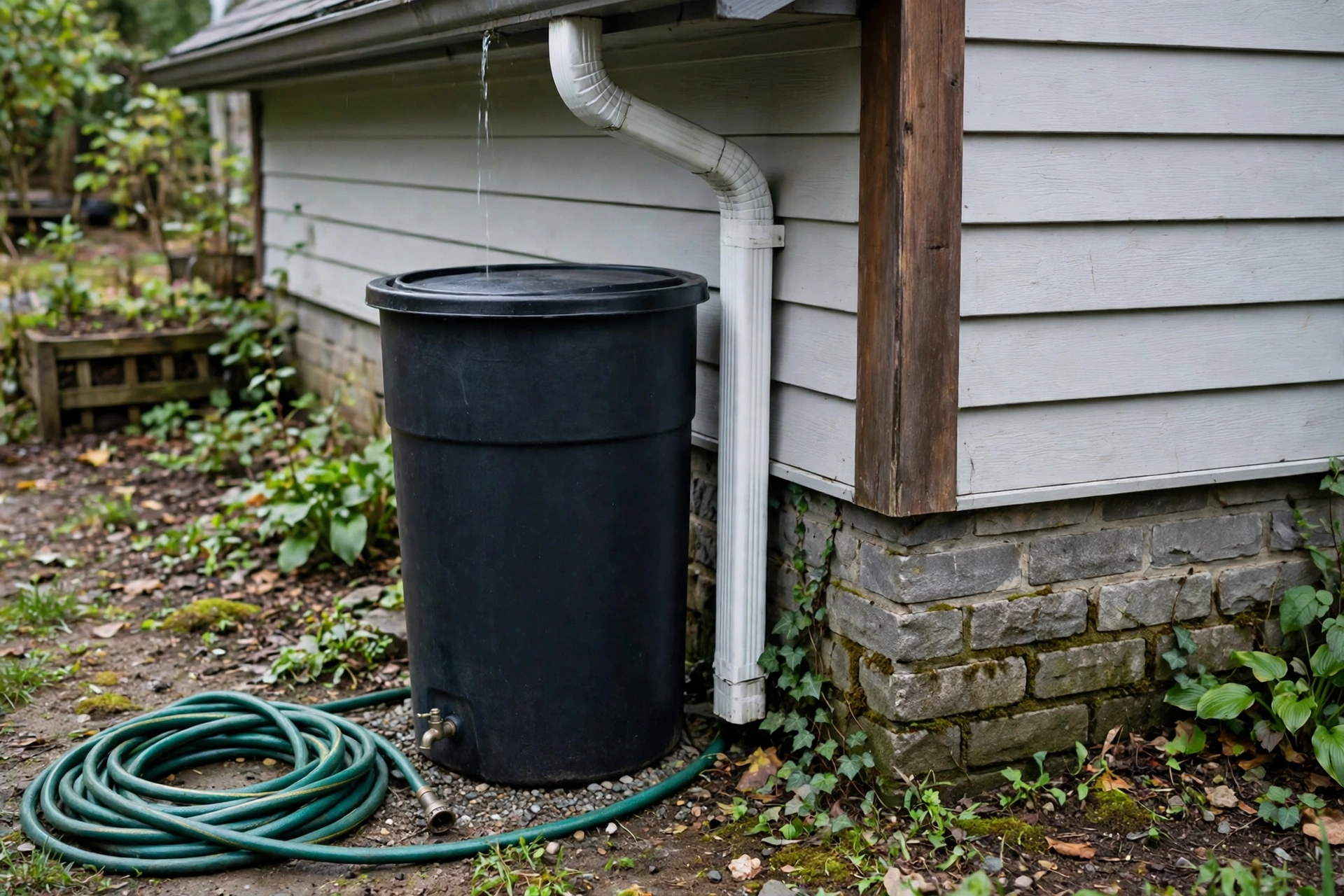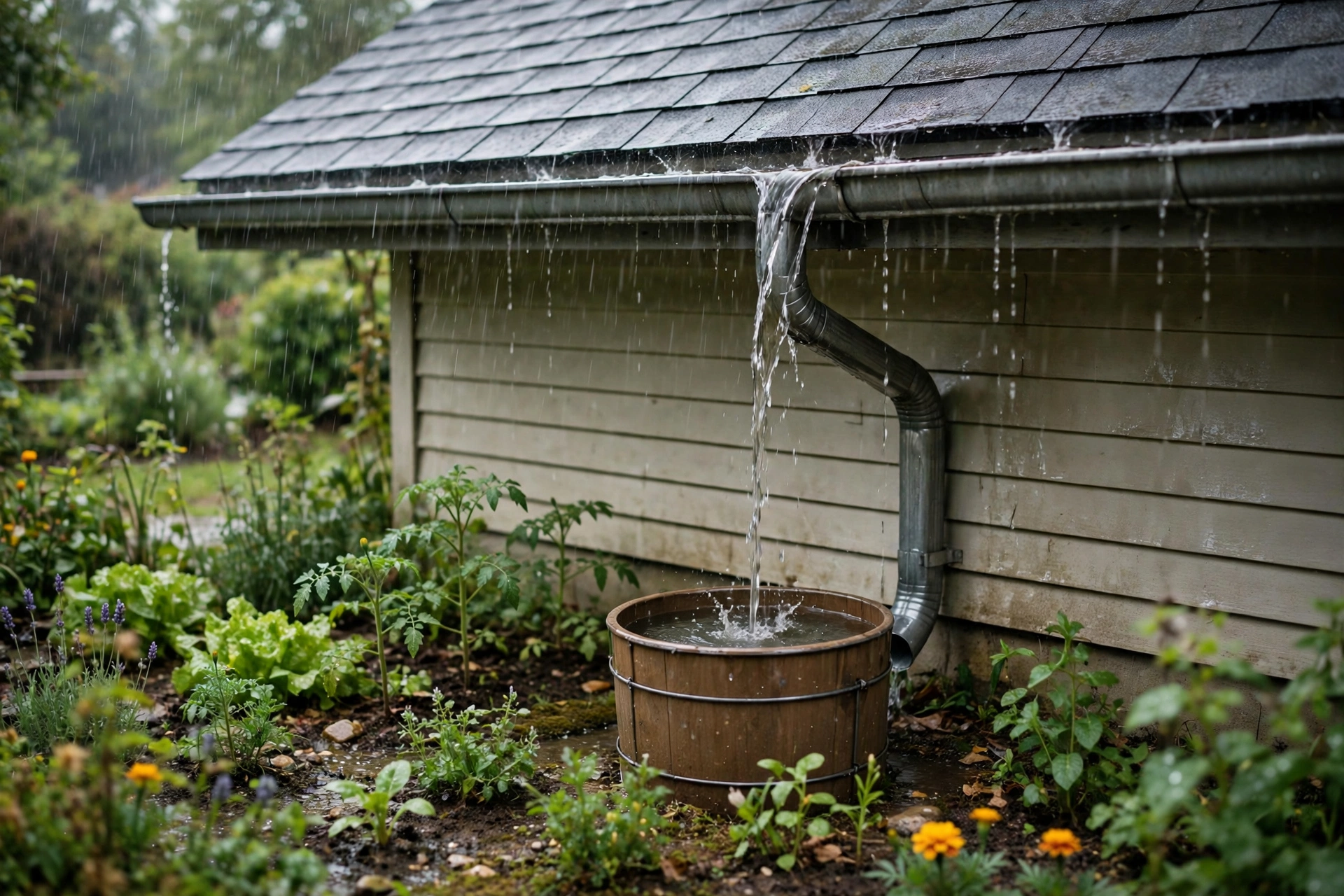
Late fall is when the roof starts talking. A steady rain drums overhead for an hour, the gutters fill, and the downspout pours like somebody left a faucet running in the yard.
That water is either a resource or a runoff problem, and the difference starts with knowing how much of it you actually have. Most gardeners guess low by a wide margin, because a single inch of rain over an ordinary roof adds up to far more than a couple of watering cans.
This table settles that guess. It shows, roof by roof, how many gallons one inch of rain delivers and how many standard 55-gallon barrels that volume fills.
Rainwater harvest by roof size
The figures use a planning rate of 0.62 gallons per square foot of roof per inch of rain, reduced to 85 percent to allow for splash, gutter loss, and the first flush off a dry roof. Every row is a single inch of rain on a single storm, stated once and plainly.
| Roof footprint | Gallons per 1 inch of rain | 55-gallon barrels filled | Source |
|---|---|---|---|
| 500 sq ft | 264 | 5 | TWDB |
| 750 sq ft | 395 | 8 | TWDB |
| 1,000 sq ft | 527 | 10 | TWDB |
| 1,250 sq ft | 659 | 12 | TWDB |
| 1,500 sq ft | 791 | 15 | TWDB |
| 2,000 sq ft | 1,054 | 20 | TWDB |
| 2,500 sq ft | 1,318 | 24 | TWDB |
| 3,000 sq ft | 1,581 | 29 | TWDB |
Barrel counts are rounded up, because a barrel that is nearly full still needs somewhere for the last gallons to go. A 1,000-square-foot roof, which is a modest house once the garage is counted, fills ten barrels in one inch of rain.
Putting the number to work
Start with the roof section that actually drains to your downspout, not the whole house. Many homes split the roof between two or four downspouts, so the footprint feeding one barrel is often a quarter or a half of the total, and that smaller figure is the one to read off the table.
For a storm amount other than one inch, or for a roof size that falls between rows, the rain barrel sizing calculator runs the same math with your own numbers. If you are still choosing the barrel itself, the guide to the best rain barrels for gardens covers capacity, screens, and spigots in plain terms.
Stand by the downspout during the next hard rain and listen to it run. That steady pour, sustained for the length of a storm, is what these gallons look like in person, and it explains why a single barrel on a large roof overflows long before the rain lets up.
What these figures do not cover
These are single-storm planning figures for one inch of rain. They do not build a monthly water balance, they do not size a cistern for household use, and they say nothing about local rules for collecting rainwater or about water quality, which are separate questions to check where you live.
Before winter settles in, an installed barrel also needs its cold-weather care, and the steps in how to winterize a rain barrel keep a full barrel from cracking when the temperature drops.
Bottom line
Size the barrel to the roof section above it, not to the space beside the house. On most homes that means more capacity than one barrel provides, so plan for overflow from the start and add the second barrel before the spring rains arrive, while the math in this table is still in front of you.
Sources
Texas Water Development Board, The Texas Manual on Rainwater Harvesting, 3rd edition (2005), Chapter 4 — http://www.twdb.texas.gov/publications/brochures/conservation/doc/rainwaterharvestingmanual_3rdedition.pdf — fetched November 19, 2026.