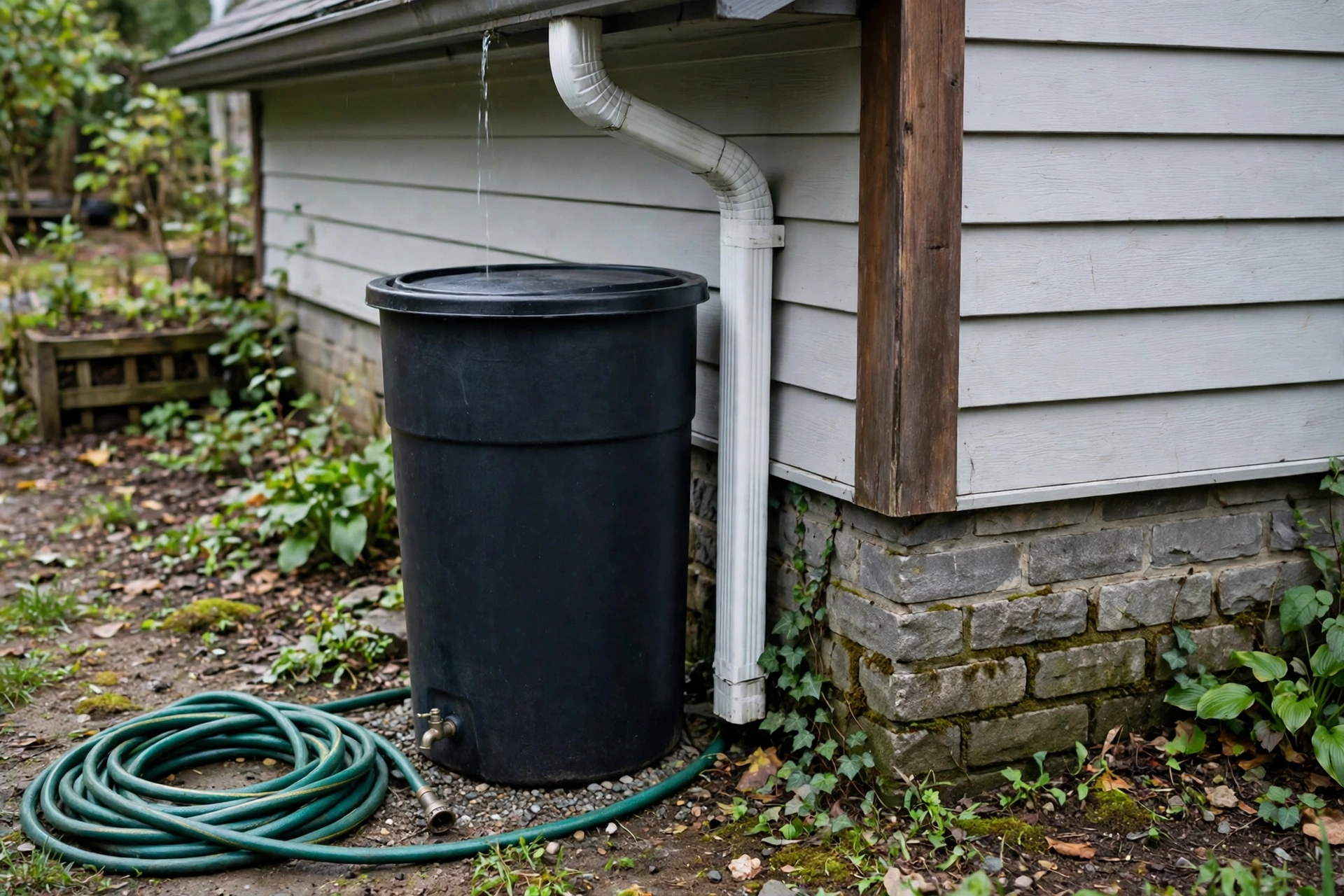
A plain barrel under a downspout does not look like much — a plastic drum, a spigot near the bottom, a screen on top to keep the mosquitoes out.
Then one ordinary storm rolls through, and that quiet drum is holding more water than a week of garden watering. The question is never whether your roof sheds water. It is how much, and whether one barrel is anywhere near enough to catch it.
This calculator answers that with your own numbers: the roof area draining to one downspout, and a storm amount you choose. It tells you the gallons that storm sends down the spout and how many barrels it would take to hold them.
The calculator
One downspout usually drains one section of roof, not the whole house. A rough length-times-width of that section is fine.
The storm size you want to plan for. Half an inch is a modest rain; one inch is a solid storm.
Not every drop makes it into the barrel — some splashes off, some evaporates, some is diverted at the start. 85 percent is a sound planning figure for most roofs.
Leave blank if you are starting from zero. If you fill this in, the result also shows how much water would overflow past the barrels you own.
What do I type?
The roof area is the footprint of the roof section above the downspout, measured flat — length times width of that section as if you were looking straight down at the house. Gutters decide which section drains where, so walk the house and count the downspouts first if you are not sure.
Rainfall is simply the storm you want to be ready for. If your barrels overflow in a one-inch storm, that is useful to know before the storm, not during it.
What does the number mean?
The first figure is the gallons that one storm sends to that downspout. The second is how many barrels of your chosen size it takes to hold all of it, rounded up — a half-filled barrel still counts as a barrel you need standing there.
Most gardeners do not try to catch every drop of the biggest storm. They size for the common storm and let the rare downpour overflow, which is exactly what the overflow figure helps you judge: it shows how much water runs past the barrels you already own, so you can decide whether one more barrel earns its space. If you are still choosing the barrels themselves, the rain barrel roundup compares the sizes and styles worth considering.
How the math works
One inch of rain on one square foot of roof yields about 0.62 gallons of water. The calculator multiplies your roof area by your rainfall by 0.62, then applies your efficiency percentage to account for the water that never reaches the barrel. Barrels needed is that gallon figure divided by your barrel size, rounded up.
Worked examples
A 1,000-square-foot roof section in a one-inch storm, at 85 percent efficiency, yields 1,000 × 1 × 0.62 × 0.85 = 527 gallons. At 55 gallons per barrel, that is 10 barrels to hold the whole storm — which is why most homes chain two or three barrels together and accept overflow in big storms. The downspout installation guide shows how linked barrels and an overflow hose are set up.
| Roof area | 0.5 in of rain | 1 in of rain | 2 in of rain |
|---|---|---|---|
| 500 sq ft | 131.8 gal (3 barrels) | 263.5 gal (5 barrels) | 527.0 gal (10 barrels) |
| 1,000 sq ft | 263.5 gal (5 barrels) | 527.0 gal (10 barrels) | 1,054.0 gal (20 barrels) |
| 1,500 sq ft | 395.3 gal (8 barrels) | 790.5 gal (15 barrels) | 1,581.0 gal (29 barrels) |
| 2,000 sq ft | 527.0 gal (10 barrels) | 1,054.0 gal (20 barrels) | 2,108.0 gal (39 barrels) |
| 2,500 sq ft | 658.8 gal (12 barrels) | 1,317.5 gal (24 barrels) | 2,635.0 gal (48 barrels) |
The table uses 85 percent efficiency and 55-gallon barrels throughout. Your own figures will shift with a different barrel size, which is what the calculator is for.
What this calculator does not do
It sizes capture for a single storm amount you enter — nothing more. It does not forecast rain, size a full cistern system across a season, or judge whether rainwater use is restricted where you live, so check local rules before you rely on stored water. However many barrels you end up with, they need draining and disconnecting before hard freezes; the winterizing guide covers that routine.
Sources
Texas Water Development Board, The Texas Manual on Rainwater Harvesting, 3rd edition (2005), Chapter 4, “Water Balance and System Sizing” — http://www.twdb.texas.gov/publications/brochures/conservation/doc/rainwaterharvestingmanual_3rdedition.pdf (fetched in full November 19, 2026). The 0.62 gallons per square foot per inch figure and the 85 percent worked-example collection efficiency both come from this manual.