This post contains affiliate links. We may receive a commission if you make a purchase after clicking on one of these links.
Buy the specialty rake. If your yard sits under pines and you are still fighting the needle mat with a regular leaf rake, the pine needle rake pays for itself in the first cleanup, because it lifts needles a leaf rake physically cannot catch.
That is the short answer. The longer one matters too, because a specialty rake is not better at everything, and plenty of yards genuinely do fine with the rake already in the garage. This post settles which side of that line your yard is on.
Why Needles Beat a Leaf Rake
A leaf rake is built for broad, flat leaves. Its plastic or bamboo tines are spaced wide so leaves ride up the fan instead of spearing on the ends.
A pine needle is a different problem entirely. Needles are thin enough to slip straight through those wide gaps, and once they land they interlock into a woven mat that flexible tines glide across instead of lifting.
Pressing harder does not fix it. The tines bend, spring back, and skim the grass crowns while the bottom layer of needles stays exactly where it fell. For the full breakdown of what separates the two tools, the site’s guide to the best pine needle rakes covers tine spacing and head width in detail.
What a Pine Needle Rake Does Differently
Three design differences do the work, and none of them is marketing.
Close tine spacing. Needles cannot fall through gaps they do not fit through. Tines set close together catch the mat as a sheet instead of combing it.
Spring steel tines. Stiff, springy tines bite into the mat and flex back. That bite is what lifts the bottom layer, and it is the thing a flexible leaf rake cannot imitate.
A narrower head. Most pine rakes run narrower than a big leaf fan, which reads as a drawback on open lawn and is the whole point everywhere else. Needles pile deepest under low branches, between shrubs, and along fence lines, and a narrow head is the one that reaches those spots.
When the Regular Leaf Rake Is Enough
Skip the specialty rake if any of these describe your yard.
You have one or two pines and the drop is light. A leaf rake handles a thin scatter slowly, and slow is acceptable twice a year.
Your needles land mostly on beds you mulch anyway. Needles left in place as mulch are a legitimate finish, not a failure, and the pine needle cleanup guide walks through when leaving them beats removing them.
You already own a lawn sweeper and the needles are on open lawn. A sweeper covers flat ground faster than any rake, which is why the rake vs. sweeper cost comparison is worth reading before buying anything.
When the Specialty Rake Earns Its Place
Buy it when the needle mat is the recurring job: several pines over lawn, needles worked down into the grass where they smother it, or beds and gravel areas a sweeper cannot reach.
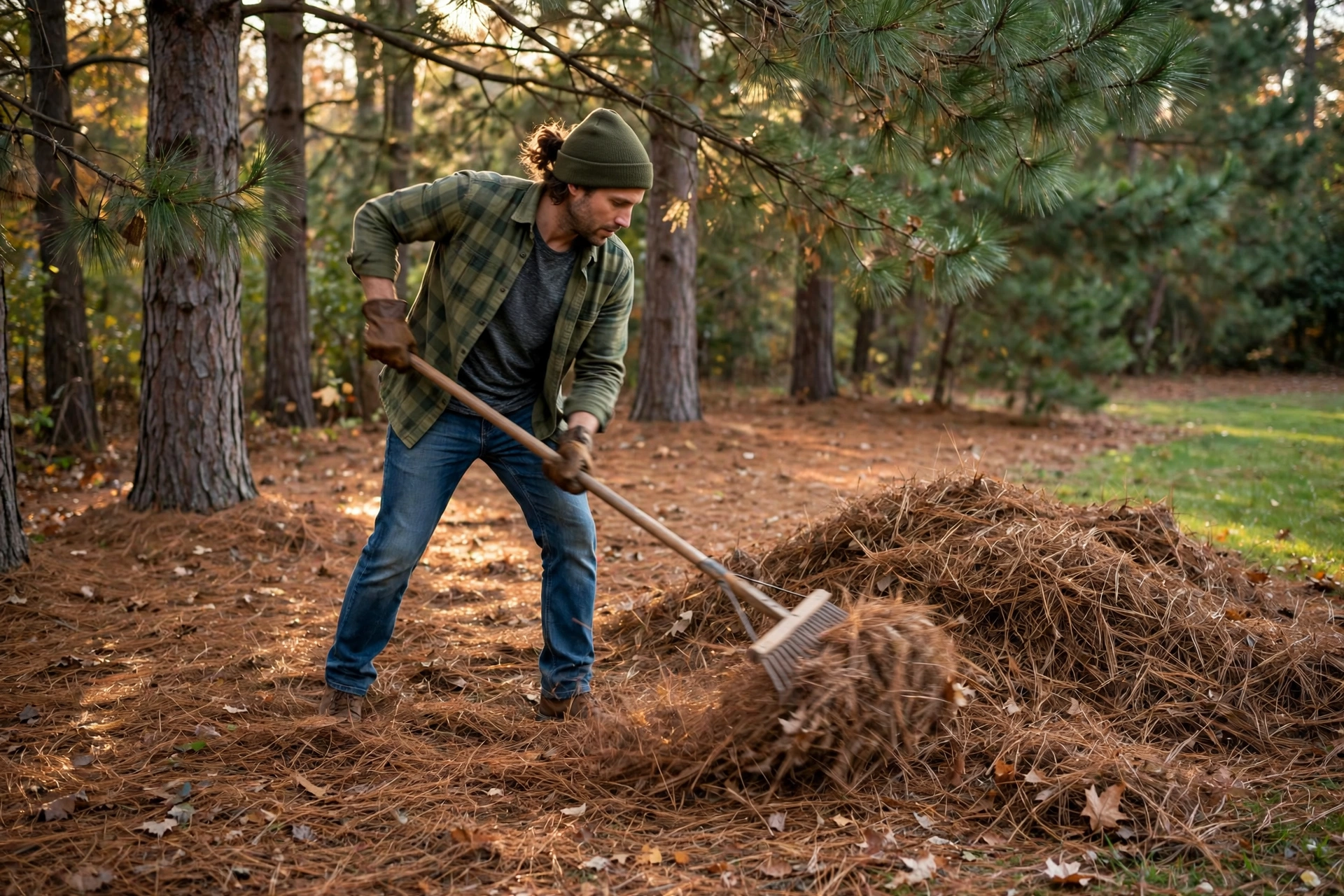
The math is time, not price. A rake that lifts the mat in two passes instead of six turns a half-day cleanup into an hour, and it does that every fall for years. The rake most often recommended for exactly this job is the Groundskeeper II, with 28 spring-loaded steel tines on a 21-inch head and a 55-inch fiberglass handle.
Its honest trade-off: at 21 inches wide it takes more passes across open lawn than a wide leaf fan, and the spring tines will dig into a soft mulch bed if you lean on them. Use a light touch on beds and save the pressure for the lawn.
The Groundskeeper II Rake
28 spring-loaded steel tines that bite into the needle mat and lift it instead of skating over it.
The Not-Recommended Shortcut
The cheap fix people reach for is a stiff bow rake, the garden rake with short metal teeth. It does bite into the mat. It also tears grass crowns, scalps high spots, and drags soil out of beds along with the needles.
On gravel it is worse, because the teeth pull the gravel up with the needles and leave you re-spreading the surface you just cleaned. A bow rake is a soil tool that tolerates needles badly, not a needle tool.
Bottom Line
If needles are a light, twice-a-year scatter, keep your leaf rake and spend nothing. If a woven mat under several pines is the job you face every fall, the specialty rake is the right purchase: the Groundskeeper II, used with a light touch on beds and real pressure only on the lawn.