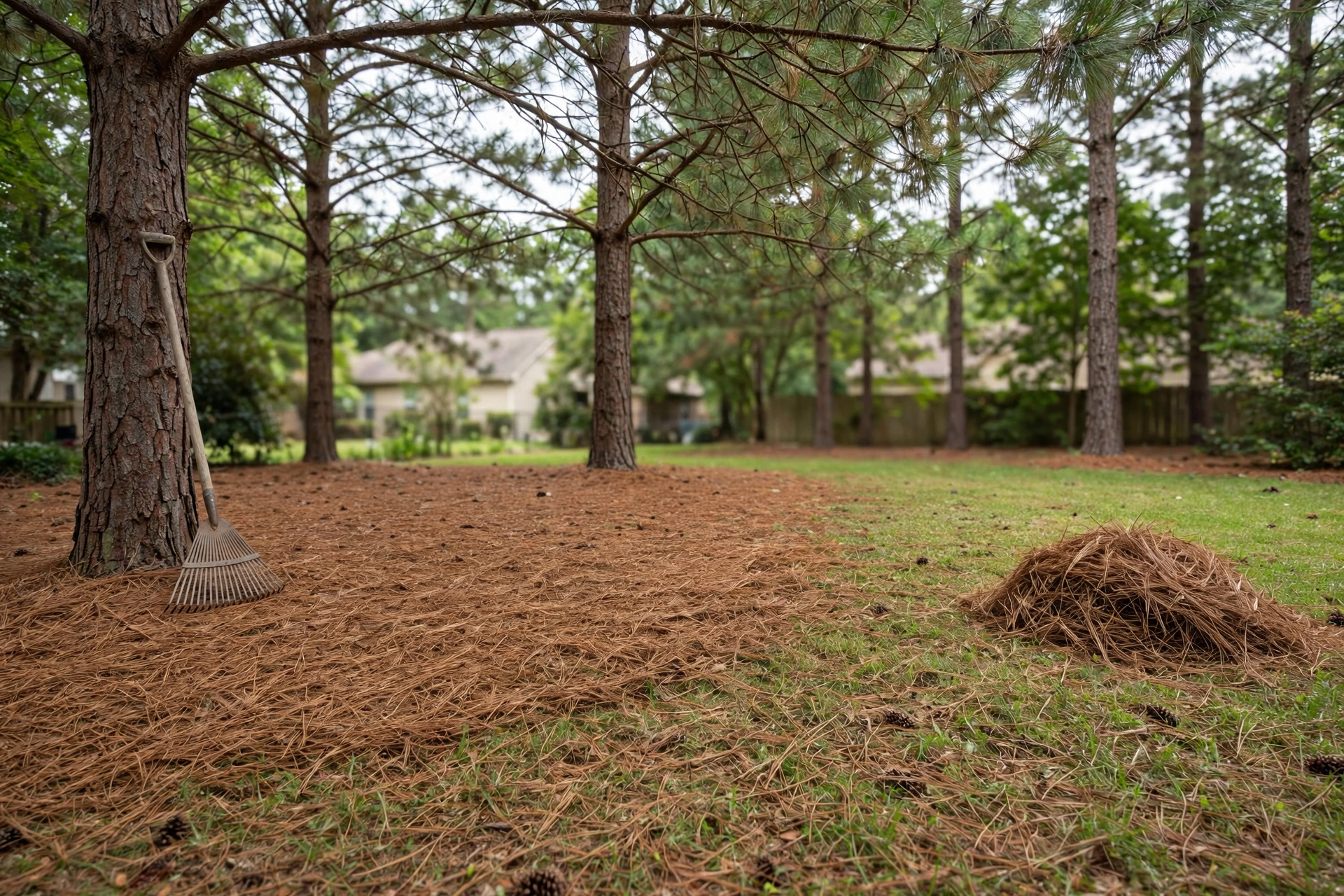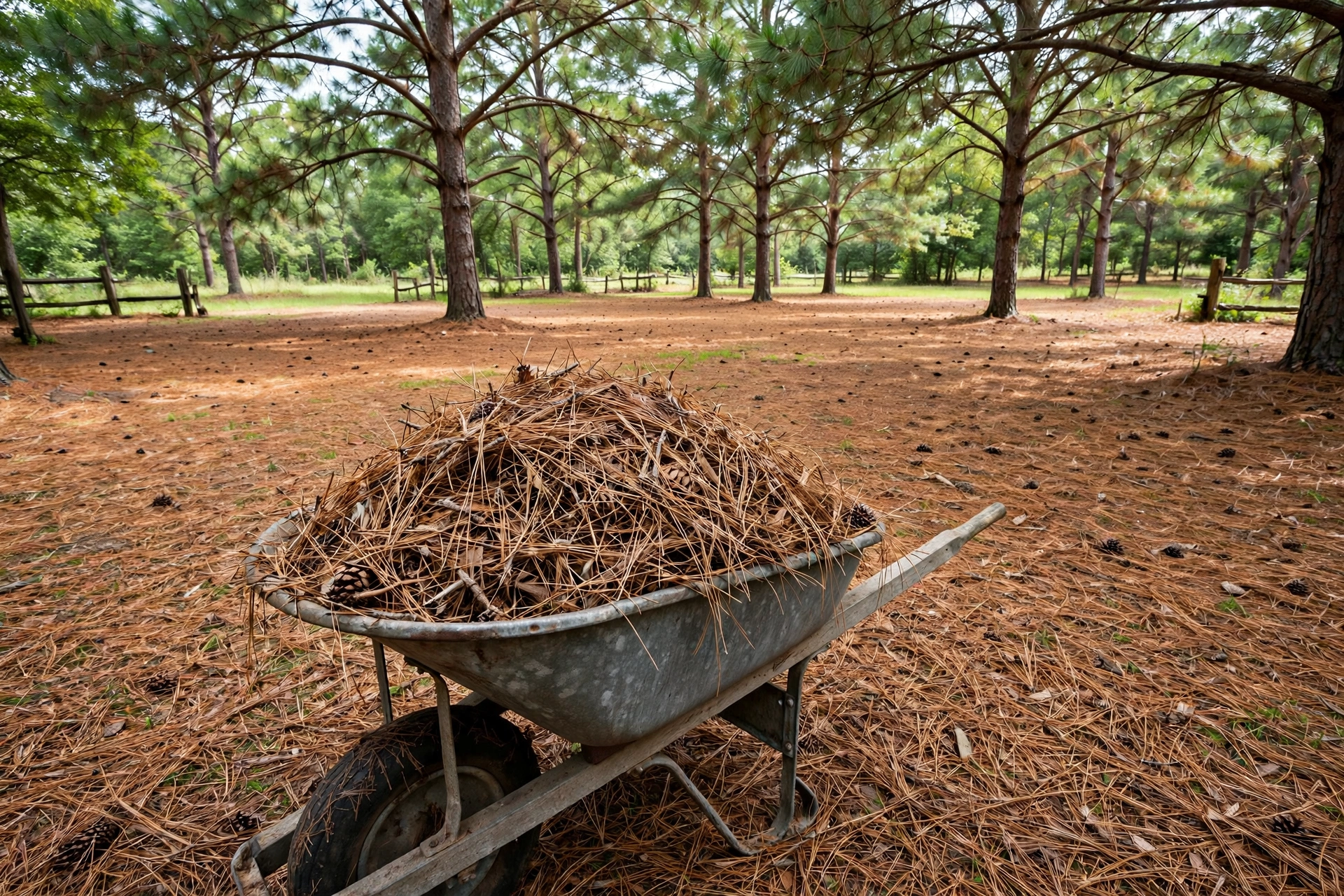
A windy week under the pines leaves the lawn looking carpeted, and the first question is not which tool to buy — it is how many hours of your weekend the needles are worth.
Three options cover the job, and each one trades money for time in a different proportion: the rake costs almost nothing and takes the longest, a sweeper costs several hundred dollars and cuts the time sharply, and a crew costs the most while taking none of your time at all. The math below runs per 1,000 square feet, so you can scale it to your own yard instead of trusting a price or a time that was measured on someone else’s.
The math, per 1,000 square feet
The complete guide to pine needle cleanup timed each method on the same ground, which is the only fair comparison, since a small flat yard and a half-acre under mature pines are not the same job.
| Option | What you pay | Time per 1,000 sq ft | Best for |
|---|---|---|---|
| Rake and tarp | $25–$40 for a good rake | 30–40 minutes | Small yards, occasional cleanup |
| Push sweeper | $150–$250 | 20–25 minutes | Small, flat lawns |
| Tow-behind sweeper | $250–$450 | 8–12 minutes | Medium to large lawns |
| Hire a crew | Priced per visit — varies by yard | None of yours | Large yards, or a season with no spare weekends |
Scale the table to your yard before deciding: a 5,000-square-foot needle drop takes roughly two and a half to three and a half hours by rake, under an hour with a tow-behind sweeper, and no time of yours at all with a crew. On a quarter-acre lot with about 10,000 square feet under pines, the rake job stretches to five to almost seven hours — the point where most people either buy the sweeper or book the crew. The equipment prices are one-time purchases, so the comparison that matters is how many cleanups a season your yard actually needs.
Raking: the cheapest tool, the longest afternoon
A good leaf rake is a $25–$40 tool, and that is the entire equipment cost of the cheapest option — no fuel, no storage, no maintenance beyond replacing it when the tines bend. The cost shows up in time instead: at 30–40 minutes per 1,000 square feet, a large yard under mature pines turns into most of a Saturday, and the needles still have to go somewhere once they are in a pile.
That somewhere matters to the real cost, because hauling and disposal are the part of raking people forget to count. The best pine needle rakes are chosen for tines that grip needles instead of letting them slip through, and once the pile is built, the guide to disposing of pine needles covers the options — bagging, hauling, or composting. A thick mat left on the lawn smothers the grass underneath it, so the pile is not a problem you can postpone until spring.
Composting is the cheapest way to make the needles useful, but it takes longer than most garden waste, because needles break down slowly — the guide to composting them faster covers the one step that actually speeds it up.
A sweeper: paying once to buy the hours back
A push sweeper at $150–$250 suits a small flat lawn, while a tow-behind at $250–$450 is the tool for a medium or large yard — and at 8–12 minutes per 1,000 square feet, it cuts a 5,000-square-foot cleanup to under an hour, roughly two hours faster than raking the same ground. The sweeper versus leaf blower comparison settles which of the two powered tools actually finishes the job.
The honest way to judge the purchase is cleanups per season, not dollars per cleanup: a yard that needs needles cleared three or four times a season gets the hours back fast, while a yard cleared once a year after the first frost will never give a several-hundred-dollar tool enough work to justify the shelf space.
Hiring it out: buying the weekend back
A crew charges by the visit, and the price moves with yard size, needle depth, and whether haul-away is included — which is the question to ask before accepting a quote, because a low price that leaves the piles on the curb is not the same job as one that takes them away. Get the haul-away in writing, ask whether cones are included, and confirm the crew will clear the beds as well as the open lawn, since beds are where needles pile deepest and where a crew’s blower work shows.
Hiring makes sense when the yard is large, the needle drop is heavy, or the season is already full — and it makes the most sense as a once-a-season reset, with a rake or a sweeper handling the lighter cleanups in between. Paying a crew to do a job a $25 rake could finish in an hour is the one way to spend the most money on the least problem.
The recommendation
For most yards under pines, buy the sweeper: a push model for a small flat lawn, a tow-behind for anything larger, with a rake kept on hand for beds and corners. Hire a crew for the once-a-season reset when the yard is large or the weekends are already spoken for, and rake alone only when the yard is small and the needles fall once a year. Of the three, the sweeper is the one that keeps the yard clear all season without eating your Saturdays — and that is the job you are actually buying.