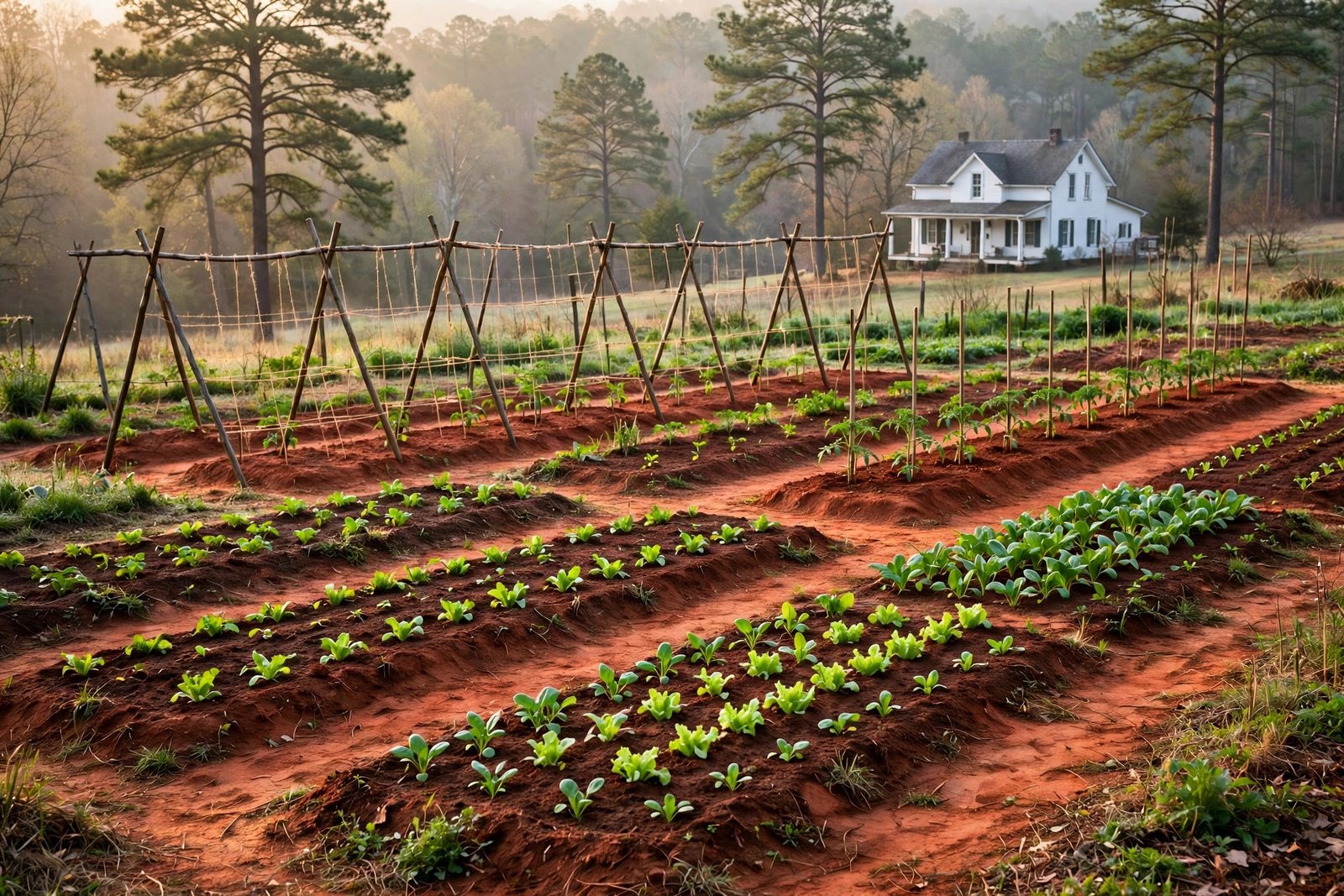
The mistake is treating Alabama as one garden. A tomato transplant set out on Mobile’s schedule in Hamilton, in the northwestern corner, meets a last frost that averages April 11 — seven weeks after Mobile’s February 21 — and a gardener who waits for Hamilton’s date on the coast gives away the longest season in the state for nothing.
The Alabama Cooperative Extension System writes its planting chart for the middle of that spread. Every date in the chart is a central Alabama date, and the adjustment is printed with it: in south Alabama, make spring plantings about 10 days earlier and fall plantings 10 days later; in north Alabama, make spring plantings about 10 days later and fall plantings 10 days earlier.
So the dates on this page are Extension’s central Alabama dates, and the 10-day shift travels with them. This calendar is one of the state calendars collected in planting calendars by state.
Ten days each way, four frost anchors
Alabama spans USDA Zones 7b to 9b on the 2023 map, and most of the state — 83 percent of its ZIP codes — sits in Zones 8a and 8b. Zones describe the coldest night of an average winter, which is perennial information; vegetables run on frost dates, and Alabama’s frost dates move by weeks as you travel from Hamilton to Mobile.
| Region | Where | Last spring frost | First fall frost | Frost-free days |
|---|---|---|---|---|
| North | Hamilton and the northwestern counties | April 11 | October 27 | 199 |
| Central-north | Birmingham | March 21 | November 11 | 235 |
| Central | Montgomery — the belt the Extension chart is written for | March 13 | November 13 | 245 |
| Gulf Coast | Mobile, at the Downtown Airport station | February 21 | December 6 | 288 |
Hamilton’s anchor is the Hamilton 3 S station, and Mobile’s is the Downtown Airport station, a few feet above sea level on the bay. All four are the 50% probability dates for 32°F in the NOAA 1991–2020 normals — in half of years, frost comes later in spring than the date printed. What that coin flip means for a tender transplant is covered in frost dates explained.
The 89 days between Hamilton’s frost-free season and Mobile’s are the reason the chart needs its shift rule at all. Ten days does not close an 89-day gap, and it is not meant to: it moves a central date into the right part of the window for the Tennessee Valley or the Wiregrass, while the anchors tell a gardener at either end of the state how much further their own date sits.
The planting table, from Extension’s chart
The windows in this table are the Alabama Cooperative Extension System’s Planting Guide for Home Gardening in Alabama (ANR-0063), spring and fall, for central Alabama. Crops the chart moves as plants — cabbage, cauliflower, lettuce, bulb onions, eggplant, peppers, and tomatoes — are marked as transplants, and sweet potatoes go in as slips. Counting back from a transplant date to an indoor start date is laid out in how planting calendars work.
| Crop | Spring | Fall | How it goes in |
|---|---|---|---|
| Cabbage | Jan 1 – Feb 15 | Jul 25 – Aug 10 | Transplants |
| Cauliflower | Jan 1 – Feb 15 | Jul 25 – Aug 10 | Transplants |
| Lettuce | Jan 15 – Feb | Aug 15 – Sep 1 | Transplants |
| Bulb onions | Jan 15 – Mar 15 | Sep 15 – Oct 15 | Transplants |
| Beets | February | August | Seed |
| Garden peas | February | — | Seed |
| Irish potatoes | February | Aug 1 – 15 | Seed pieces |
| Radish | Feb 1 – Apr 1 | Sep 1 – Oct 15 | Seed |
| Turnips | Feb 1 – Apr 1 | Aug 10 – Oct 1 | Seed |
| Mustard | Feb 1 – Mar 15 | Aug 15 – Sep 5 | Seed |
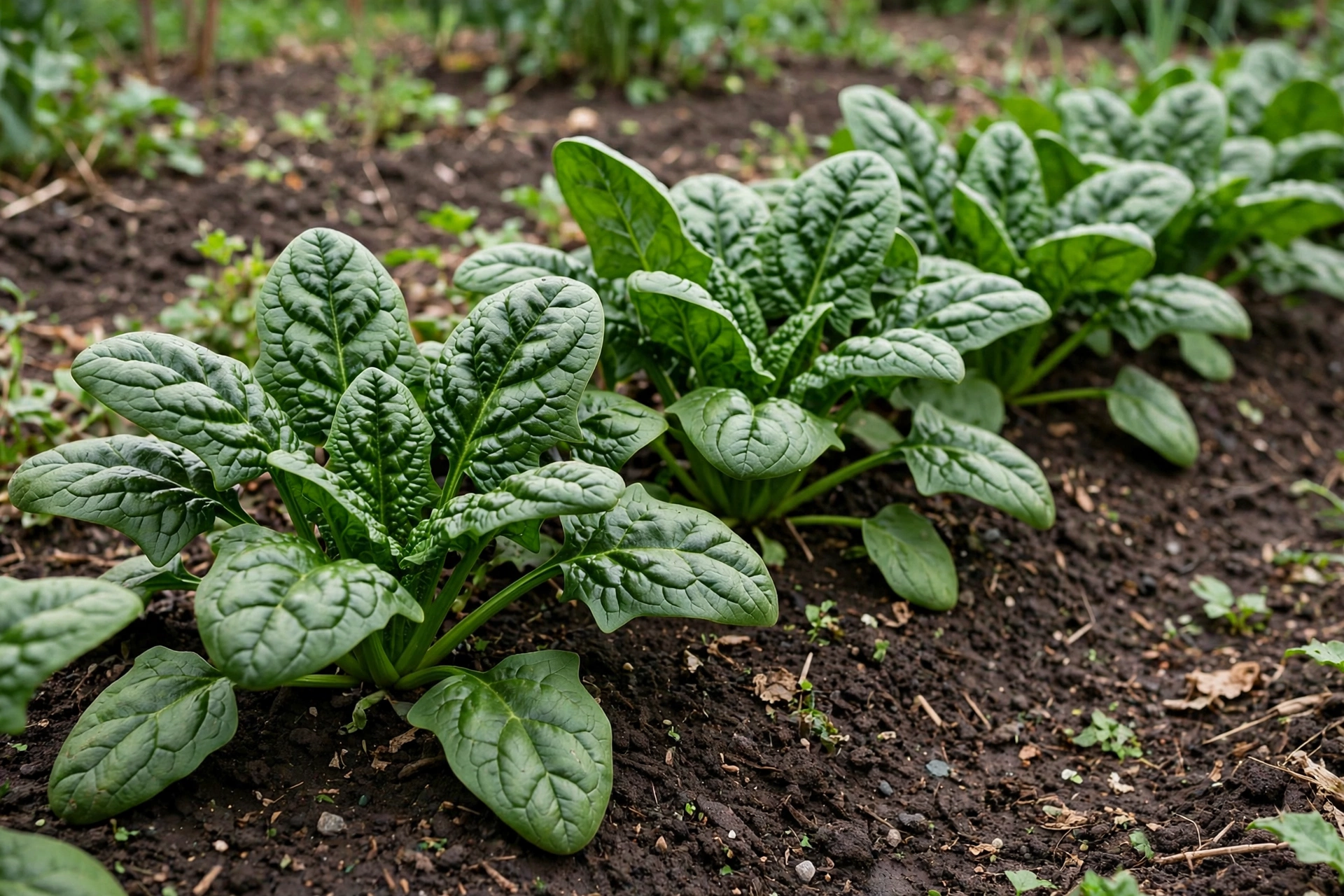
| Spinach | Feb 15 – Mar 15 | September | Seed |
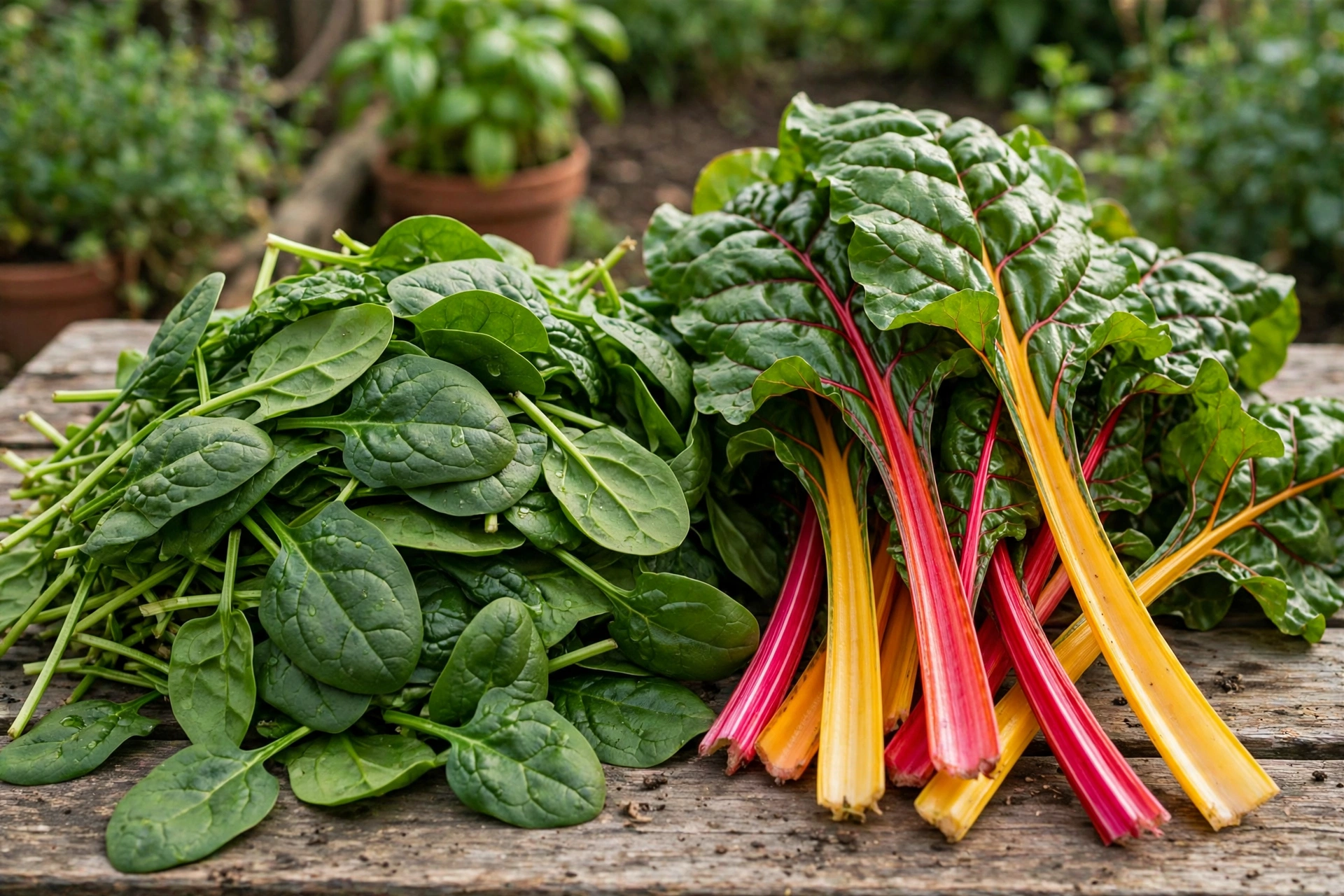
| Swiss chard | Feb 15 – Mar 15 | September | Seed |
| Carrots | March | Jul 20 – Sep 20 | Seed |
| Kohlrabi | March | Aug 15 – Sep | Seed |
| Sweet corn | Mar 1 – Jun 1 | — | Seed |
| Bush snap beans | April | Aug 5 – 20 | Seed |
| Muskmelon | April | — | Seed |
| Summer squash | April | Aug 1 – 15 | Seed |
| Winter squash | April | Jul 15 – Aug 1 | Seed |
| Tomatoes | April | July | Transplants |
| Watermelon | April | Jun 15 – 30 | Seed |
| Lima beans | Apr 10 – May 10 | Jul 20 – Aug 5 | Seed |
| Pole snap beans | Apr 10 – May 10 | Jul 20 – Aug 5 | Seed |
| Okra | Apr 10 – Jun 30 | — | Seed |
| Pole lima beans | Apr 15 – May 15 | Jul 15 – Aug 1 | Seed |
| Cucumbers | Apr 15 – May 15 | Jul 1 – 20 | Seed |
| Eggplant | Apr 15 – May 15 | Jul 1 – 20 | Transplants |
| Sweet potatoes | Apr 15 – Jun 15 | — | Slips |
| Peppers | Apr 1 – May 10 | July | Transplants |
| Southern peas | April – July | — | Seed |
| Asparagus | April | — | Crowns |
| Broccoli | — | Aug 1 – 15 | Seed |
| Oriental cabbage | — | Aug 1 – 15 | Seed |
| Brussels sprouts | — | Aug 1 – Sep 1 | Seed |
| Collards | — | Jul 1 – Sep 15 | Seed |
| Kale | — | Aug 15 – Sep 15 | Seed |
| Pumpkins | — | July | Seed |
| Rutabagas | — | July | Seed |
| Green onions | — | October – February | Sets |
Read the tomato row with the anchors in mind. April is a central Alabama transplant month; shifted 10 days later it is still mid-April in the north, three weeks ahead of Hamilton’s average last frost, which is why northern gardeners hold tender transplants or keep a cover ready. On the coast, the same row shifted earlier lands in late March, well past Mobile’s February frost date.
What to plant, month by month
Central Alabama’s year has two full planting seasons. Spring runs from January transplants to a June finish, and fall planting opens in July while the summer garden is still producing.
January and February. Cabbage and cauliflower transplants open the year, lettuce and bulb onions follow in mid-January, and February takes the first direct sowings — beets, garden peas, and Irish potatoes, with radish, turnips, and mustard from February 1 and spinach and Swiss chard from mid-month. A soil sample goes to the county Extension office in this window if the garden has not been tested in three years.
March. Carrots and kohlrabi go in, and sweet corn’s long window opens March 1. March is a sowing month rather than a transplant month in this chart: the warm-season transplants wait for April, even in a mild spring, because the chart’s dates are built around the frost anchors and not around one warm week.
April. The main spring planting, and the busiest month on the chart: bush snap beans, muskmelon, both squashes, tomatoes, and watermelon, then lima and pole beans, okra, cucumbers, eggplant, and sweet potato slips from mid-month, with peppers running April 1 to May 10 and Southern peas opening a window that runs to July. Harvest kept current from here on — beans, okra, and cucumbers left to mature on the plant stop producing.
May and June. The tail of the spring windows: cucumbers and eggplant to mid-May, pole lima beans to mid-May, sweet potatoes to mid-June, and okra and Southern peas still plantable through June. In a long dry spell the Extension guidance is one thorough soaking a week rather than a daily sprinkle, which wets the surface and leaves the roots dry.
July. Fall planting opens inside the summer garden: carrots from July 20, winter squash and collards with windows already running, cucumbers and eggplant to July 20, and fall tomatoes and peppers inside the month. Watermelon’s fall window, June 15 to 30, has just closed — an 80-to-90-day crop has no slack left by July.
August. The fall garden’s main month: beets, broccoli, and Irish potatoes from August 1, summer squash to August 15, snap beans August 5 to 20, and lettuce, kale, and mustard from mid-August. Seed beds need steady moisture in this heat, because a hard crust forms over seed in heavy clay soil and lettuce and spinach seed will not germinate at all in soil above 85°F.
September and October. Spinach and Swiss chard in September, radish to October 15, turnips to October 1, and bulb onions for fall from September 15 to October 15. Green onions run October to February, the longest window on the chart, and the cool-season rows planted in August are sizing up as the nights cool.
November and December. No new windows open in central Alabama, and the work is the ground itself: organic matter worked in during late fall, by the guide, and the fall rows carried as long as the weather allows. At Mobile the first frost averages December 6, so a coastal garden is still harvesting fall greens while Hamilton’s beds, frosted since late October, are already turned.
The fall garden, planted in summer
Extension’s fall guidance starts from a fact about Alabama springs: heat arrives fast enough that lettuce and spinach bolt or turn bitter when they mature into summer. The same crops planted for fall mature into cooling weather instead, and carrots, broccoli, cauliflower, and Brussels sprouts make their best flavor when they finish in cool weather.
The scheduling rule is counting backward. Take the average first fall frost at your anchor, subtract the crop’s days to maturity, and plant by the date that leaves. Broccoli at 55 to 75 days against Montgomery’s November 13 frost belongs in the ground by late August at the latest, which is where the chart’s August 1 to 15 window sits — with margin for the slower varieties.
The chart’s long spring windows reward the same arithmetic in the other direction. Southern peas plantable from April to July and sweet corn from March 1 to June 1 are not single plantings; sown in successive blocks a few weeks apart, they spread one harvest across the summer instead of landing it in a single week. That staggered planting is succession planting, and Alabama’s windows are wide enough to make it the default rather than the exception.
Tender fall crops can be carried through the first frost with a floating row cover held off the leaves on stakes or wire, and Extension notes that several weeks of good growing weather often follow that first frost in Alabama. Hardy and semi-hardy rows need little of that help, and mulched carrots and radishes can be harvested well into winter in a mild year.
Soil first: a test, then lime
Extension puts the soil pH for most vegetables at 6.0 to 6.5, set by a soil test rather than by habit, with testing at least every three years through the county Extension office. Lime only works if it is mixed into the soil before planting, so the test belongs in winter, not the week the transplants arrive.
The site guidance is plain. Full sun, soil that drains, and no competition from tree roots or shade from buildings and fences — the guide names shade competition as the quiet failure behind many Alabama gardens. Long-season crops such as tomatoes, cabbage, peppers, okra, and potatoes draw more fertilizer than short-season crops, and side-dressing follows observation of the plants rather than a fixed calendar.
Plant the central dates if you garden near Montgomery, shift them 10 days if you garden north or south of it, and let your nearest anchor — not a warm week in March — decide when the tender crops go in. Alabama gives every gardener in the state two full seasons. The chart’s only demand is that you plant each one on the date written for your end of it.
Sources
Alabama Cooperative Extension System, Planting Guide for Home Gardening in Alabama (ANR-0063, reviewed September 2018) — the governing source for the planting windows, days to maturity, transplant marks, the central Alabama basis and 10-day regional shifts, and the pH and site guidance. https://www.aces.edu/blog/topics/lawn-garden/planting-guide-for-home-gardening-in-alabama/ Fetched November 23, 2026.
Alabama Cooperative Extension System, Basics of Fall Vegetable Gardening (ANR-1422, reviewed August 2021) — the fall planting guidance, the count-back rule, the 85°F germination limit for lettuce and spinach seed, and frost protection. https://www.aces.edu/blog/topics/vegetables-lawn-garden/basics-of-fall-vegetable-gardening/ Fetched November 23, 2026.
NOAA National Centers for Environmental Information, U.S. Climate Normals 1991–2020 — spring and fall freeze-date probabilities (32°F, 50%) for the Hamilton 3 S, Birmingham Airport, Montgomery Airport, and Mobile Downtown Airport stations.
USDA Plant Hardiness Zone Map, 2023 — Alabama’s span of Zones 7b to 9b.