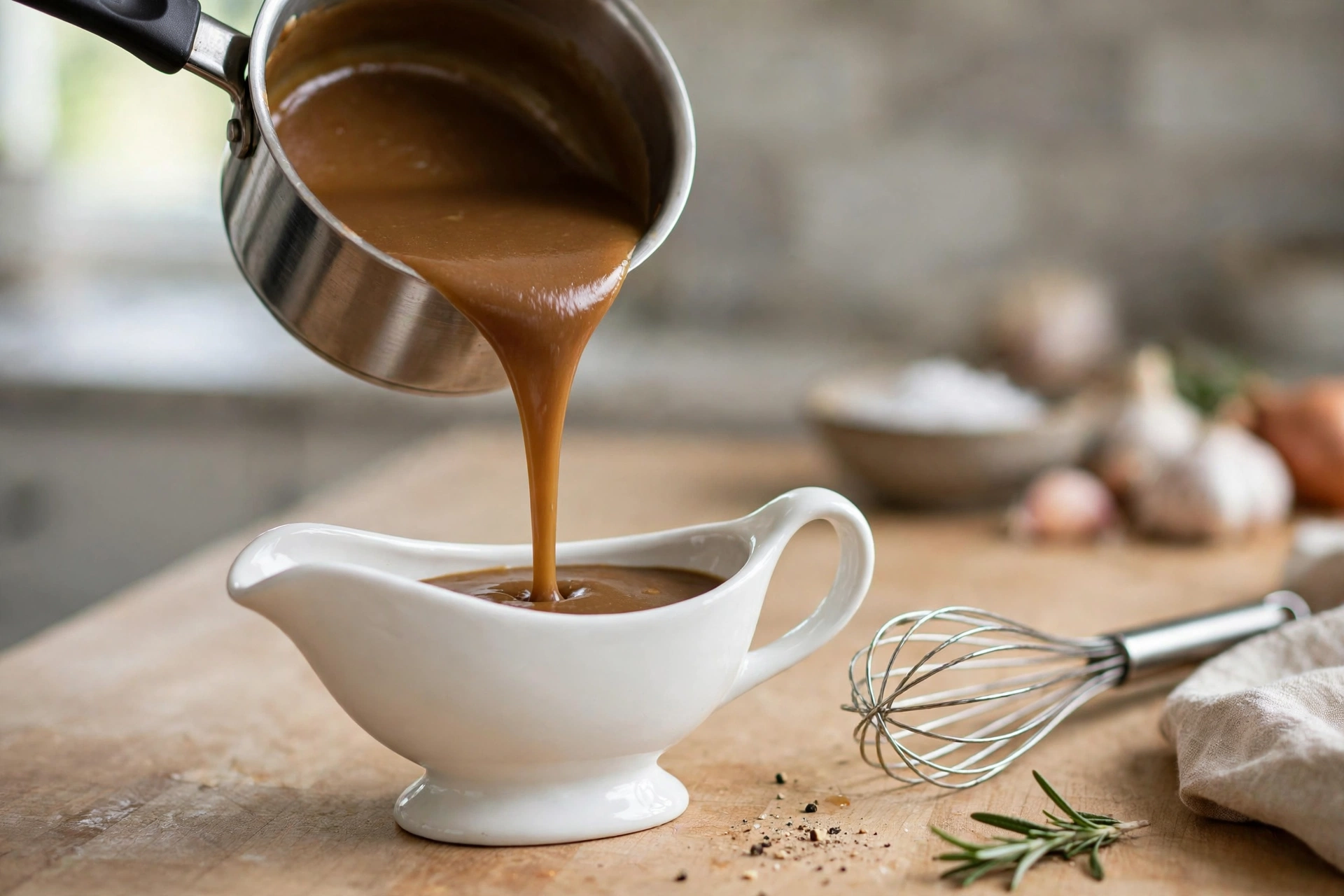
Two tablespoons of fat, two tablespoons of flour, one cup of liquid. That ratio — per cup, scaled as high as the crowd requires — is the entire architecture of smooth gravy, and lumps are what happens when one of its three parts gets skipped: the flour goes in raw, the liquid goes in cold, or the liquid goes in all at once.
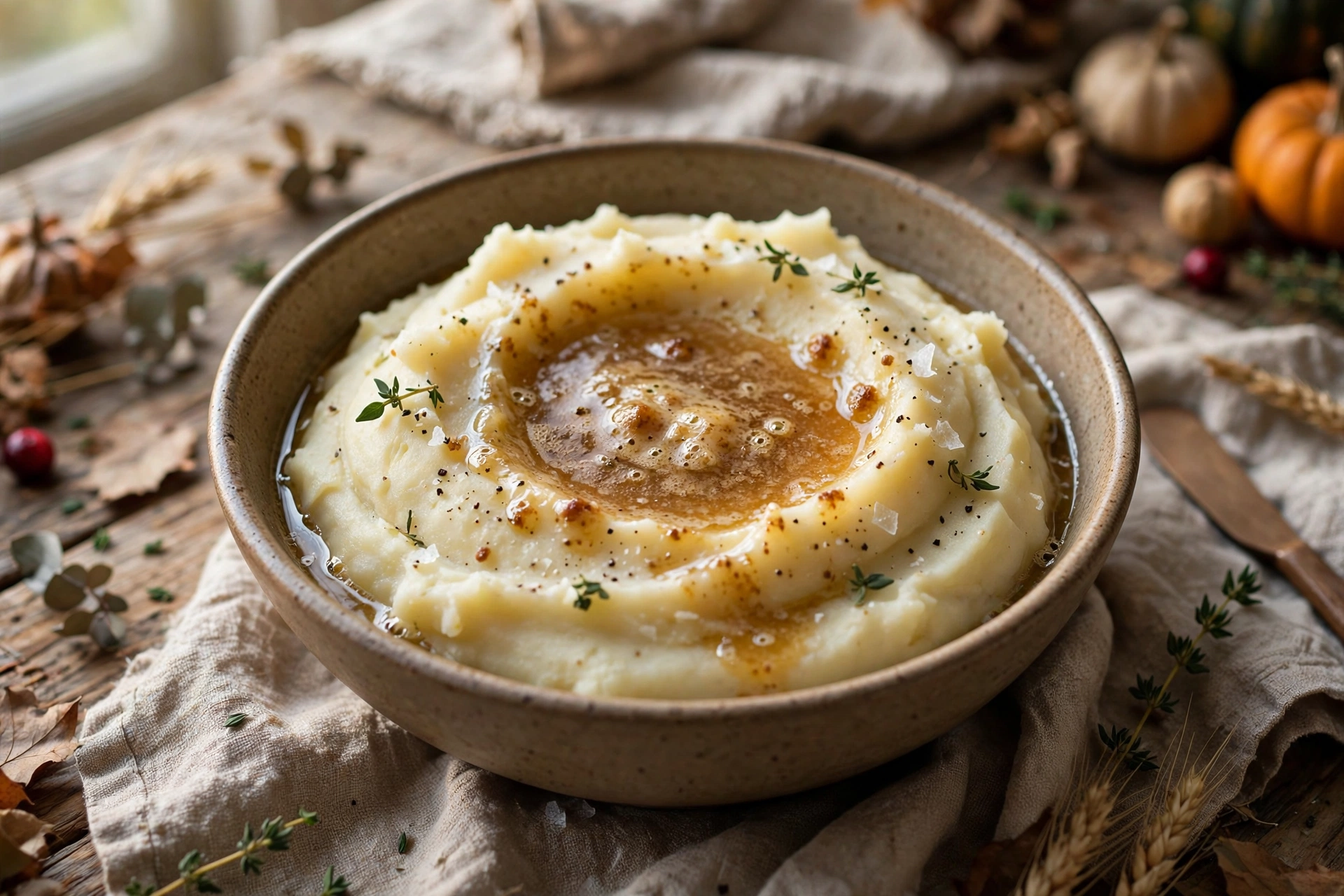
This is the technique to have settled before the turkey comes out of the oven, because gravy is made in the loudest ten minutes of the cooking day. It is also the natural partner to a bowl of brown butter mashed potatoes — the potatoes can hold warm while the gravy gets your full attention, which is all it asks.
Why lumps form
A lump is a pocket of dry flour sealed inside a shell of gelatinized starch. Hot liquid hits loose flour and cooks the outside of the clump instantly, and once that shell sets, no amount of whisking reaches the raw flour inside it. Every anti-lump rule in this post is really the same rule stated three ways: never let dry flour meet hot liquid unprotected.
The roux is the protection. Flour whisked into hot fat coats every granule, so when liquid arrives, the granules separate and disperse instead of clumping. Cooked for a minute or two, the roux also loses its raw, pasty taste — which is why flour stirred straight into simmering broth fails twice: lumps, and a gravy that tastes like paste underneath.
The method
1. Measure the fat. Pour the pan drippings into a measuring cup and let the fat rise. Spoon off 2 tablespoons of fat per cup of gravy you want, topping up with butter if the pan ran lean. The dark juices underneath count toward your liquid, and they carry most of the roast’s flavor, so none of them get left behind.
2. Cook the roux. Heat the fat in a saucepan or the roasting pan itself over medium heat, whisk in an equal measure of flour, and keep it moving for 1 to 2 minutes, until it bubbles and smells faintly toasty. For a darker gravy, keep cooking to the color of peanut butter — knowing a browned roux thickens a little less, so round the flour up slightly.
3. Add warm liquid, slowly. Warm your stock and pan juices first — warm liquid and warm roux are at similar temperatures, so the starch swells evenly instead of seizing. Pour in a slow stream, whisking constantly, and let each addition smooth out before the next. The mixture will look alarmingly thick and pasty at the first splash. That is correct. Keep whisking and adding, and it loosens into silk.
4. Simmer to finish. Once all the liquid is in, bring the gravy to a gentle simmer and hold it there 2 to 3 minutes, whisking now and then. The simmer finishes the thickening and cooks out the last of the flour taste. Gravy thickens further as it cools on the table, so pull it off the heat a shade thinner than you want to serve it.
Scaling the ratio
| Gravy wanted | Fat | Flour | Liquid |
|---|---|---|---|
| 2 cups | 4 tablespoons | ¼ cup | 2 cups |
| 4 cups | ½ cup | ½ cup | 4 cups |
| 6 cups | ¾ cup | ¾ cup | 6 cups |
Plan on roughly ⅓ to ½ cup of gravy per person. Six cups covers a holiday table of twelve with a little left for tomorrow’s sandwiches, which is the correct amount of leftover gravy.
Rescues, if it happens anyway
Lumps already in the pot: pour the gravy through a fine-mesh strainer into a clean pan, pressing the lumps against the mesh. This is not a defeat — professional kitchens strain gravy as a matter of routine. An immersion blender works too, but it can thin the texture and whip in air, so the strainer is the first move.
Too thin: whisk a teaspoon of flour into a tablespoon of cold water — a slurry, where the flour is already dispersed before it meets heat — and stir it into the simmering gravy a little at a time.
Too thick: whisk in warm stock a splash at a time. Cold stock works, but warm keeps the gravy at serving temperature.
Greasy on top: the fat was short-measured against the flour, or the gravy sat. Skim, then whisk hard as it returns to a simmer so the fat re-emulsifies.
The short version
Equal fat and flour, 2 tablespoons of each per cup of liquid. Cook the roux a minute, add warm liquid in a slow stream while whisking, simmer two minutes, and serve it a touch thinner than perfect. Lumps are not bad luck — they are dry flour meeting hot liquid — and now they have no way in.
Sources
Iowa State University Extension AnswerLine, “Gravy: Getting It Right” — 2 tablespoons fat, 2 tablespoons flour, and 1 cup liquid per cup of gravy; separate the fat from the drippings and build the roux from it.