Sandy soil and clay soil can sit at the exact same pH and need completely different amounts of lime. At pH 5.4 to 5.5, a sand takes 69 pounds per 1,000 square feet to reach pH 6.5, while a silty clay loam at that same reading takes 275 pounds.
That gap is why guessing by the bag goes wrong in both directions. Too little lime on a heavy soil barely moves the number, and too much on a sand can push pH past where your grass and vegetables want it.
Two ways of setting the rate are covered here. The first table works from the pH on your soil test and the texture of your soil. The second works from the exchangeable acidity figure a lab reports, for three different target pH levels.
Lime to reach pH 6.5, by starting pH and soil texture
Find your starting pH in the left column, then read across to your soil texture. Figures are pounds of lime per 1,000 square feet, with the original tons per acre in parentheses.
| Initial soil pH | Sands and gravels | Sandy loams | Loams and silt loams | Silty clay loams |
|---|---|---|---|---|
| 4.5 | 184 (4 tons/acre) | 321 (7 tons/acre) | 551 (12 tons/acre) | 689 (15 tons/acre) |
| 4.6 to 4.7 | 161 (3.5 tons/acre) | 298 (6.5 tons/acre) | 459 (10 tons/acre) | 597 (13 tons/acre) |
| 4.8 to 4.9 | 138 (3 tons/acre) | 275 (6 tons/acre) | 413 (9 tons/acre) | 574 (12.5 tons/acre) |
| 5.0 to 5.1 | 115 (2.5 tons/acre) | 252 (5.5 tons/acre) | 390 (8.5 tons/acre) | 551 (12 tons/acre) |
| 5.2 to 5.3 | 92 (2 tons/acre) | 207 (4.5 tons/acre) | 298 (6.5 tons/acre) | 367 (8 tons/acre) |
| 5.4 to 5.5 | 69 (1.5 tons/acre) | 138 (3 tons/acre) | 184 (4 tons/acre) | 275 (6 tons/acre) |
| 5.6 to 5.7 | 46 (1 ton/acre) | 92 (2 tons/acre) | 138 (3 tons/acre) | 252 (5.5 tons/acre) |
| 5.8 to 5.9 | 37 (0.8 tons/acre) | 83 (1.8 tons/acre) | 115 (2.5 tons/acre) | 161 (3.5 tons/acre) |
| 6.0 to 6.1 | 28 (0.6 tons/acre) | 69 (1.5 tons/acre) | 92 (2 tons/acre) | 138 (3 tons/acre) |
| 6.2 to 6.3 | 23 (0.5 tons/acre) | 46 (1 ton/acre) | 69 (1.5 tons/acre) | 115 (2.5 tons/acre) |
Source for every row in this table: Cornell University, Cornell Cooperative Extension (SoilNOW). Go easy on coarse sandy soils — they change pH fast, and overshooting is harder to undo than adding a second, smaller application later.
Lime by exchangeable acidity, for three target pH levels
A lab soil test that reports exchangeable acidity gives a more precise rate than pH alone, because two soils at the same pH can hold very different amounts of reserve acidity. Find the acidity figure on your report, then read across to the pH you are aiming for. Figures are pounds of lime, rated by calcium carbonate equivalent (CCE), per 1,000 square feet.
| Exchangeable acidity (meq/100 g) | Goal pH 6.0 | Goal pH 6.5 | Goal pH 7.0 | Source |
|---|---|---|---|---|
| 2.0 | 50 | 50 | 50 | Penn State AASL |
| 3.9 | 50 | 70 | 90 | Penn State AASL |
| 5.2 | 50 | 90 | 110 | Penn State AASL |
| 6.5 | 70 | 110 | 160 | Penn State AASL |
| 7.8 | 90 | 140 | 180 | Penn State AASL |
| 9.0 | 110 | 160 | 210 | Penn State AASL |
| 11.0 | 160 | 210 | 250 | Penn State AASL |
| 12.9 | 180 | 250 | 300 | Penn State AASL |
| 14.8 | 230 | 280 | 340 | Penn State AASL |
| 16.8 | 250 | 320 | 390 | Penn State AASL |
| 18.7 | 300 | 370 | 440 | Penn State AASL |
| 20.0 | 320 | 390 | 460 | Penn State AASL |
If the lime you buy is rated below 100% CCE, divide the table figure by its CCE percentage written as a decimal. A product at 80% CCE needs 110 divided by 0.80 — about 138 pounds — to do the work of 110 pounds at full strength.
The buffer pH method, in brief
Some lab reports set the rate from buffer pH instead. On that method, a buffer pH of 6.5 calls for 64 pounds of pure, fine calcium carbonate per 1,000 square feet to reach soil pH 6.5, and a buffer pH of 6.0 calls for 147 pounds to reach the same target.
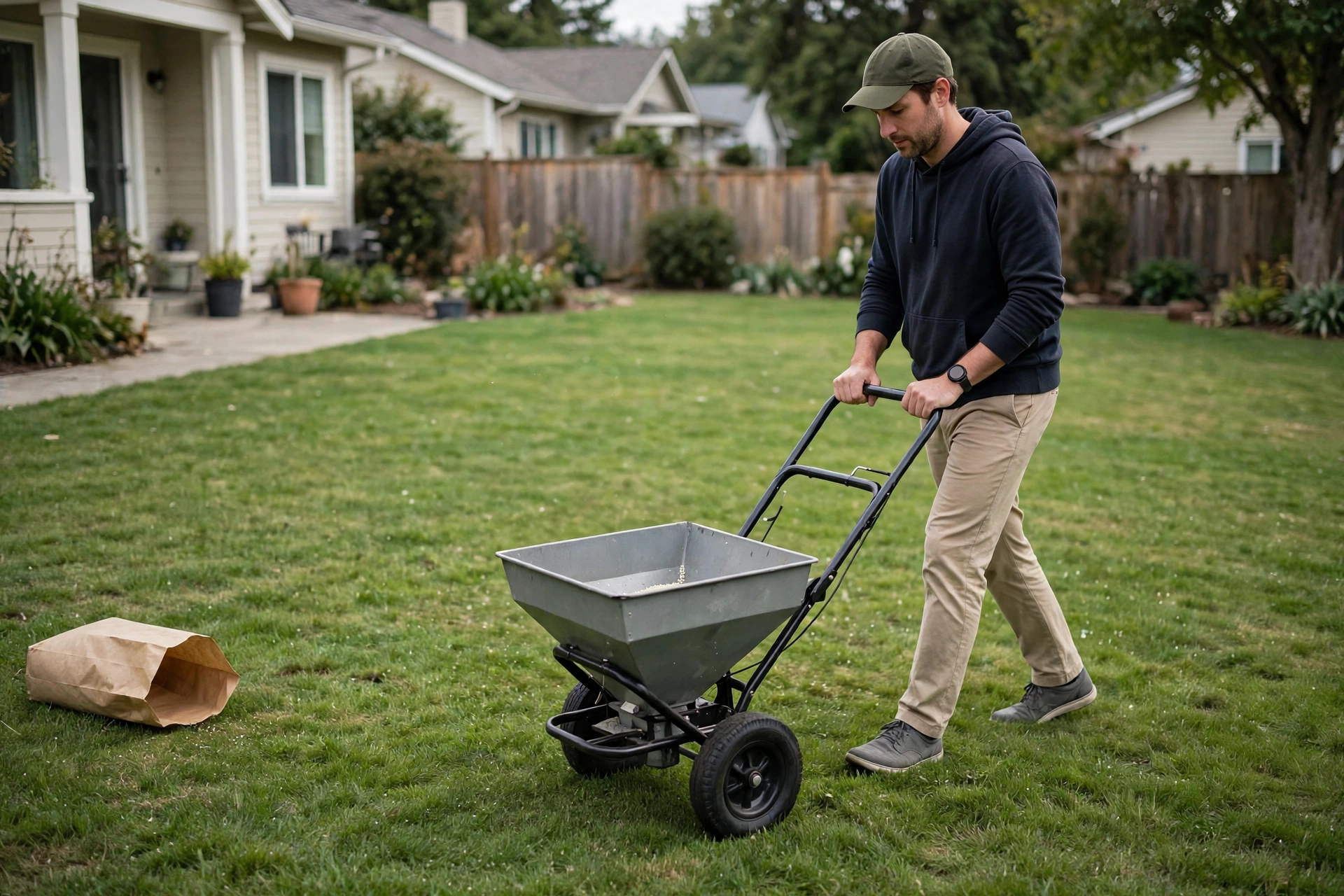
The pellets settle into the thatch with a faint grit underfoot, and then nothing visible happens for weeks. Lime works slowly, dissolving a little with each rain, so retest in six to twelve months rather than adding more because the lawn has not changed yet.
What this table does not decide
These tables give application rates only. Which pH your plants actually want comes first — see the preferred soil pH ranges reference table for vegetables, fruit, and turf — and a lab test with buffer pH or exchangeable acidity is the input that sets the rate properly.
Work from your own soil texture and your own lab number, not from a neighbor’s rate. The same starting pH can call for 69 pounds on one side of a street and 275 on the other, and the texture column is what tells you which side you are on.
Sources
Cornell University / Cornell Cooperative Extension, SoilNOW — pH (Table 1, lime to raise pH to 6.5): https://blogs.cornell.edu/soilnow/ph/ — fetched November 28, 2026.
Penn State Agricultural Analytical Services Laboratory — Lime Recommendations, Turf (Table 1): https://agsci.psu.edu/aasl/soil-testing/fertility/handbooks/turf/tables/lime-recommendations-turf — fetched November 28, 2026.
Iowa State University Extension — How to Change Your Soil’s pH (PM 1688, Table 14, buffer pH method): https://yardandgarden.extension.iastate.edu/how-to/how-change-your-soils-ph — fetched November 28, 2026.