A core aerator removes soil from the ground. A spike aerator pushes soil aside to make a hole, and the soil it displaces has to go somewhere — in clay, it packs into the wall of that hole.
That single difference decides the job on clay soil. Clay particles are flat and fine, and they stack tightly under foot traffic and mower weight until air and water stop moving through. Removing soil creates room in that stack. Pushing soil sideways makes the stack denser around every hole.
For compacted clay, the core aerator is the tool that fixes the problem, and the spike aerator is the cheaper tool that can leave the lawn worse than it found it. The machine picks in our best core aerators for compacted soil roundup all work on that removal principle.
What a Core Aerator Actually Removes
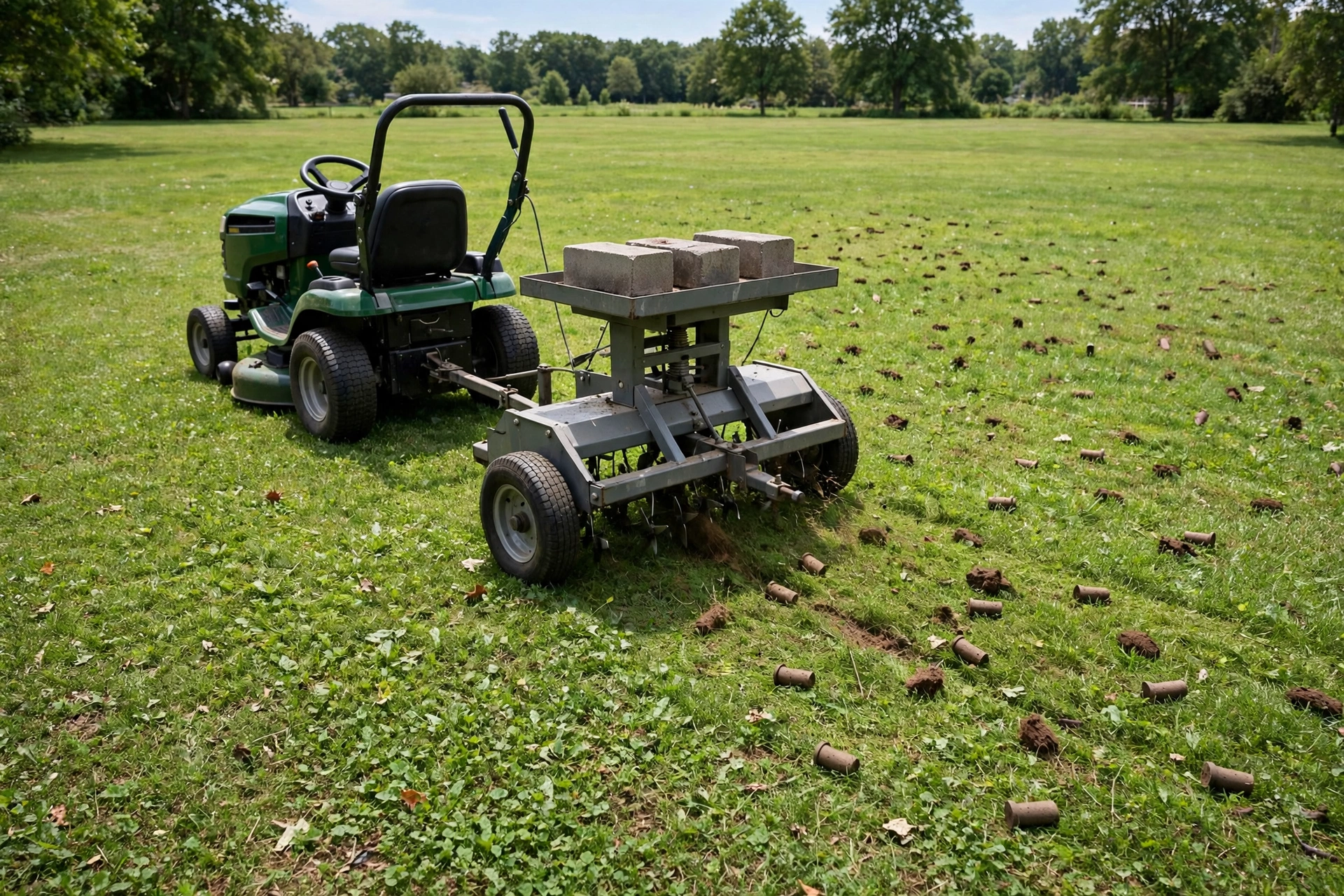
A core aerator runs hollow tines into the lawn and pulls out plugs of soil, thatch, and root. Kansas State Extension puts the working spec at plugs about 3/4 inch in diameter and 2 to 3 inches deep, spaced about 3 inches apart.
Each plug is soil that no longer occupies space underground. The hole stays open, the surrounding clay can shift slightly into it, and water, air, and fertilizer get a channel down to the roots instead of sheeting off the surface.
The plugs sit on the lawn afterward, which looks messy for a week or two. Leave them. Rain and mowing break them down, and the soil and microbes in them filter back into the holes.
What a Spike Aerator Actually Does
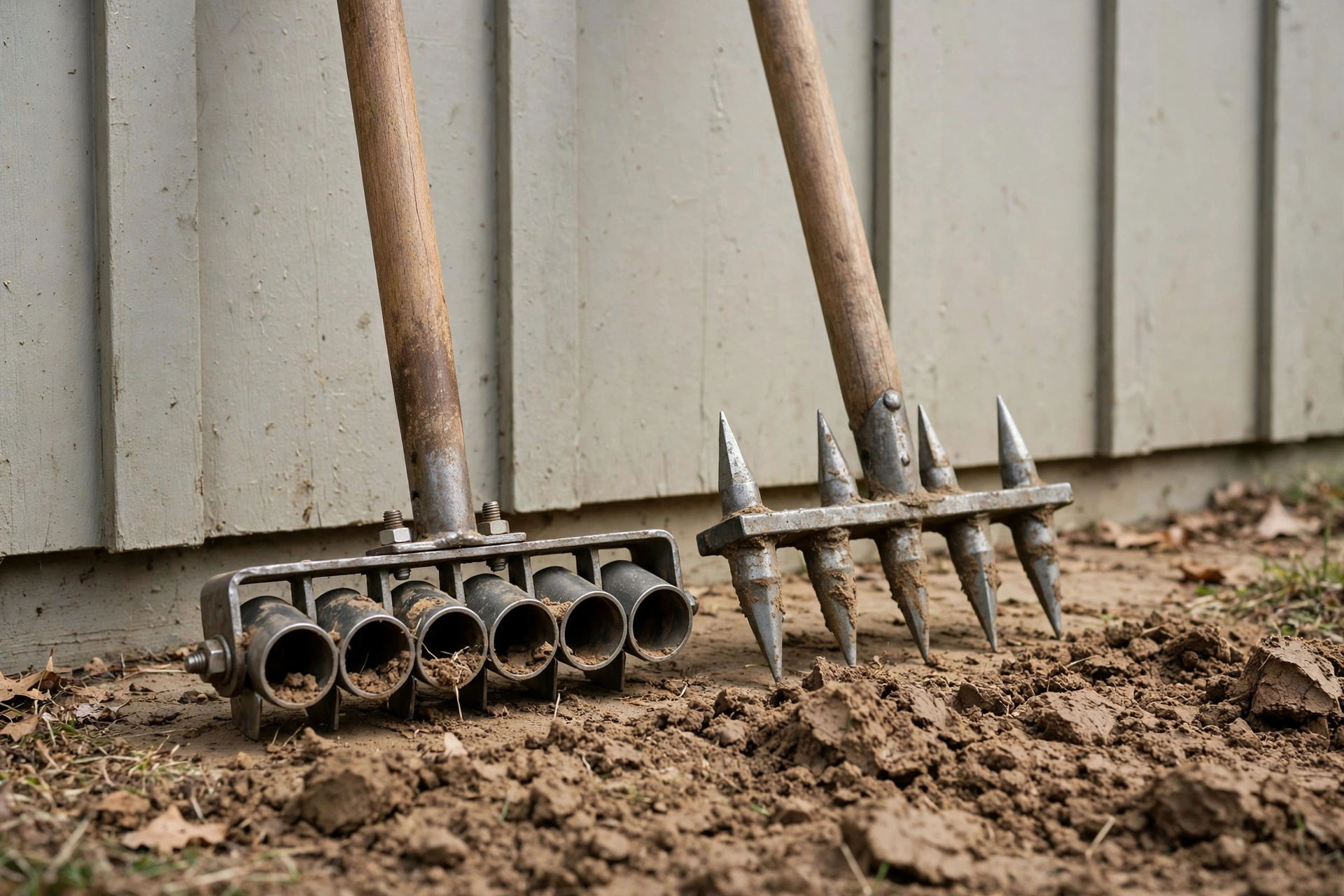
A spike aerator drives solid tines, spikes, or a star wheel into the ground and pulls them back out. No soil comes out with them, so the volume of the hole comes entirely from soil compressed sideways and downward.
On loose or sandy soil, that compression is minor, because sand grains roll past each other and settle back. On clay, the compressed wall stays compressed — Nebraska Extension warns that spiking can increase compaction between the holes in clay soil.
The hole also seals faster in clay. A spike dragged through moist clay smears the wall smooth, and a smeared wall passes water about as slowly as the unbroken surface did.
Core vs. Spike on Clay, Side by Side
| Factor | Core (plug) aerator | Spike aerator |
|---|---|---|
| How the hole is made | Hollow tines pull out plugs 3/4 in. wide, 2–3 in. deep | Solid spikes push soil aside; nothing is removed |
| Effect on clay compaction | Relieves it — open holes give clay room to expand | Can worsen it — soil packs tighter around each hole |
| Hole spacing that works | About 3 in. apart, usually 2 or more passes | Closer spacing just compresses more soil per square foot |
| Best soil | Clay and compacted loam | Sand and loose, friable soil |
| Overseeding | Seed falls into open holes with direct soil contact | Light seed-to-soil contact on loose soil only |
| Typical cost | Rent about $79 for 4 hours or $113 per day | Push and manual models commonly $40–$80 to buy |
Why Clay Punishes the Spike
Compaction is measured as bulk density — how much dry soil is packed into a given volume. Clay starts denser than sand or loam because its flat particles nest together, and every pass of a mower or a pair of boots presses the nesting tighter.
Once the pore space is gone, roots stop pushing down and spread sideways near the surface, where summer heat hits them first. A shallow-rooted clay lawn thins in the same worn paths every year, and those paths are exactly where compaction is worst.
Core aeration lowers the density by subtraction, one plug at a time. Spike aeration raises the density at the hole wall by addition of pressure. On clay, the arithmetic only runs one way.
The field test is a screwdriver pushed into moist soil by hand. It should slide in several inches with steady palm pressure. If it stops at an inch or two, the lawn is compacted enough that spiking it is wasted work.
Depth, Spacing, and Moisture for a Core Pass
Depth. Set the machine to pull plugs 2 to 3 inches long. Plugs under an inch mean the tines are skating on dry ground or the machine needs more weight, and shallow holes do not reach the compacted layer.
Spacing. Holes about 3 inches apart is the extension target, and a single pass from most rental machines lands wider than that. Run a second pass at right angles to the first, and give paths, gate areas, and play spots the extra pass first.
Moisture. Aerate when the soil is moist, not wet — a day or two after a soaking rain or a deep watering. Dry clay bounces tines off the surface, and wet clay smears, clogs hollow tines, and ruts under a heavy machine.
The full sequence, from mowing height to watering afterward, is in our guide on how to aerate a compacted lawn.
When a Spike Aerator Is Acceptable
Sandy soil. Sand does not hold the compression a spike creates, so the holes stay open long enough to help water in. Spiking a sandy lawn that is only lightly compacted is reasonable maintenance.
Light overseeding contact. A spike pass before spreading seed on loose soil knocks some seed off the blades and into shallow slots. That is a seed-placement job, not compaction relief, and it works only because the soil was not compacted to begin with.
Small worn patches. A hand spike tool on a square yard of loose soil by a gate is faster than renting a machine. The same patch in clay gets a manual core tool instead, for the same reason the big job does.
Aerator shoes fall on the spike side of this line, and they fail on clay for the same compression reason — the head-to-head is in aerator shoes vs. core aerator.
Rent or Buy: The Cost Math
A walk-behind core aerator rents for about $79 for four hours and $113 for a full day at Home Depot, and four hours covers a typical suburban lawn with two passes. Buying a comparable walk-behind machine runs $500 to $1,500, which pays back only across many years of annual use.
Clay lawns with real traffic usually need aerating once a year, and heavy-use clay can need it twice. At one rental a year, renting wins for a decade or more. At two rentals a year on a large lawn, a tow-behind core aerator behind a mower or tractor starts to close the gap — the current picks are compared in our best tow-behind lawn aerators roundup.
Spike tools look cheaper because there is less machine to buy. On clay, the low price buys holes that close fast and soil that is denser at every hole wall, so the comparison is not $113 against $200 — it is a treatment that works against one that has to be redone with the rental anyway.
The Verdict for Clay Soil
Rent the core aerator. Set it for 2- to 3-inch plugs, run two passes at right angles while the soil is moist, and leave the plugs where they fall.
Keep the spike aerator for sandy soil and light seed contact, and leave it in the shed when the lawn is clay. On clay, every spike hole is soil packed tighter than before the pass started.