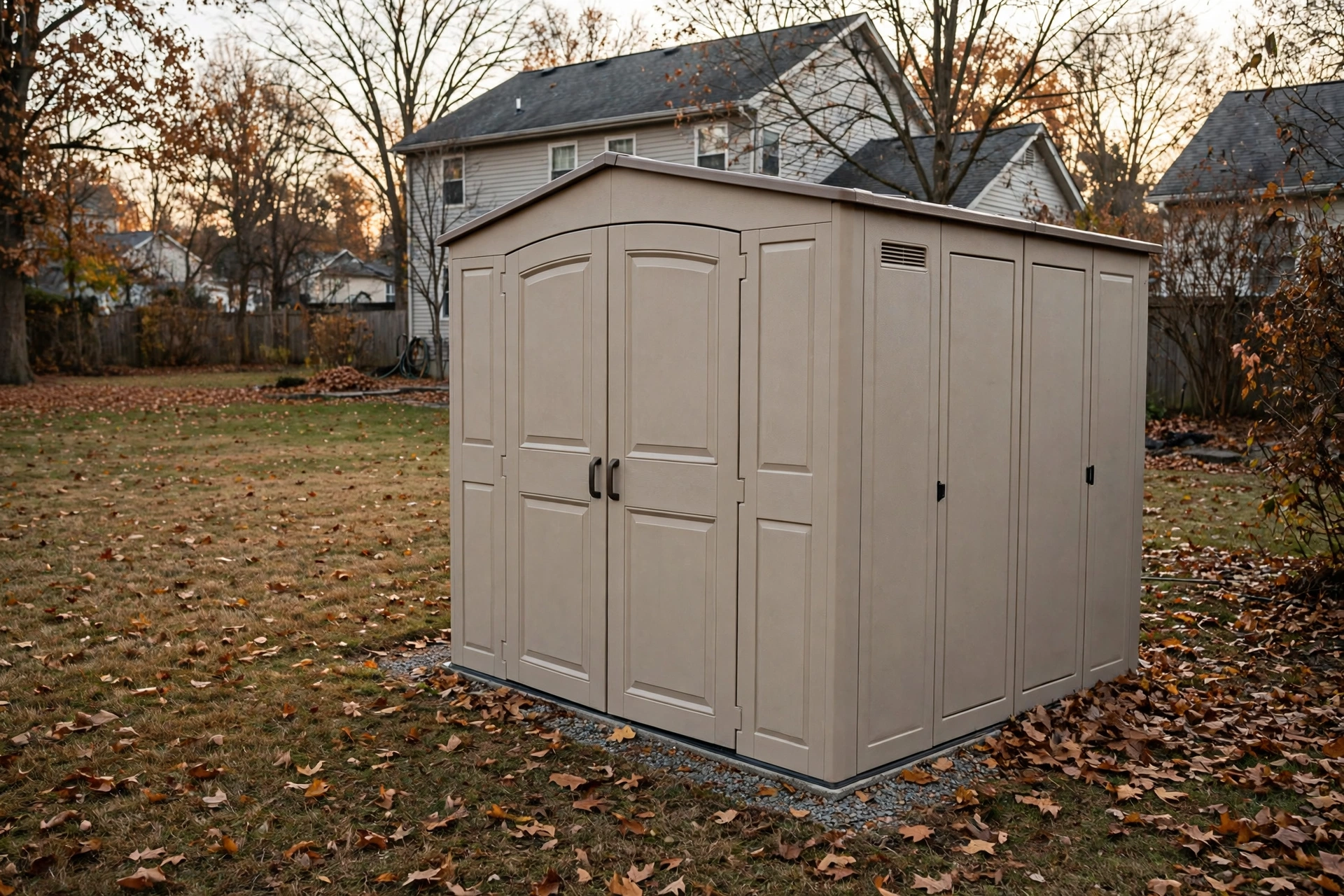
10 to 15 years. That is a realistic working life for a well-built resin storage shed on a decent base, and sheds that are shaded, anchored, and kept dry regularly push past it.
The shed itself is rarely the cheapest part of the setup once you count the pad, the anchoring, and a weekend of assembly, so the difference between a shed that fades at year seven and one still square at year fifteen is worth real money. What decides it is mostly settled in the first month: where the shed sits and what it sits on.
The warranty is the honest floor
No manufacturer publishes a lifespan, because lifespan depends on the yard. What they publish is a warranty, and the warranty length is the clearest signal of how long the maker expects the panels to hold up.
The walk-in sheds from the three big resin brands all carry a 10-year limited warranty: Lifetime’s steel-reinforced HDPE sheds, Suncast’s multi-wall resin sheds, and Keter’s steel-reinforced walk-in models. Ten years of coverage on a product the maker knows will sit outside in all weather is a confident number.
Smaller horizontal storage boxes carry shorter terms, and that gap is informative. Lifetime’s horizontal storage shed carries a 5-year limited warranty, and Keter’s Store-It-Out Prime carries 2 years. The small boxes are built lighter, and their warranties say so.
| Shed class | Construction | Warranty | Realistic life |
|---|---|---|---|
| Lifetime walk-in | Dual-wall HDPE, steel-reinforced | 10-year limited | 12–20 years, sited well |
| Suncast walk-in | Multi-wall resin, metal-reinforced | 10-year limited | 10–15 years, sited well |
| Keter walk-in | Polypropylene resin, steel-reinforced | 10-year limited | 10–15 years, sited well |
| Horizontal storage box | Single- or double-wall resin, lighter panels | 2–5 years, varies by brand | 5–10 years |
Two warranty conditions matter more than the headline number. Suncast requires registration within 90 days and a proper level foundation for coverage, and every brand excludes storm damage. A shed that was never anchored and blows over in year three is not a warranty claim, whatever the term says.
What the panels are, and why it matters
Resin is the shelf label for several different plastics. Lifetime molds its sheds from high-density polyethylene (HDPE), Keter uses polypropylene, and Suncast uses its own multi-wall resin panels, with steel reinforcement in the walls and roof of the walk-in models from all three.
None of these plastics rot, rust, or need paint, which removes the three failures that end most wood and metal sheds. What plastic does instead is degrade slowly under ultraviolet light, flex under load, and grow brittle with age and cold — a slower, more predictable decline.
Double-wall panels hold up better than single-wall ones because the inner wall braces the outer one against dents and oil-canning in heat. When you compare models in our roundup of the best resin storage sheds for backyards, mowers, and garden tools, wall construction is the spec that tracks lifespan most closely.
Four things that shorten a resin shed’s life
Sun on the same wall, all day
UV protection is blended into the panels, but it is a finite defense. A south- or west-facing wall in full sun in a hot climate chalks, fades, and turns brittle years ahead of a shaded one, and dark colors absorb more heat on top of the UV load.
Heat works on the structure, too. Panels expand on a hot afternoon, and a shed assembled tight in cool weather can bow or pop a seam in August if it has no room to move.
A base that moves
Resin panels lock together in alignment, so a base that settles unevenly racks the whole building. Doors drift out of square first — the early warning — and then seams open, roofs leak at the ridge, and latches stop meeting.
A level concrete slab, paver pad, or compacted gravel base with a frame is the single best lifespan purchase you can make. Getting the size and site right before you build is covered in what size storage shed you need.
Wind the shed was never anchored against
A resin shed is light for its size, and an unanchored one can shift, rack, or lift in a storm gust. Every shifted panel stresses the joints it locks into, so one bad storm can take years off a shed even when it stays upright. Anchoring is a one-time job with a permanent payoff — see how to anchor a resin storage shed against wind.
Water standing inside
The panels shrug off moisture, but standing water on the floor corrodes everything stored on it and keeps the interior humid enough to grow mold on cardboard, fabric, and tool handles. A shed that stays wet inside ages its contents even when the shell is fine; keeping a resin shed dry is mostly ventilation and a base that drains.
What stretches the years
Afternoon shade is worth more than any coating. A shed under a tree line or on the north side of a fence keeps its panels cooler and its UV exposure lower, and it gives up nothing except a little convenience in placement.
An annual wash with a garden hose and mild soap removes the grit and mildew film that hold moisture against the panels. Skip the pressure washer at close range, which can force water through seams that rain never reaches.
Keep the roof clear. Wet leaves sitting on a resin roof hold moisture against the panels and add weight the roof was not given, and snow left to accumulate does the same job faster — winter care for resin sheds covers the loads involved.
Finally, fix small failures while they are small. A hinge pin, latch, or single cracked panel is a cheap part from the manufacturer in year four; left alone, each one lets water and wind work on the joints around it.
When replacement beats repair
Replace the shed when the failure is in the structure rather than a part: multiple panels chalked brittle enough to crack under hand pressure, a roof that sags between trusses after the snow is off, or a floor cracked across a traffic path. Those are the panels themselves giving out, and no hardware restores them.
Repair wins when the damage is local and the rest of the building is still sound — one storm-torn door, a failed latch, a single split panel on a shaded wall. Manufacturers sell individual replacement panels and hardware for current models, which is one more reason to buy a brand that keeps parts available.
Do the arithmetic against the warranty. If a shed is inside its 10-year term and a panel has failed without storm or impact damage, file the claim before you buy the part.
Buy the walk-in with the 10-year warranty, put it on a level pad in partial shade, anchor it the weekend you build it, and wash it once a year. That combination is what turns a resin shed from a ten-year purchase into a fifteen- or twenty-year one.