Landscape & Leisure is reader-supported. When you buy through links on our site, including Botanical Interests seed links, we may earn a commission at no extra cost to you. Prices change, so click through to confirm current pricing.
A zinnia packet costs less than a coffee, and by August it can fill a vase every week. The only real decision is which packet, because one grows a tall plant with palm-sized blooms and the next grows a neat little edging plant with pom-poms the size of a marble. Get the match right and the cutting lasts until frost.
The seven varieties below cover the whole range: giants for cutting, a workhorse that blooms harder the more you cut it, a dwarf for pots, and a red that costs less than a stamp. For how to grow whichever you pick, see our guide to sowing, spacing, and deadheading. For how zinnias stack up against the other two easy annuals, see our zinnias vs. cosmos vs. marigolds comparison. If you are building a cutting garden more broadly, our best cut flowers roundup puts zinnias in good company.
Tall or Short? Pick the Plant Before the Bloom
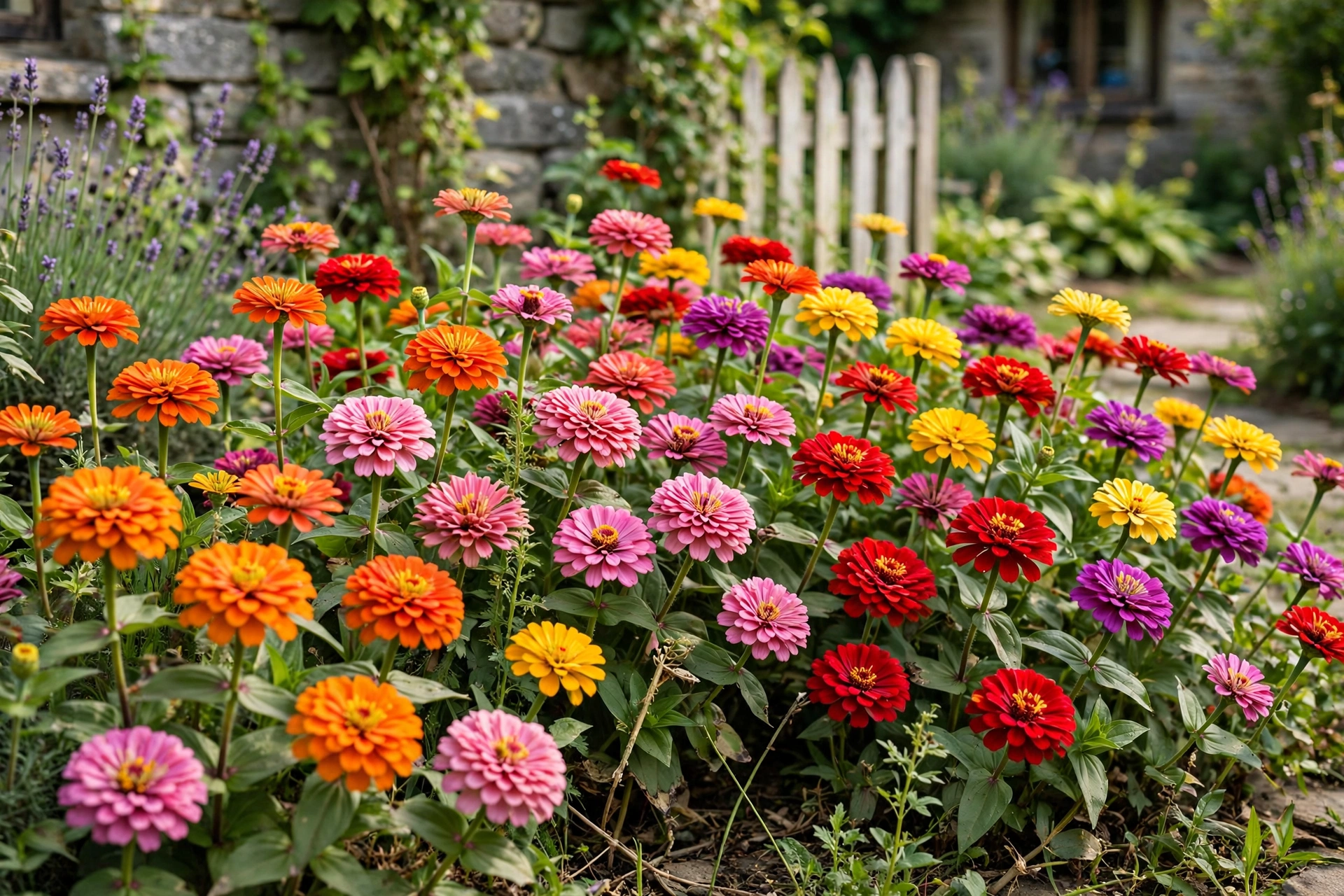
Before the varieties, one split decides almost everything. Tall zinnias grow past two feet with long, sturdy stems made for the vase. Short types stay in the 12- to 24-inch range and belong at the front of a bed or in a pot. The photo below shows the difference better than any description: one giant double bloom on a tall stem, and beside it a small single bloom on a much shorter plant.

Best Overall: California Giants Blend
California Giants is the zinnia most people picture when they hear the word, and it has earned that place over a century — Botanical Interests has sold it since 1926. The blend grows tall, past two feet, and carries large 4- to 6-inch flowers in red, pink, purple, and white. Each flower lasts a very long time on the plant and in the vase, and the plants keep blooming harder the more you cut. Gardeners rate it 4.8 from 76 reviews, the highest rating of any zinnia in the collection.
The trade-off is that a blend gives you no control over the mix. You cannot order a bed of only the reds or only the pinks. If you want one color in one spot, buy a single-color variety instead.
Pros: 4- to 6-inch blooms in four colors; the highest gardener rating in the collection; blooms harder the more you cut; deer resistant.
Cons: a blend, so you cannot choose which color grows where; tall plants need their spacing.
California Giants Blend Zinnia Seeds
Big 4- to 6-inch blooms in four colors, sold since 1926, and the highest gardener rating of any zinnia here.
Best for Cutting: Cut and Come Again
Cut and Come Again does exactly what the name promises. Cut the 2- to 2½-inch blooms for bouquets and the plant produces more, continuously, until fall frost. The flowers are old-fashioned and cheerful, the plants are heat-loving, and the blooms are edible — a pretty garnish for salads and cold drinks. Gardeners rate it 4.7 from 78 reviews, the largest review count of any zinnia in the collection.
The trade-off is bloom size. At 2 to 2½ inches, these are not statement flowers. They keep a vase full week after week, even if no single bloom stops a room.
Pros: blooms continuously until frost; the most-reviewed zinnia here; heat-loving and deer resistant; edible blooms.
Cons: smaller blooms than the giants; mixed colors, so no single-color control.
Cut and Come Again Zinnia Seeds
Cut it and it blooms again — 2- to 2½-inch flowers that keep a vase full until frost.
Biggest Blooms: Giant Purple
Giant Purple is the single-color giant to buy when you want one color and you want it big. The blooms run 4 to 6 inches across in a deep, saturated purple, carried on long, sturdy stems built for bouquets. The plants grow tall, past two feet, and the variety is heat tolerant and resistant to powdery mildew — the disease that usually ends zinnia season early. Gardeners rate it 4.3 from 29 reviews.
The trade-off is that purple is the whole palette. This is a one-note plant, and a bed of it reads as a block of purple rather than a mix. Pair it with a blend or a second color if you want variety.
Pros: 4- to 6-inch purple blooms; long, sturdy cutting stems; powdery mildew resistant.
Cons: one color only; needs full spacing or the mildew resistance does not save it.
Giant Purple Zinnia Seeds
Four- to six-inch purple blooms on long, sturdy stems — with powdery mildew resistance built in.
Best for Small Spaces: Thumbelina
Thumbelina is the zinnia for gardeners without a big garden. It stays 12 to 24 inches tall and covers itself in 1- to 1½-inch blooms in pink, red, yellow, and orange — small flowers, but so many of them that the plant reads as a mound of color. It won the All-America Selections award back in 1963 and it still wins the small-space job today: pots, window boxes, and the front of a bed. Gardeners rate it 4.4 from 41 reviews.
The trade-off is that the flowers are too small for a statement vase. Thumbelina is a garden plant first and a cut flower second — lovely in a small jar on a table, lost in a big bouquet.
Pros: just 1 to 2 feet tall — fits pots and small beds; a 1963 All-America Selections winner; good for containers; deer resistant.
Cons: small 1- to 1½-inch blooms; not a cutting-garden mainstay.
Thumbelina Zinnia Seeds
A 1963 award winner that stays 1 to 2 feet tall — zinnias for a pot, a window box, or a small bed.
Best Small Blooms: Lilliput
Lilliput plays a trick worth knowing about: the flowers are tiny, 1 to 1½ inches, but the plants are tall, past two feet, with long stems. That makes it the edging zinnia that still cuts — small pompon blooms in salmon, purple, rose, orange, and scarlet, on stems long enough for a bouquet. Butterflies love it, bees follow, and the flowers keep coming all summer. Gardeners rate it 4.6 from 8 reviews, a small sample but a happy one.
The trade-off is the review count. Eight reviews is the thinnest track record in this roundup, so the 4.6 rating carries less weight than the 76 behind California Giants. The plant itself is a proven type — small-flowered zinnias have been garden staples for decades.
Pros: small pompon blooms on long cutting stems; five bright colors; a butterfly magnet; deer resistant.
Cons: only 8 gardener reviews so far; small blooms need massing to read in the garden.
Lilliput Zinnia Seeds
Tiny 1- to 1½-inch pompons on tall, long-stemmed plants — small blooms that still cut for a bouquet.
Best Statement Color: Queeny Lime Orange
Queeny Lime Orange is the variety for a gardener who wants one flower that nobody walks past. The double blooms run about 3 inches wide, deep coral at the outer edge fading to peach and then lime toward the center — a color combination no other zinnia in the collection has. The plants grow tall, past two feet, with sturdy stems that hold the blooms up in a bouquet. Gardeners rate it 4.1 from 17 reviews.
The trade-off is the price. At $6.49 a packet, it is among the priciest zinnias in this roundup, and the rating is the lowest of the picks here. You are paying for a color nobody else grows, not for the surest performer.
Pros: a coral-peach-lime color no other zinnia has; 3-inch double blooms on long stems; tall plants for the back of a bed.
Cons: one of the priciest packets here; the lowest gardener rating of the picks.
Queeny Lime Orange Zinnia Seeds
Coral fading to peach and lime — a color combination no other zinnia in the collection offers.
Best Budget Red: Meteor
Meteor is the cheapest way into a tall red zinnia. At $2.69 a packet it grows past two feet and carries large 4- to 5-inch scarlet blooms, semi-double to double, on long, strong stems that a florist would be happy with. The color is a deep, velvety red, and the plants bloom from summer to frost. It is heat tolerant and pulls in butterflies and pollinators.
The trade-off is that red is all you get. For $2.69, that is a fair bet.
Pros: large 4- to 5-inch scarlet blooms for $2.69; long, strong cutting stems; heat tolerant.
Cons: one color only.
Meteor Zinnia Seeds
Four- to five-inch scarlet blooms on long, strong stems — the cheapest tall red zinnia here.
The One to Skip: Benary’s Giant Blend
Benary’s Giant Blend would have belonged in this roundup on merit — big dahlia-type blooms in a full color range, and a 4.7 gardener rating from 27 reviews. But both packet sizes are sold out right now, and a variety you cannot buy is not a recommendation. The same goes for Señora, the salmon-pink double, also sold out. Check back later in the season, or plant California Giants above — it covers the same big-bloom ground and it is in stock.
Side-by-Side Comparison
| Variety | Bloom size | Colors | Best for | Rating |
|---|---|---|---|---|
| California Giants Blend | 4–6 in | Red, pink, purple, white | Cutting, mass planting | 4.8 (76) |
| Cut and Come Again | 2–2½ in | Mixed | Cutting, continuous bloom | 4.7 (78) |
| Giant Purple | 4–6 in | Purple | Big single-color blooms | 4.3 (29) |
| Thumbelina | 1–1½ in | Pink, red, yellow, orange | Pots, small beds, edging | 4.4 (41) |
| Lilliput | 1–1½ in | Salmon, purple, rose, orange, scarlet | Edging that still cuts | 4.6 (8) |
| Queeny Lime Orange | 3 in | Coral, peach, lime | Statement color, bouquets | 4.1 (17) |
| Meteor | 4–5 in | Scarlet red | Budget red, cutting | — |
Final Thoughts
Plant California Giants first. It is the zinnia most likely to make the summer feel like a summer, and the one your neighbors will ask about. Then add Cut and Come Again for the vase — it is the plant that keeps producing after every cutting — and Thumbelina if your garden is a patio. Read our sowing, spacing, and deadheading guide before you sow, because the one mistake that ruins a zinnia season is planting into cold soil and finding out in June.