A covered patio on a cool evening is exactly where a heater earns its keep. It is also exactly where a heater can get you into trouble, because a roof changes what the heat and the exhaust do after they leave the burner.
The short answer: it depends on the heater and the roof. An open-slatted pergola and a solid roof are not the same situation, and a freestanding propane heater and a wall-mounted electric heater are not the same appliance. Get those two distinctions right and the rest follows.
Why the roof changes everything
Heat rises. Out in the open, it disperses. Under a roof, it collects against whatever is overhead — wood beams, a vinyl ceiling, a fabric canopy — and anything combustible sitting in that hot zone can scorch, warp, or, in the worst case, catch fire. That is why every patio heater manual prints minimum clearances to combustibles, and why those numbers matter more under a roof than they do on an open patio.
The second problem is exhaust. A propane or natural gas heater burns fuel, and burning fuel produces carbon monoxide. Outdoors, wind carries it away. Under a solid roof, especially one with walls, curtains, or drop-down shades closing the sides, exhaust can pool overhead instead of dispersing. Freestanding fuel-burning heaters are outdoor appliances for this reason, and “outdoor” means genuinely ventilated, not merely outside the house walls.
What your heater’s manual actually requires
There is no single clearance number, because manuals differ by model. Many freestanding propane mushroom heaters specify about 3 feet of clearance from the sides and 2 feet from the top to any combustible material. Other models require more — one common manual calls for 42 inches at the top, front, and sides, and another specifies 3 feet 7 inches of clearance to combustibles overall.
That spread is the point. Do not borrow a number from an article, including this one, and apply it to your heater. Open your own manual, find its clearance diagram, and measure from the top of the reflector and the sides of the burner to the nearest beam, ceiling, curtain, or hanging plant. If you no longer have the manual, the manufacturer posts most of them online by model number.
Two more manual rules show up in nearly every fuel-burning heater’s instructions: never use the heater in an enclosed or unventilated space, and never store or use gasoline, solvents, or other flammable vapors near it. Local fire codes can add their own requirements on top of the manual, and where they conflict, the stricter rule wins.
Freestanding propane under a pergola vs. a solid roof
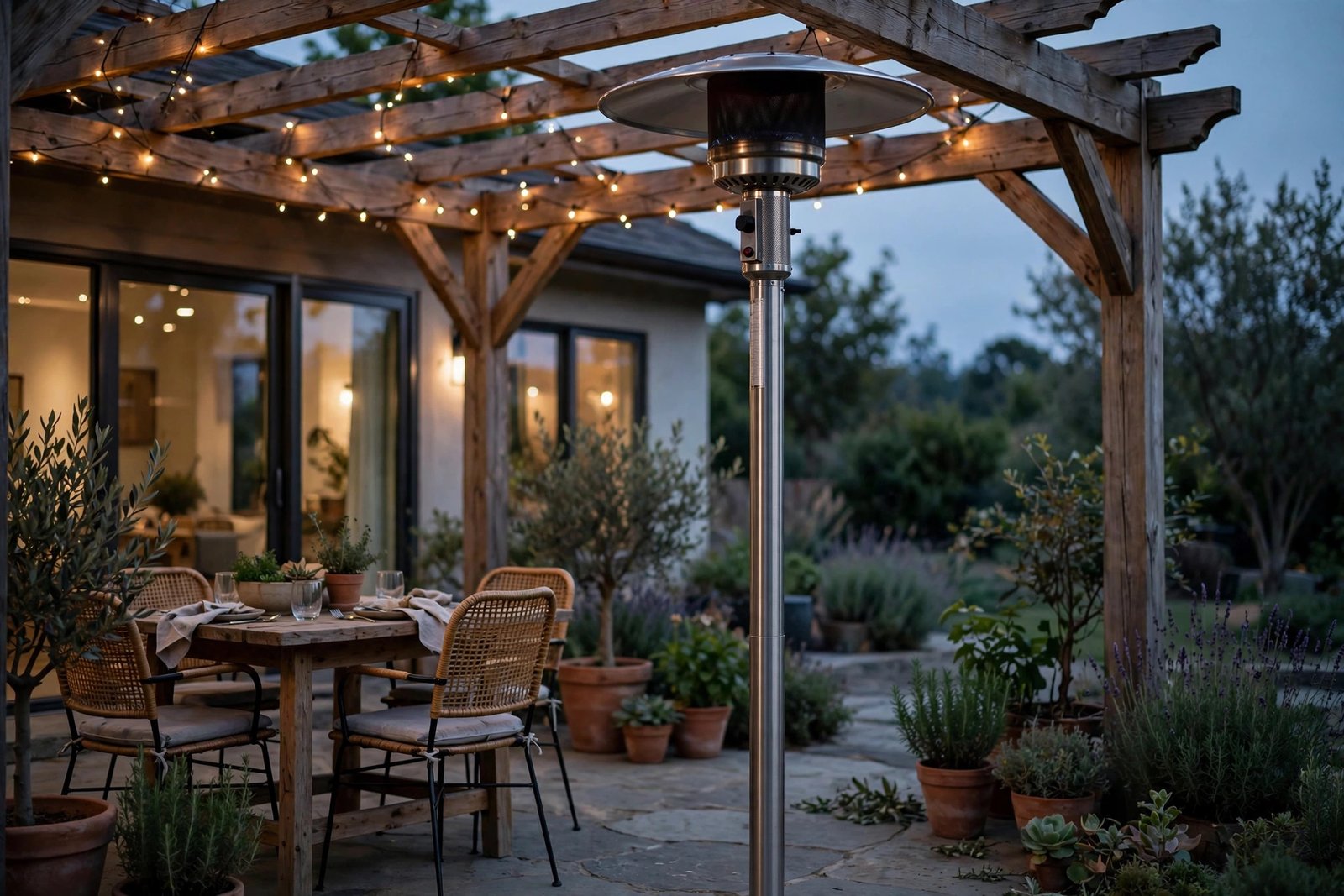
An open pergola — slatted top, open sides — is the friendlier case. Heat and exhaust escape through the slats, and the structure stays ventilated. A freestanding propane heater can work there provided the manual’s clearances are met with room to spare, the reflector is not tucked up against a beam, and the sides stay open while the heater runs. Closing the sides with curtains or drop shades turns that pergola into something closer to a room, and the answer changes with it.
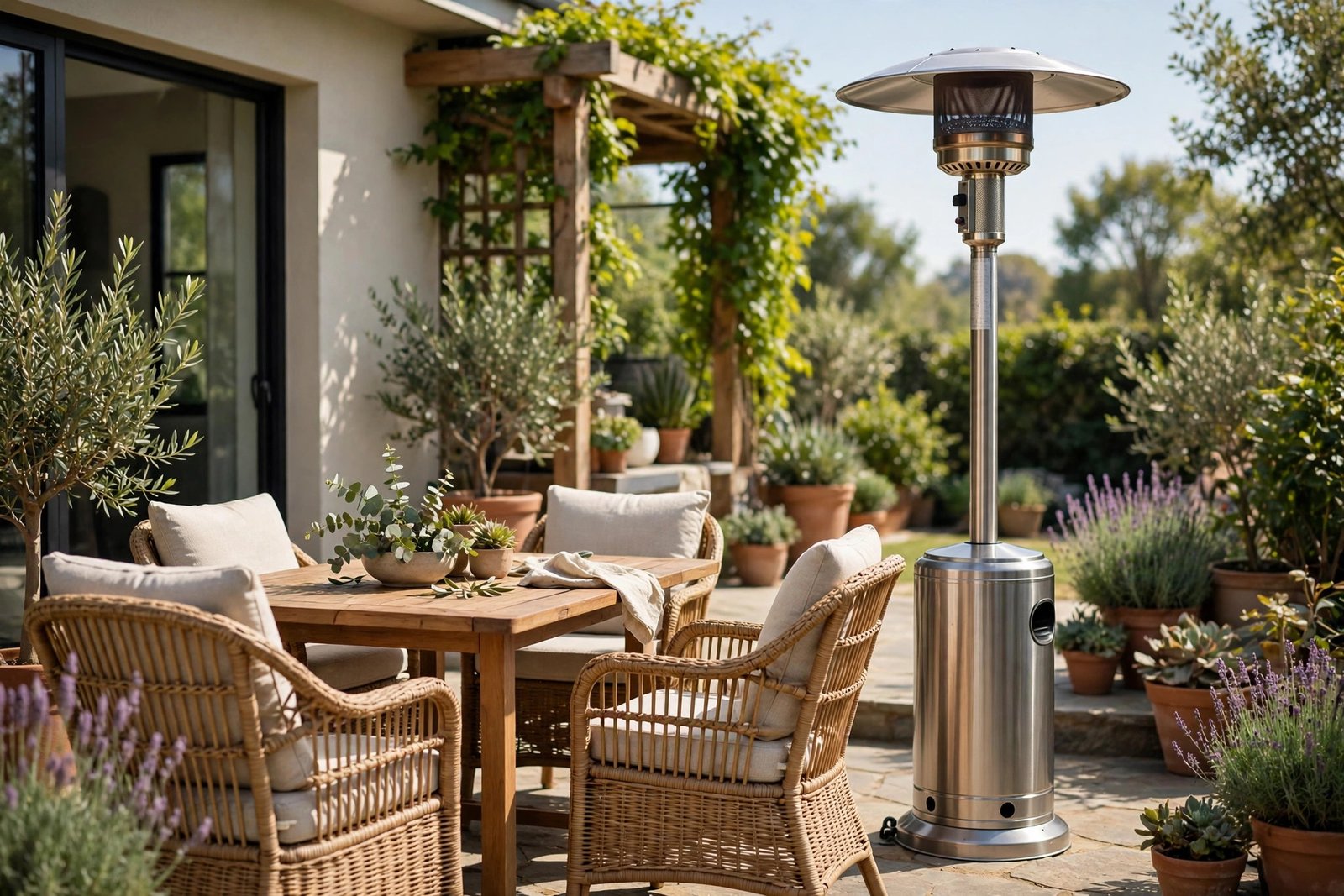
A solid roof is the harder case. The roof traps heat and exhaust, and the clearance you actually have is often less than you think: a standard mushroom heater stands about 7 feet tall, so a patio roof at 8 feet leaves roughly a foot above the reflector before you account for beams, fans, or lights. That is not enough for most propane models. If the numbers do not work, they do not work — moving the heater a few inches closer to the edge of the roof does not fix a clearance problem, it just moves the hot zone.
| Heater type | Under an open pergola | Under a solid roof | Watch out for |
|---|---|---|---|
| Freestanding propane mushroom | Usually workable if manual clearances are met and sides stay open | Often fails clearance; check the manual’s top clearance against real roof height | Heat collecting on beams; exhaust pooling if sides are closed |
| Tabletop propane | Same clearance logic as full-size, scaled to the model | Same problem, lower down — still a combustion appliance | Small size tempts people to skip the clearance check |
| Wall-mounted electric infrared | The usual under-cover choice; no combustion exhaust | Generally the best fit, within its own clearance and rating | Must be rated for damp or wet locations; still needs its stated clearances |
| Ceiling-mounted electric | Works where mounting height allows | Designed for this job; follow mounting-height specs exactly | Needs a proper electrical circuit, not an extension cord |
| Propane fire pit table | Open flame plus a low roof is a bad combination | Do not use under a solid roof unless the manual explicitly allows it | Flames, sparks, and radiant heat all rise straight at the roof |
The safer under-cover options
For a solid roof, electric infrared heaters are the usual answer. They produce no combustion exhaust, so the carbon-monoxide problem goes away, and wall- or ceiling-mounted models put the heat where people sit without a tall reflector crowding the ceiling. They still have clearance requirements in their own manuals, and they still need to be rated for outdoor or damp locations — a heater built for a dry indoor room does not belong on a patio, roof or not.
What about a fire pit table under the roof? Treat it as a no unless its manual explicitly approves covered use. An open flame under a low roof combines every problem at once: radiant heat, sparks, and exhaust, all rising into the same structure. Our electric vs. propane patio heater comparison covers the running-cost and heat differences between the two heater families in more detail.
The checks before you light it
Run through this list once, with a tape measure, before the first evening you use a heater under cover:
- Manual clearances, measured. Top and side clearances from the reflector and burner to the nearest combustible, with the heater in its real position, not its ideal one.
- Open sides. At least two sides open for a fuel-burning heater, and no curtains, shades, or stored items closing the space while it runs.
- Nothing overhead but roof. No hanging plants, fabric, string lights, or paper lanterns inside the clearance zone.
- Stable, level footing. A heater that can tip is a heater that can put its burner against something flammable.
- Hose and cord routing. Propane hoses and power cords out of walkways, away from the burner, and never pinched under furniture legs.
- Local code. A quick check with your fire department or building office beats discovering a rule after an incident.
What never goes under a roof
Some placements are not judgment calls. Never run a freestanding propane heater in a garage, an enclosed porch, a tent with the sides down, or any room without ventilation, even with the door open. Never store a propane cylinder indoors — tanks live outside, upright, with the valve closed, a rule our winter storage guide for heaters and fire pits covers in full. And never use a heater with a damaged reflector, a frayed hose, or a burner that will not stay lit; those are not quirks, they are the failure modes the clearance numbers exist to contain.
If your roof is solid, your ceiling is low, and your heater is a tall propane mushroom, the honest answer is usually a different heater, not a braver placement. A wall-mounted electric unit under that same roof gives you the warm patio without asking a combustion appliance to do a job its manual never approved.