Landscape & Leisure is reader-supported. When you buy through links on our site, including Botanical Interests seed links, we may earn a commission at no extra cost to you. Prices change, so click through to confirm current pricing.
The melon mistake that costs the most is the 25-pound watermelon in a 4-by-8 bed. By August the vine has eaten the paths, the fruit has nowhere to finish, and the one melon you do get is still pale inside when the first frost warning shows up. The cantaloupe next to it ripened three weeks ago and fed the family twice. Same soil, same summer, same gardener — the wrong melon for the space.
Cantaloupe and watermelon are not interchangeable. They are different plants with different appetites for space, season, and patience, and the choice is made before you sow, not at harvest. Our best melon varieties roundup rates the five varieties in stock right now; our melon growing guide covers the timing, spacing, and harvest in full. This is the decision itself.
The Size Difference Is the Decision
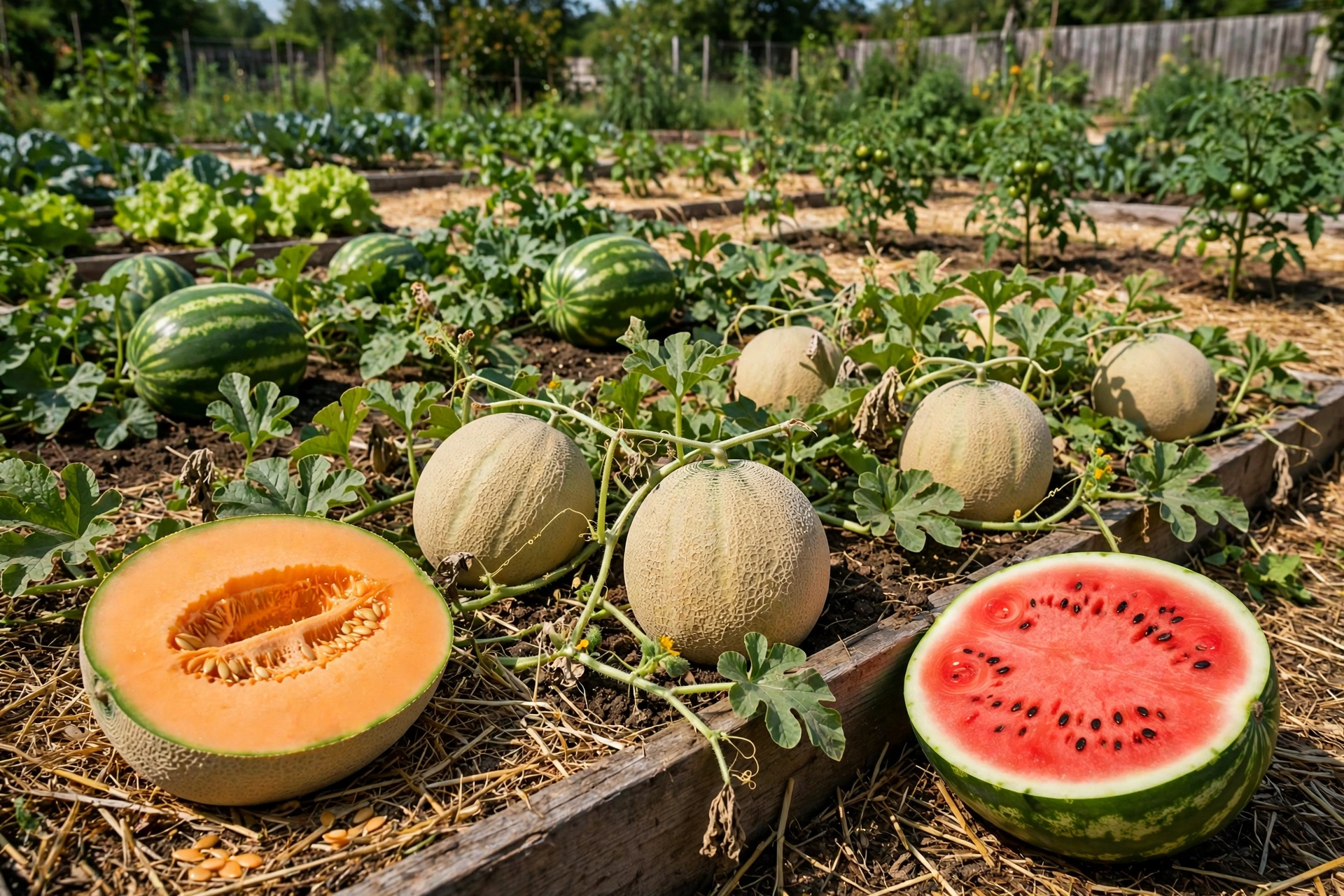
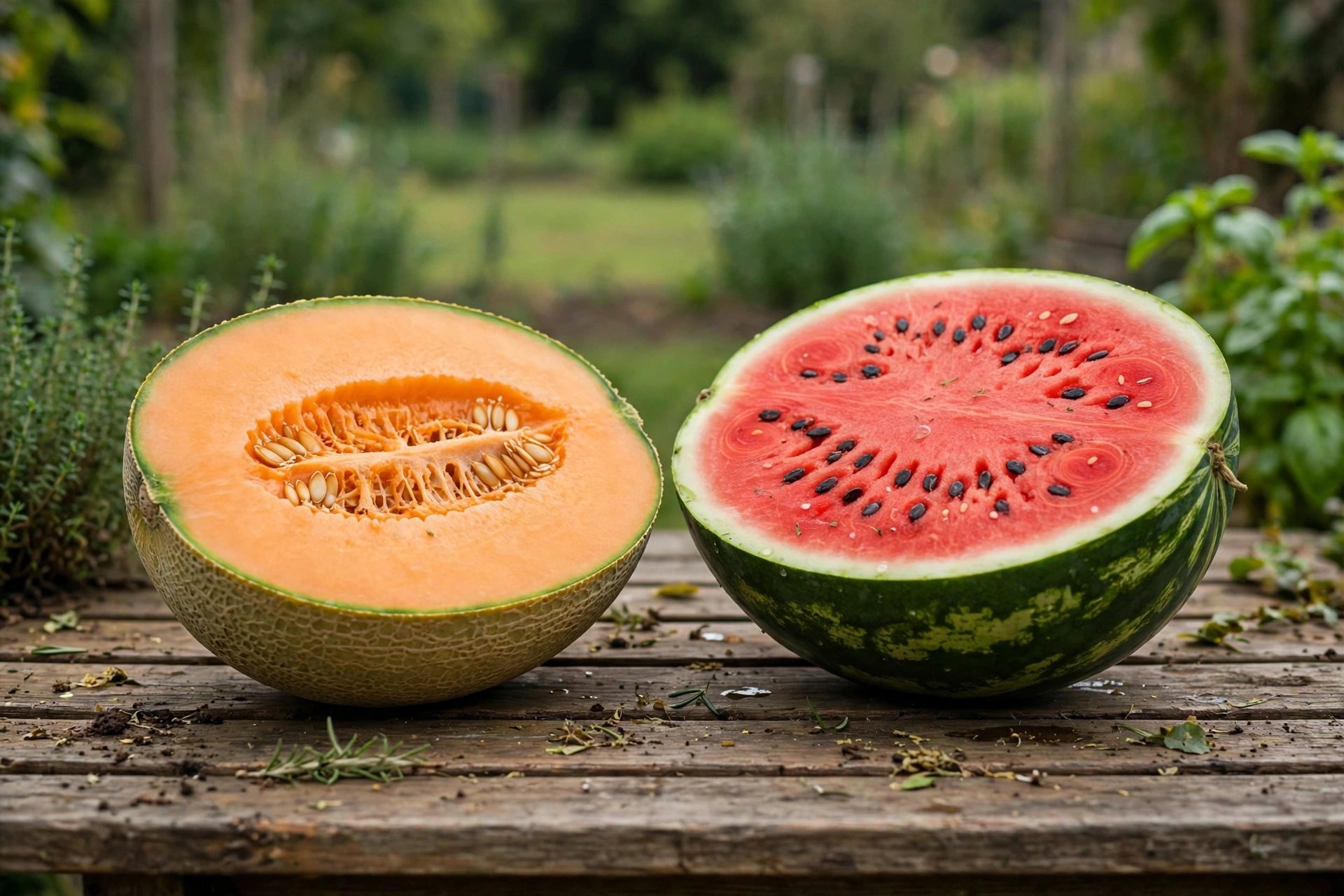
A cantaloupe is a 3-to-5-pound fruit you carry in one hand. A watermelon is a 20-to-35-pound fruit you carry with both arms and a plan. That is not a garnish difference — it decides how much garden the vine gets, how many fruit one plant can finish, and whether the harvest feeds a household or a neighborhood.
Hale’s Best Jumbo runs 3 to 5 pounds, about 6 inches across, with thick salmon-pink flesh and a small seed cavity. Hearts of Gold is smaller still, about 3 pounds. Crimson Sweet, the best watermelon in the roundup, runs 20 to 25 pounds and 12 inches by 10. Charleston Gray runs 22 to 26 inches long and 25 to 35 pounds, with only one or two fruit per plant, and spends the summer doing it. A cantaloupe’s smaller fruit finish faster — Hearts of Gold is on the table in 80 days.
If your melon patch is a corner of a vegetable bed, the cantaloupe wins on arithmetic alone. If you have a full bed to give away for the season, the watermelon earns it.
The Season: 80 Days or 100
Both melons want the same start: full sun, soil at 70 to 90 degrees, sown one to two weeks after the last frost. The difference is how long they need after that. Hearts of Gold ripens in 80 days, the fastest melon in the roundup, and it is the one Botanical Interests calls out for short-season climates. Hale’s Best Jumbo and Crimson Sweet both take 85 days. Charleston Gray takes 85 to 100 days, the longest season of any melon here.
Count backward from your first frost, not forward from sowing. An 85-day watermelon sown in mid-June in a northern garden finishes in early September if the summer cooperates — and a cold August can push it past the point where the vine gives up. The 80-day cantaloupe buys you two weeks of margin, and in a short season two weeks is the difference between a ripe melon and a compost melon.
How You Know It Is Ripe
Here is where the two melons part company completely. A cantaloupe tells you when it is ready. The color between the netting turns brown, not green. The blossom end smells sweet and fruity. A crack forms on the stem right where it meets the fruit, and in a few days the melon slips off the vine with a gentle pull. If you have to tug, it is not ready. Charentais is the one exception: it does not slip, so you watch the skin turn from pale green to creamy yellow and the blossom end yield slightly to pressure, then cut it from the vine.
A watermelon makes you guess, and it gives you four signs that do not all arrive at once: the belly turns from light green to yellowish where it lies on the soil, the surface turns dull, the skin turns rough and resists your thumbnail, and the curly tendril near the fruit turns brown and dry. Check them against the days-to-maturity on the packet and start checking as the date draws near. Pick a watermelon early and it will not sweeten off the vine the way a cantaloupe does — the last few days on the vine are where the sugar goes in.
Cantaloupe vs. Watermelon, Side by Side
| Cantaloupe | Watermelon | |
|---|---|---|
| Fruit size | 3–5 lb (Charentais 1.5 lb) | 20–35 lb |
| Days to maturity | 80–90 | 85–100 |
| Ripeness tell | Slips off the vine; brown netting, aroma | Yellow belly, dull rind, dry tendril |
| Best pick | Hale’s Best Jumbo | Crimson Sweet |
The Picks
On the cantaloupe side, Hale’s Best Jumbo is the pick: 3 to 5 pounds, thick salmon-pink flesh, a small seed cavity, and more drought tolerant than other melons, at 4.8 from 11 reviews. On the watermelon side, Crimson Sweet is the pick: 20 to 25 pounds of brilliant red, crisp, very sweet flesh, resistant to fusarium wilt and anthracnose, at 4.8 from 8 reviews — the highest rating in the roundup. If the season is the constraint, Hearts of Gold is the cantaloupe that gets there first, in 80 days.
Pros: Hale’s Best Jumbo: classic size, drought tolerant, top rating. Crimson Sweet: the picnic melon, disease resistant, top rating. Hearts of Gold: 80 days, built for short seasons.
Cons: Hale’s Best Jumbo still loses yield in a long dry stretch. Crimson Sweet needs a full bed and a long summer. Hearts of Gold is a 3-pound fruit — one sitting, not a week of melon.
Hale’s Best Jumbo Cantaloupe/Muskmelon Seeds
The classic cantaloupe — thick, sweet, salmon-pink flesh in a 3–5 pound package.
Crimson Sweet Watermelon Seeds
A 20–25 pound watermelon with the highest gardener rating here — the picnic melon, done right.
Hearts of Gold Cantaloupe/Muskmelon Seeds
An 1890 heirloom that ripens in 80 days — the cantaloupe for gardens with a short summer.
Bottom Line
Plant the cantaloupe. For most gardens, Hale’s Best Jumbo is the right call — a 3-to-5-pound fruit that ripens in 85 days, tells you when it is ready, and feeds the family without taking over the bed. Plant Crimson Sweet only if you can give a watermelon vine a full bed and a long summer, and count the days backward from frost before you sow. The wrong melon in the wrong space is a season of work for a pale, unfinished fruit — the right one is a melon that slips off the vine exactly when it should.