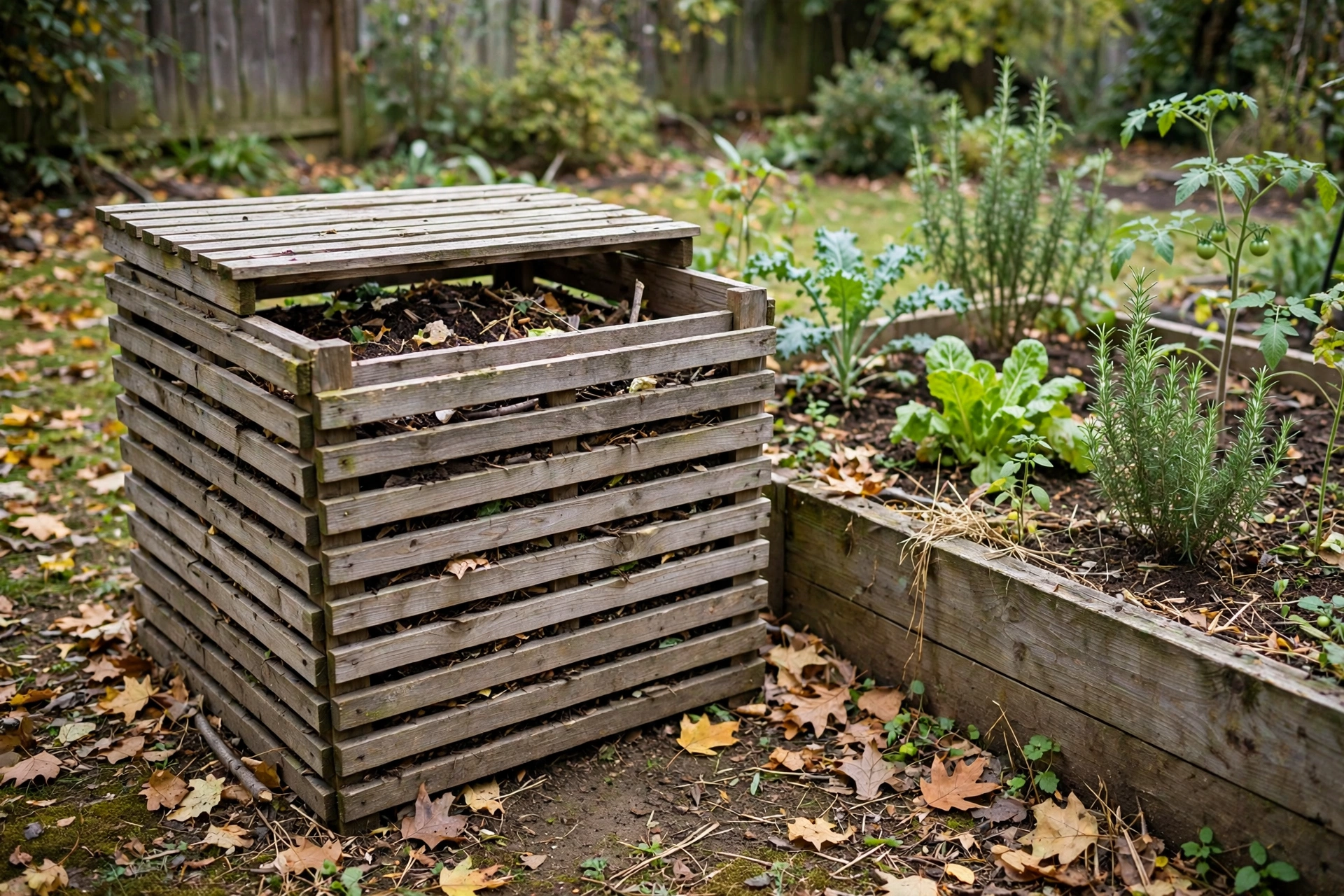
27 cubic feet. That is the size a compost pile needs to reach before it heats up properly, and it is the number to know before you cut a single board or drive a single stake.
Build smaller than that and the pile stays cold, dries out at the edges, and breaks down slowly no matter how carefully you layer it. This calculator takes the bin you are planning, in feet, and tells you its volume, how much finished compost to expect from it, and whether the size will actually work.
Calculate your bin volume
What do the numbers mean?
Cubic feet is the space inside the bin, and cubic yards is the same space in the unit compost and soil are usually counted in. One cubic yard holds 27 cubic feet, which is why a 3-by-3-by-3-foot bin and the one-cubic-yard minimum are the same thing said two ways.
The finished-compost figure is an estimate, about half or less of what you put in. A full bin of leaves and kitchen scraps settles and breaks down as it rots, so the pile you finish with is smaller than the pile you built, and woody mixes shrink less than wet, green ones.
If you already know your mix and want to work out what goes into the pile, the Compost Blend Calculator handles the greens-and-browns side of the job. This page handles the box itself: how big it is, and how much it holds.
How the math works
Multiply the length by the width by the height, all in feet, and that gives you the volume in cubic feet.
Divide the cubic feet by 27 to get cubic yards.
Take half of the starting volume for the finished-compost estimate, and read it as an upper end rather than a promise, because most piles finish at about half or less.
If you entered more than one bin, the total is the volume of one bin multiplied by the number of bins. The size verdict is based on one bin, since each bin has to heat on its own.
Worked examples
A 3-foot by 3-foot by 3-foot bin holds 27 cubic feet, which is 1.00 cubic yard. Expect about 0.50 cubic yard of finished compost from a full bin, and know that this size just meets the minimum for a pile that heats well.
A 4-foot by 4-foot by 4-foot bin holds 64 cubic feet, which is 2.37 cubic yards. Expect about 1.19 cubic yards finished, with enough mass to hold heat through cooler weather.
| Bin size (ft) | Volume (cu ft) | Volume (cu yd) | Finished compost, estimate (cu yd) |
|---|---|---|---|
| 3 × 3 × 3 | 27 | 1.00 | ~0.50 |
| 3 × 3 × 4 | 36 | 1.33 | ~0.67 |
| 4 × 4 × 3 | 48 | 1.78 | ~0.89 |
| 4 × 4 × 4 | 64 | 2.37 | ~1.19 |
| 5 × 5 × 4 | 100 | 3.70 | ~1.85 |
Finished compost is about half the starting volume or less — an estimate, not a guarantee. Woody mixes shrink less, and wet green mixes shrink more.
What size should you build?
For most yards, a bin between 3 and 4 feet in each direction is the practical answer. It reaches the one-cubic-yard minimum, it is small enough to turn with a fork without dreading the job, and it fits the corner of a garden without taking it over.
Go bigger only when the material is there to fill it, because a large bin filled halfway behaves like the small pile you were trying to avoid. Two 3-foot bins, one filling while the other finishes, suit many gardeners better than one oversized box.
Most piles take somewhere in the range of three to nine months to finish, depending on the mix, the moisture, and how often the pile gets turned. A bin sized right at the start makes that wait shorter, since a pile with enough mass holds the heat that does the work.
Limits of this calculator
This calculator tells you how much space your bin holds and gives a rough finished-compost estimate — it does not work out your mix of greens and browns, predict how long the pile will take, or tell you how hot it will get.
Sources
University of Kentucky Cooperative Extension, ID-192, “Composting” — https://publications.mgcafe.uky.edu/files/id192.pdf — Fetched November 23, 2026.
Colorado State University Extension, “Making Compost” — https://extension.colostate.edu/resource/making-compost/ — Fetched November 23, 2026.