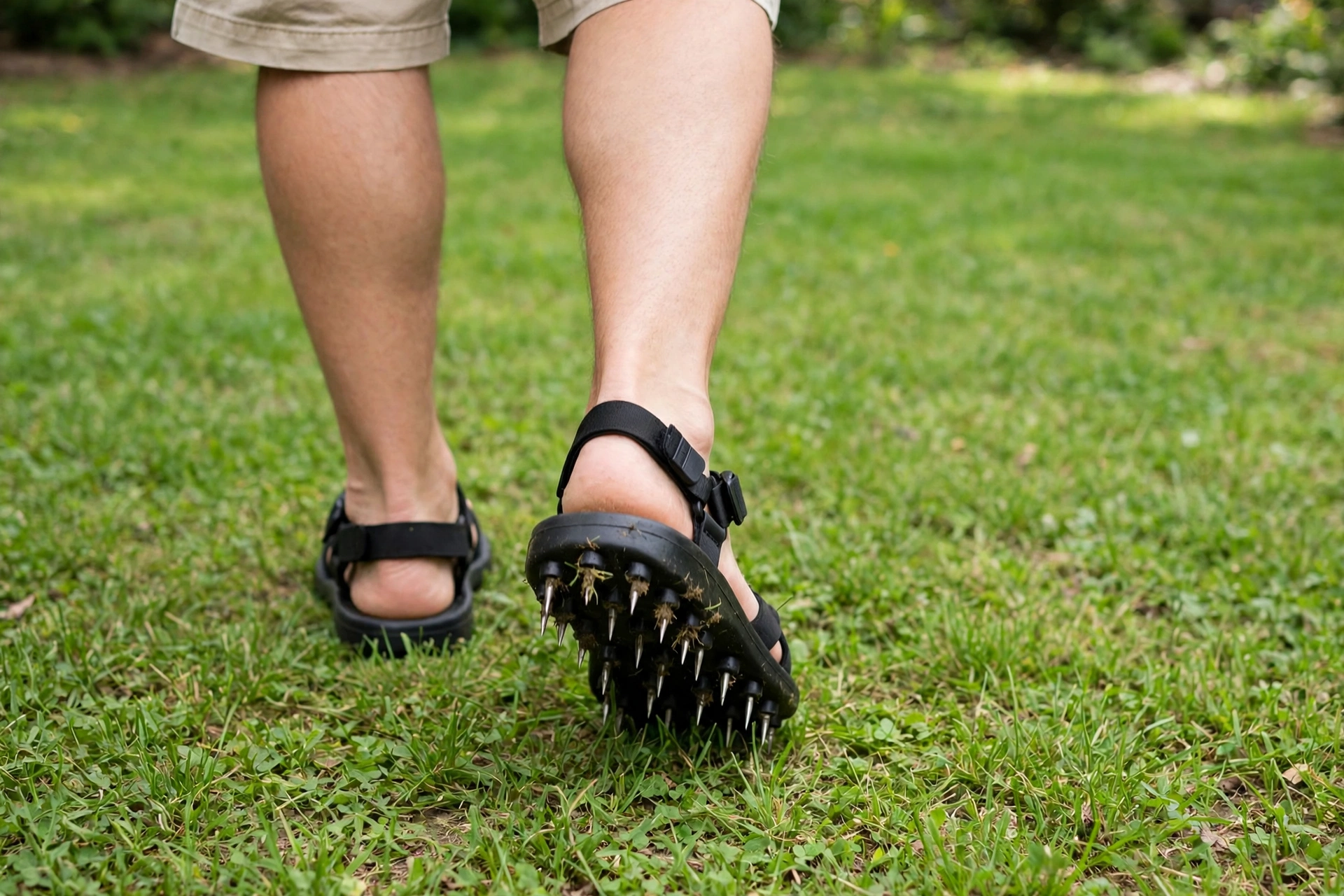
The grass thins along the same worn path every summer, the ground feels hard under your shoes after rain, and water sits on the surface instead of soaking in. Those are the signs of compacted soil, and they are also the signs that send people shopping for aerator shoes — the spiked sandals that promise to fix the problem while you walk.
The shoes do make holes, which is why the promise feels believable. What they do not do is make enough of them, and that gap is the whole diagnosis. Here is what the symptom is really telling you, what the shoes can and cannot fix, and what to reach for instead.
What the symptom is telling you
Compacted soil shows up in a few familiar ways: grass that thins in high-traffic areas, bare patches that seed will not take in, and water that pools on the surface after rain instead of draining through. The first step is to confirm compaction is actually the cause, because the same thinning can come from shade, grubs, or a lawn that simply needs water. Push a screwdriver into the soil the day after rain, then push it into a healthy bed nearby for comparison — if it stops short in the thin area while sinking easily in the good one, compaction is the likely cause.
Compaction matters because roots need air and water in the soil, and pressed-together soil holds neither. The fix has to open the soil up at a scale the roots can use, which is where the shoes start to fall short. A hole that is real but rare does not change the soil around it.
What aerator shoes actually do
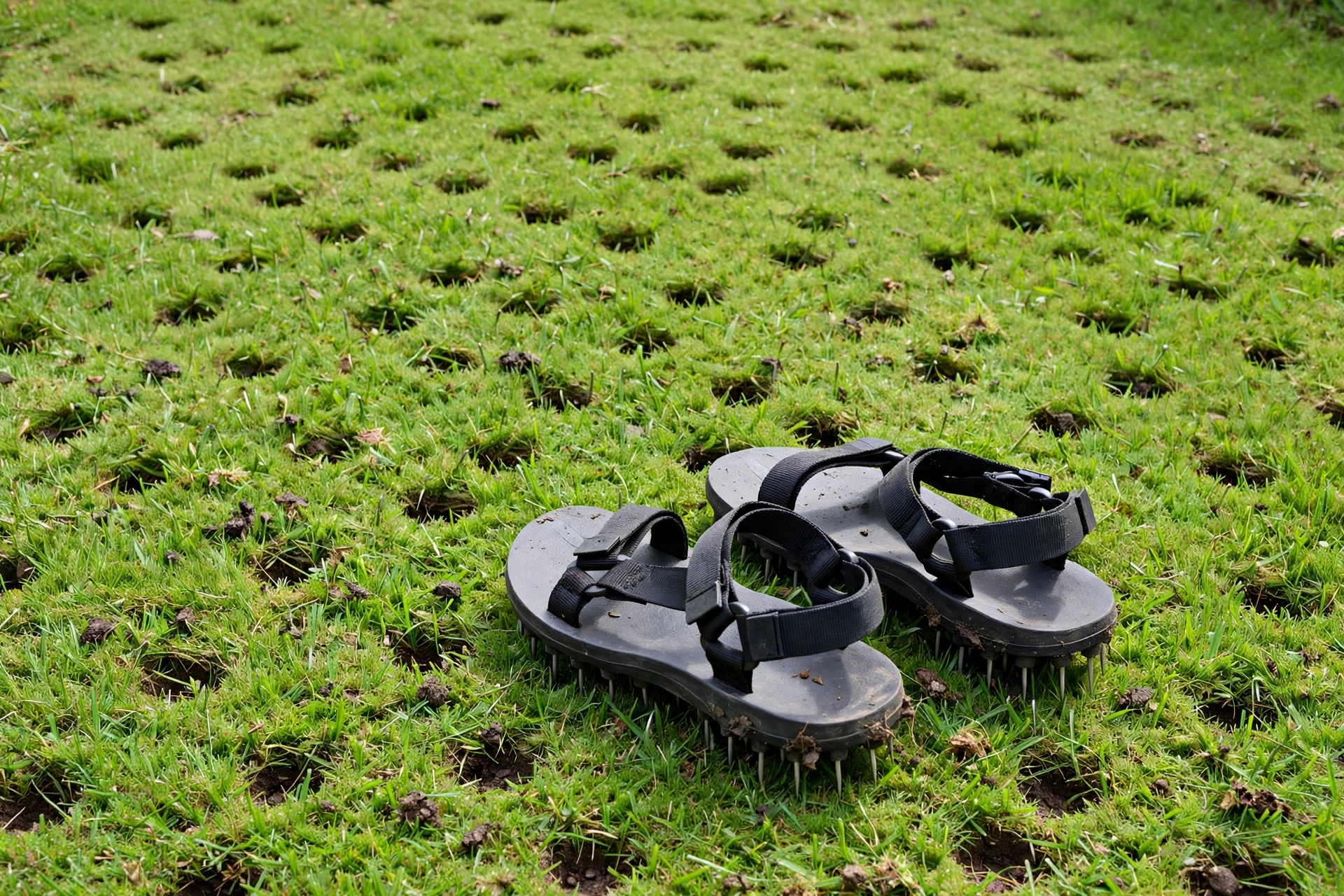
Aerator shoes are spike aeration at the smallest possible scale. Solid steel spikes punch into the soil and pull back out without removing any material, which means they push soil sideways around each hole rather than taking it away. On soft soil that loosens the top inch or two; on hard clay it can press the soil around the hole even tighter, which is the opposite of the intended effect.
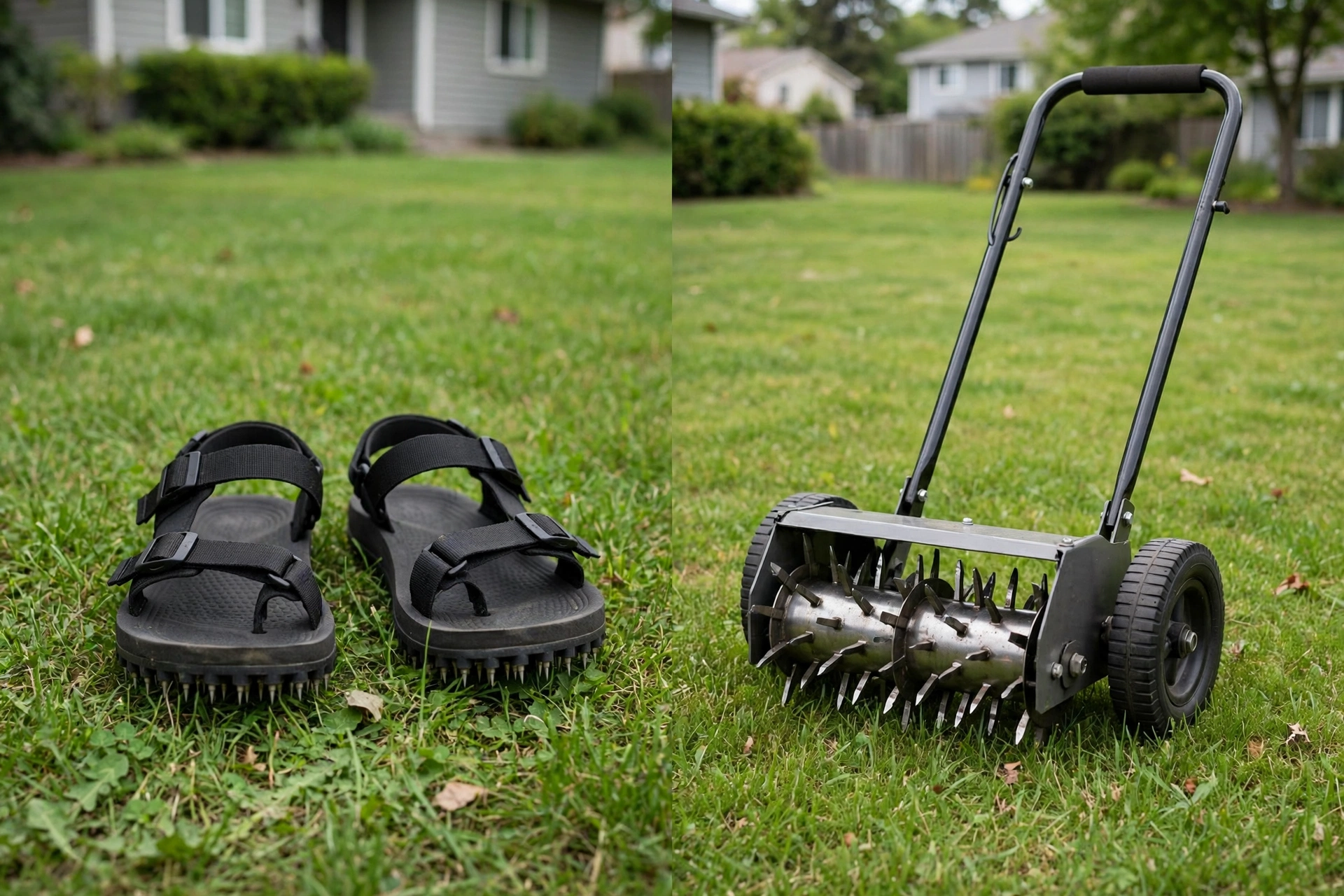
The bigger problem is how little ground they cover. A turf specialist’s calculation, reported by Family Handyman, found that walking normally in aerator shoes — roughly 40 steps across a 10-by-10-foot patch — punctures only about 0.04% of that patch, while turf professionals generally recommend around 5% surface coverage to meaningfully reduce compaction. Closing that gap by walking alone would take about 125 crossings of the same small patch. Our aerator shoes vs. core aerator comparison puts that coverage gap side by side with the tool that actually removes soil.
Where they help anyway
The shoes have a narrow, honest use, and it is worth naming plainly rather than writing the whole category off. Loosening the very top layer of soil on a small bare patch before overseeding gives seed better contact with the soil, and that is a job where a scattering of shallow holes is enough. Wearing them while you are already walking the lawn for another job — checking sprinkler heads, picking up debris — adds a marginal bonus at no extra effort. And for a homeowner who has never aerated anything, a cheap pair is a low-stakes way to learn what the work feels like before spending on a rental.
None of those uses is compaction relief, and that is the distinction to hold onto. If the lawn is hard across the whole yard and water pools after every rain, the shoes are treating the symptom in a few square feet while the cause covers the rest. Our spike vs. plug comparison explains why removing soil beats displacing it on ground like that.
What to do instead
For a small lawn, the realistic upgrade is a manual core aerator — a hand-push or foot-press tool that pulls actual plugs of soil out in a controlled pattern instead of scattering shallow spike holes. Our best manual aerators for small lawns covers the ones worth buying. For a medium lawn, a rented walk-behind core aerator covers the ground far faster and more evenly than any hand tool, and our rent vs. buy guide works through when renting starts to make more sense than buying.
Timing matters as much as the tool. Our guide to how often to aerate by lawn type sets the schedule, and our aerators explained guide covers which type fits which lawn. If you do decide a pair of shoes is worth having for spot work, our best lawn aerator shoes roundup names the pair to buy, and our guide to using them without wrecking your lawn covers the walk itself.
Bottom line
Do lawn aerator shoes work? They punch real holes, and for loosening a small patch before seed they do the job. For relieving compaction across a lawn, no — the coverage math is too far short, at about 0.04% against the roughly 5% that matters, and no pair of shoes closes that gap. If the screwdriver test says your soil is compacted, skip the sandals and pull real cores, by hand on a small lawn or with a rental on a bigger one.