Dear Spade,
I built my first compost pile this fall and it was steaming along nicely until the cold showed up. Now it just sits there, frozen on the outside and doing nothing I can see. Did I kill it? Should I start over in spring?
— Chilled to the Core in Minnesota
Dear Chilled,
You did not kill it. You are watching a compost pile do in winter what most of us do in winter — move slower, complain less than we do, and wait for better weather with more patience than it gets credit for.
So, What’s the Deal with a Cold Pile?
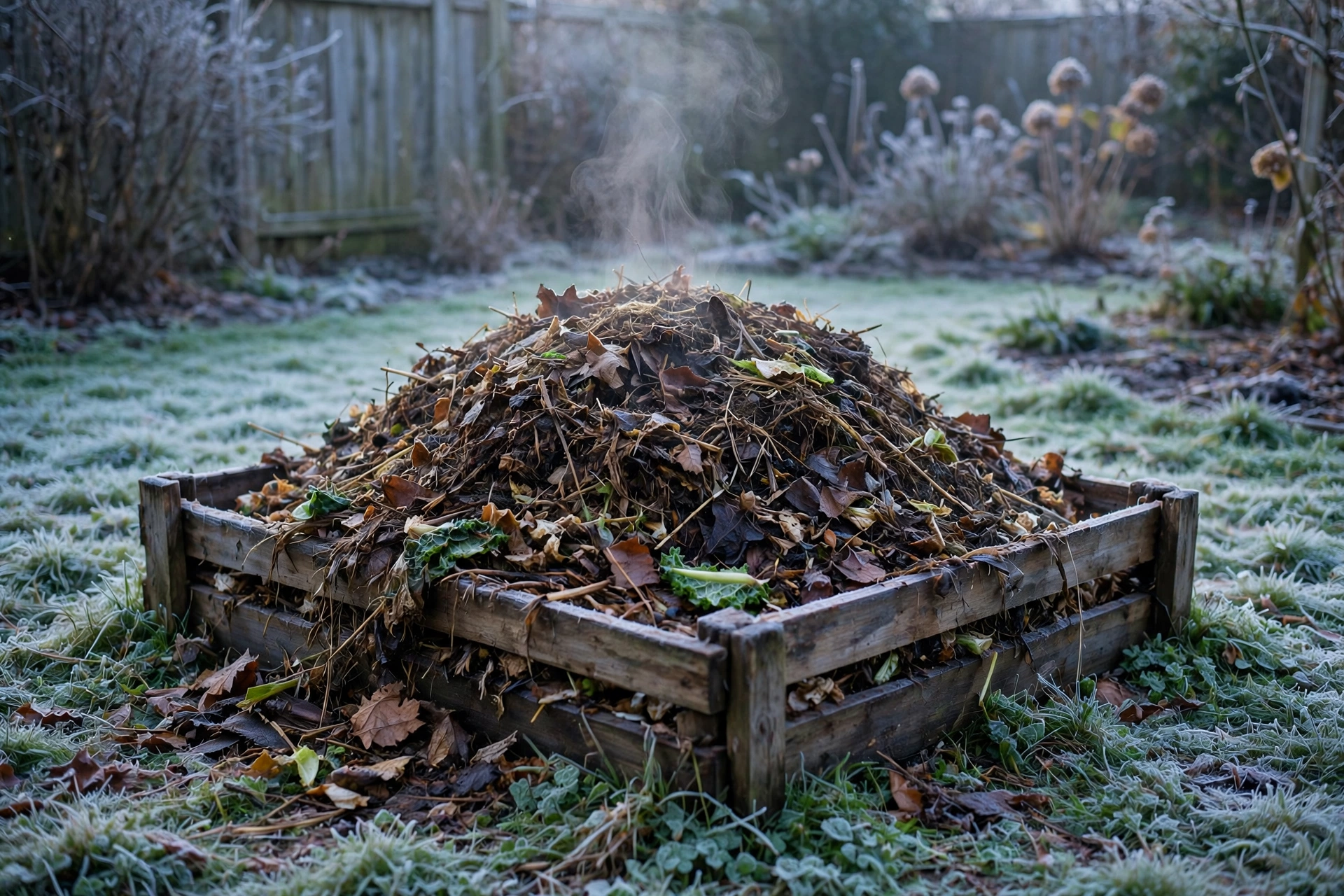
Here is the plain mechanism. Compost is not the pile breaking down by itself; it is microbes eating, and microbes work at the speed the temperature allows. In a warm, well-fed pile the center can run hot enough to steam on a cold morning. As the weather turns, the outer layers cool first and insulate the middle for a while, then the whole pile drifts down toward the temperature of the yard around it.
Down near freezing, the work does not stop so much as it crawls. The microbes are still there, still alive, still doing a slow version of the job — the botanical equivalent of a crew working with mittens on. What has actually paused is your ability to see progress, which is a different problem, and a much less serious one.
So no, the pile is not asleep in the sense of gone. It is dormant at the edges, sluggish in the middle, and fully prepared to wake up the moment spring hands it some warmth to work with.
Here’s Where It Gets Tricky
Winter does punish two mistakes, and both are worth naming plainly.
The first is a pile that went into winter too wet. A soggy pile freezes into a solid, airless block, and without air the good microbes stall while the sour, slimy processes take over. If your pile smells off when it thaws, that is the smell of a pile that drowned before it froze.
The second is a pile that went in too small. A heap under about three feet in each direction has too much surface for its volume, so it loses heat as fast as the microbes make it and never holds a warm core at all. Small piles still compost — they just do it entirely at spring’s pace, not their own.
Neither mistake means starting over. Both just mean the spring version of you has a little adjusting to do, and spring-you is famously energetic.
What to Do While It Dawdles
Keep adding kitchen scraps through winter if you like, burying them in the middle of the pile where they will freeze, wait, and break down when things warm up. Frozen scraps do not rot in place, which is a genuine winter courtesy — no smell, no fuss.
Hold off on turning a frozen pile. Forking apart a half-frozen heap mostly breaks your fork’s spirit and lets out whatever modest warmth the center was hoarding. One turn on a mild thaw day is plenty; daily winter turning is exercise for you, not help for the pile.
Cover the top if it sits open to winter rain and snowmelt, because the goal is moist, not soaked. A breathable cover sheds the extra water while the pile keeps the moisture it already has — the same judgment call you make with a good layer in our spring mulching guide, where the right depth protects without smothering.
And keep the pile’s diet balanced when spring returns: dry, carbon-rich material like shredded leaves alongside the green kitchen scraps is what lets it heat back up. If you are weighing what to spread on beds versus what to feed the heap, the trade-offs in choosing the right mulch for your landscaping are worth a read before you haul anything anywhere.
Keep the Faith, and the Fork
Your pile has not quit on you, Chilled. It is sitting in the cold doing slow, honest work, saving every scrap you gave it for the season when it can finish the job properly. Come spring, give it a turn, feed it a mix of dry and green, and it will reward you by heating up like it remembers exactly what it was doing — because it does.
Seasonedly yours,
The Seasoned Spade