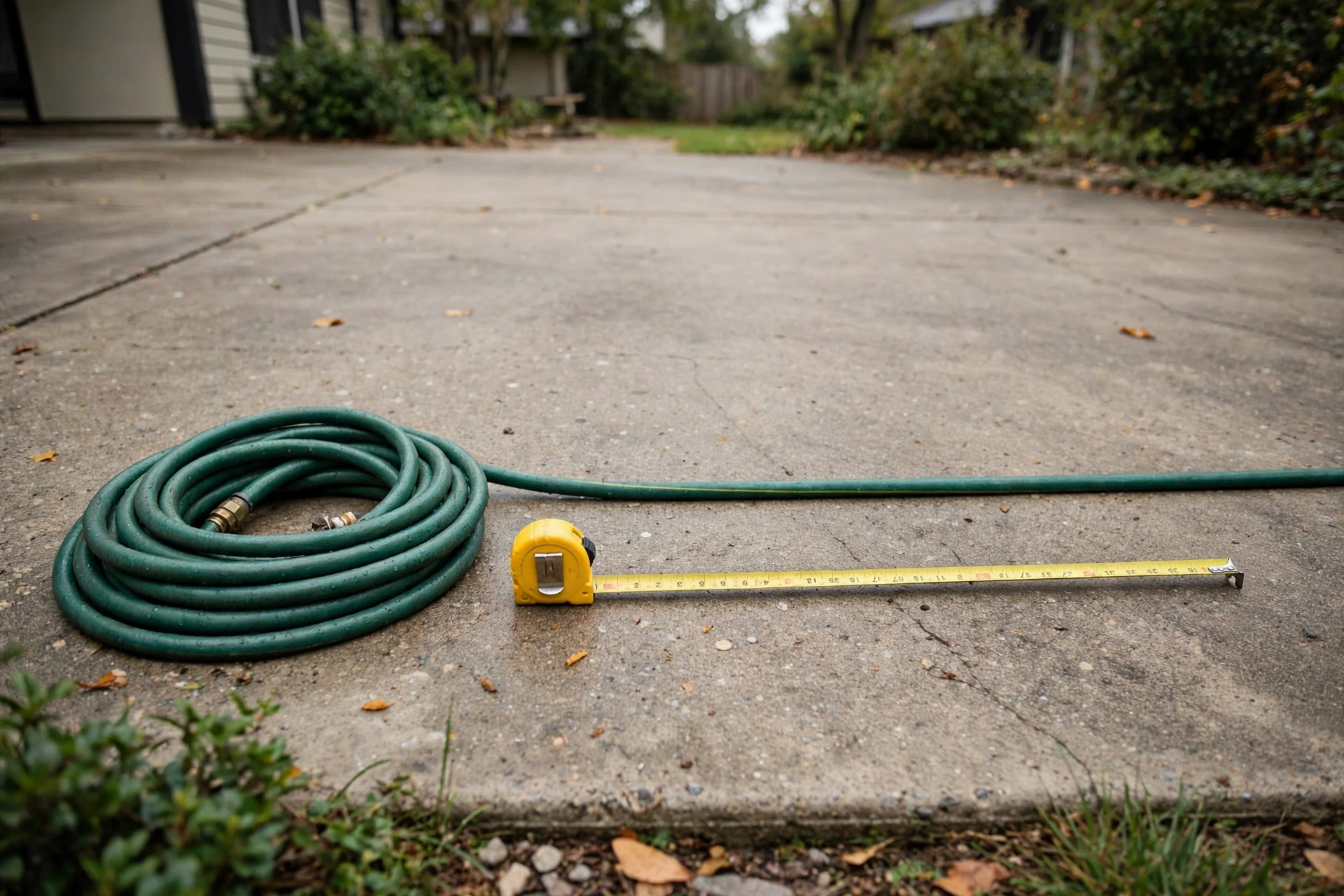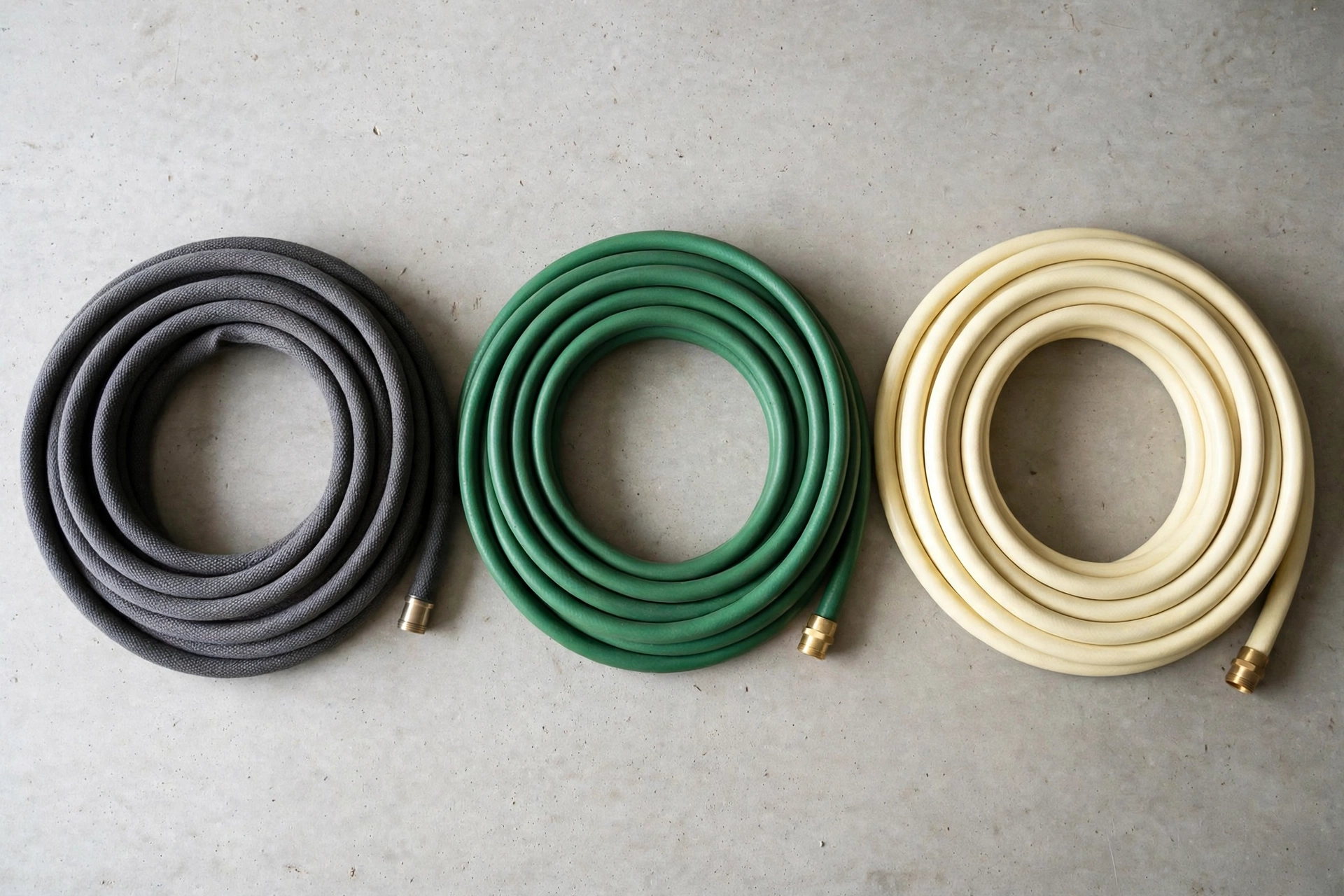
An expandable hose shrinks to fit in a pot and stretches only while the water is on, a rubber hose holds its full length and weight all the time, and a vinyl hose sits between them on price while aging fastest in the sun.
That contrast decides most of the choice. Storage space, how far the water has to travel, and whether the hose lives outside year-round matter more than any single durability claim.
None of the three is best at everything. Rubber lasts longest and weighs most, expandable stores smallest and delivers least flow, and vinyl costs least and gives up years to do it.
The three materials side by side
| Type | Typical lifespan | Weight | Kink behavior | Storage |
|---|---|---|---|---|
| Expandable | Shortest, often 1 to 3 seasons | Lightest | Rarely kinks, twists instead | Drains and shrinks into a pot or small bin |
| Rubber | Longest, often a decade or more | Heaviest | Resists kinking, can fold at the spigot | Coils large, handles cold storage well |
| Vinyl | Middle, often 3 to 5 seasons | Light to moderate | Kinks most readily, worse when cold | Coils stiffly in winter, store indoors |
Expandable hoses: convenience with conditions
An expandable hose is a latex inner tube inside a woven jacket. Water pressure stretches it to its rated length, and when the water drains it pulls back to roughly a third of that length, which is why a 50-foot hose can sit in a flowerpot.
The conditions are strict. It must be drained after use, kept out of prolonged sun while pressurized, and never dragged across rough concrete or thorns, because the jacket protects against abrasion only lightly and the inner tube is thin.
Flow is the quieter limitation. The inner tube is narrower than a standard 5/8-inch hose, so a sprinkler fed by an expandable hose throws a shorter pattern, a point covered in what size garden hose you need.
Rubber hoses: the long-service option
Rubber, usually EPDM in better hoses, stays flexible in cold weather, tolerates hot water that would damage vinyl, and resists the cracking that ends a vinyl hose left on a reel through winter. A premium rubber hose such as the Dramm ColorStorm carries a 518 PSI burst rating and a lifetime guarantee.
The penalty is weight, and it is not small. A 50-foot rubber hose can weigh close to twice what a comparable vinyl hose weighs, and that difference is felt on every trip across the yard, especially on a slope or with a full hose.
Rubber also marks light concrete when dragged and costs the most up front. For a hose that stays mounted by one spigot and gets used hard, those trade-offs are usually worth paying.
Vinyl hoses: the budget default, with a clock on it
Vinyl is what most inexpensive hoses are made of, often reinforced with a mesh layer to resist kinks, as in the Teknor Apex NeverKink line, a 5/8-inch by 50-foot vinyl hose rated to 340 PSI. Reinforcement helps handling, but it does not change how the base material ages.
Sun and cold are the two enemies. Ultraviolet light stiffens and eventually cracks vinyl, and cold weather makes it hold a coil and fight being straightened, which is when most kinks happen.
The vinyl goes board-stiff on the first cold morning of fall, and uncoiling it becomes a two-handed job until the sun warms it. Store a vinyl hose indoors over winter and out of direct sun in summer, and it gives fair service for its price.
Which one fits your yard
Small patio, pots, no storage room. An expandable hose, drained and stored in its pot after each use, is a sensible pick, and its limits matter least at that scale.
One spigot, hard use, hose lives outside. Rubber. It is the only one of the three that treats year-round outdoor storage as normal, and it anchors the picks in the best garden hoses for lawns and gardens roundup for exactly that reason.
General garden use on a budget. A reinforced vinyl hose, stored out of the sun, covers most beds and borders without the rubber price. The primer at garden hoses: the good, the bad, and the kinky covers the failure patterns to watch for in cheaper hoses.
Care that changes the lifespan numbers
Drainage is the habit that matters most for all three. A hose left full of water in freezing weather can split at its weakest seam, and an expandable hose left pressurized in summer sun ages its latex core faster than any other single mistake.
Coiling helps too. A loose, wide coil on a reel or hanger avoids the sharp bends that become permanent kinks in vinyl and stress points in rubber, while dragging any hose by its nozzle end pulls directly on the coupling crimp.
Keep every hose off hot pavement in storage where possible, and keep expandable hoses off rough surfaces in use. Those two habits close much of the lifespan gap in the table for vinyl, though they do not close it for expandable hoses used daily.
Hybrid polymer hoses, such as the Flexzilla in the roundup, sit outside this three-way split and borrow from both sides: lighter than rubber, more cold-flexible than vinyl. They are worth considering once the three basic types are understood, because their trade-offs only make sense against this baseline.
The recommendation
Buy rubber if the hose will live outside and serve a lawn, and buy expandable only for light work where storage is the real problem. Vinyl is the budget middle, acceptable when it is stored indoors and replaced without regret in a few seasons.