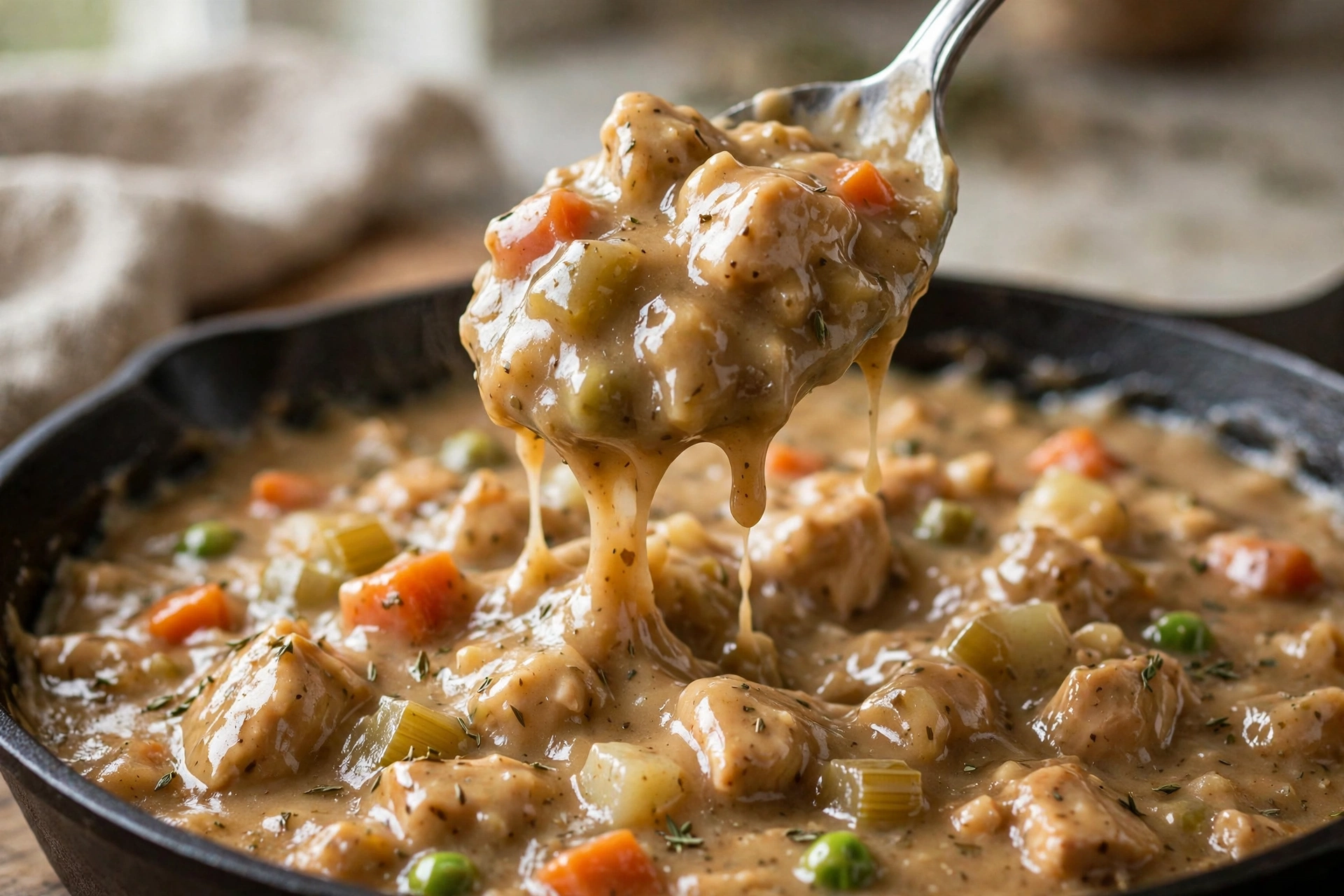
The back of a spoon, lifted out of the pot, tells you whether a pot pie filling will slice or spill. If the sauce coats the spoon and a finger drawn through it leaves a clean line, the filling is ready for its crust. If it runs off like soup, it will still be soup under the crust, because the oven does not thicken a filling that went in thin.
This is the fix to know before you bake the leftover turkey pot pie, and it applies to any pot pie, chicken or beef, stovetop or slow cooker. Three thickeners cover every case, and choosing between them is mostly about timing.
Method 1: The Roux (Best Before the Filling Is Built)
A roux is equal parts fat and flour, cooked together before the liquid goes in. For a medium-thick pot pie sauce, the working ratio is 2 tablespoons of butter and 2 tablespoons of flour for every 1 3/4 to 2 cups of liquid.
Cook the flour in the melted butter for a full minute, stirring constantly, until it loses its raw smell. That minute matters twice: it removes the pasty flavor, and flour that goes in raw and undercooked never reaches its full thickening power. Then add the liquid a splash at a time, stirring smooth between additions, and give the finished sauce 3 to 4 minutes at a simmer to reach its real thickness before you judge it.
Method 2: The Cornstarch Slurry (Best for a Filling Already Made)
When the filling is finished and still thin, a slurry fixes it without rebuilding the sauce. Stir 1 tablespoon of cornstarch into 1 tablespoon of cold water until smooth, for every cup of liquid you need to thicken, then whisk it into the simmering filling.
Two rules keep a slurry from going wrong. The water must be cold (cornstarch stirred straight into hot liquid seizes into lumps), and the filling must come back to a full simmer for about a minute afterward, because cornstarch only reaches full strength at a boil. Cornstarch sets a little softer than flour, so for a pie you plan to slice, thicken to just past where you want it.
Method 3: Simmer It Down (Best When It Is Almost There)
A filling that is only slightly thin often needs nothing added at all. Simmer it uncovered, stirring often so the bottom does not catch, and let evaporation do the work; five minutes of steady simmering makes a visible difference. Frozen vegetables are the usual reason a filling thins as it cooks (they release water into the sauce), which is why a filling can look right before they go in and loose after.
One caution with this method: simmering concentrates salt along with everything else. If the filling still needs reducing, hold the final seasoning until after it has thickened.
How Thick Is Thick Enough?
Aim for the consistency of a thick gravy: the filling should mound slightly on a spoon and move slowly when the pot is tilted. It will set a little more as the baked pie rests (that 10-minute rest in the recipe is part of the thickening, not a courtesy), so a filling that looks slightly loose on the stove usually slices fine, while one that looks perfect for slicing on the stove can bake up stiff. When in doubt, err a spoonful loose.
Too thick is fixable too: whisk in broth a tablespoon at a time until the spoon test reads right again. Thickening is a dial, not a point of no return, and the spoon is how you read it.