10 volts is the floor. If the last light on a low-voltage run gets less than that, it runs dim or not at all, no matter how good the fixture is.
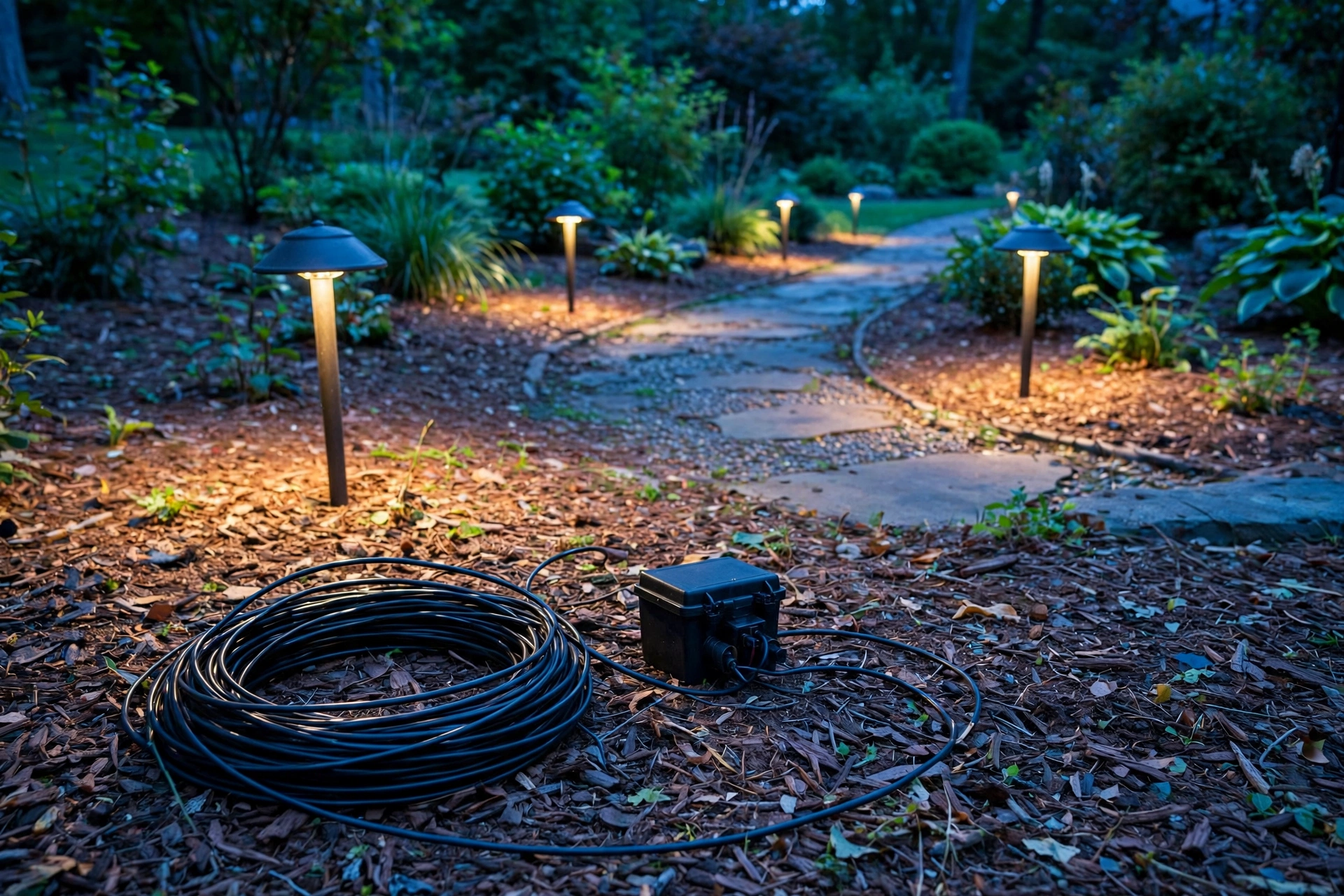
That is the quiet problem with landscape lighting: the lights near the transformer glow, and the ones at the far end of the yard fade. The wire itself uses up some of the voltage on the way out, and long runs on thin wire use up the most.
This calculator settles it before you bury any cable. Type in the load on one run, how far that run reaches, and the wire you plan to use, and it tells you the voltage waiting at the last fixture — and whether that clears the 10-volt floor.
Use the calculator
Work out one wire run at a time. If your transformer feeds three runs, run the numbers for each one on its own, because each run has its own load and its own length.
What to type in
Total load is every fixture on this one run added together. Each fixture lists a wattage or a VA figure in its specs — VA is simply the draw number the maker prints for low-voltage fixtures, and either figure goes in the same box. Six 10-watt path lights on one run are a 60-watt load.
One check before you start: the total VA of everything your transformer feeds should not be larger than the transformer’s own wattage rating. A 300-watt transformer is the ceiling for a system that adds up to 300 VA.
Run length is the one-way distance from the transformer to the last fixture, measured along the path the cable actually takes. Follow the bends around beds and patios, not the straight line across the lawn.
Wire gauge runs backwards from what most people expect: the lower the number, the thicker the wire. Thick wire wastes less voltage, so 12-gauge is the usual starting point for landscape runs, and long runs often need 10-gauge.
Transformer tap is the voltage your transformer sends out on that run. Many low-voltage transformers offer 12, 13, 14, and 15-volt taps, and the higher taps exist for exactly the problem this calculator finds. Leave it at 12 unless you already know you are using a higher tap.
Choosing the fixtures themselves is the other half of the job. Our Gardenreet brass path lights review covers one solid-brass option in detail.
What your answer means
Above 10 volts: the run works. Every fixture on the run should be operating somewhere in the 9-to-15-volt range these systems are built for, with the last one comfortably lit.
An answer between 10 and 10.5 volts still passes, but the far fixtures will run a little dimmer than the ones near the transformer. If even brightness matters on that run — a row of matching path lights, say — treat 10.5 as the number to beat.
At or below 10 volts: the run falls short. The calculator lists three fixes to try, and each one is worth testing in the tool before you change anything in the yard, because often the cheapest change is enough.
How the math works
The calculator turns your total load into amps by dividing it by the tap voltage, because the same load pulls fewer amps when the voltage pushing it is higher.
It then works out how much voltage the wire itself uses up. The electricity travels out to the last fixture and back again, so the run length counts twice, and thicker wire gives less of it up than thin wire does.
Last, it takes what the wire used up away from the tap voltage. What is left is the voltage at the far fixture, and that is the number compared against the 10-volt floor.
Worked examples
A short, light run. 36 watts over 50 feet on 12-gauge wire at the 12-volt tap. The load pulls 3.0 amps, the wire uses up 0.48 volts, and the last fixture gets 11.52 volts. That passes with room to spare — most short path-light runs look like this.
A medium run at the edge. 60 watts over 100 feet on 12-gauge wire at 12 volts. The load pulls 5.0 amps, the wire uses up 1.59 volts, and the last fixture gets 10.41 volts. That clears the 10-volt floor, so the run works, though the far lights sit just under the brighter 10.5-volt mark.
A long run on thin wire. 20 watts over 200 feet on 16-gauge wire at 12 volts. The load pulls about 1.67 amps, the wire uses up 2.68 volts, and the last fixture gets 9.32 volts. That fails, even though the load is small — the length and the thin wire do the damage. The three fixes all work on a run like this: move up to a higher tap, switch to thicker wire such as 12-gauge, or split the run into two shorter runs with fewer fixtures on each.
Wire resistance by gauge
Resistance is how much a wire resists the flow of electricity, measured here in ohms per 1,000 feet. Higher resistance means more voltage used up along the way, which is why the thin 18-gauge wire gives up more than six times as much as 10-gauge over the same distance.
| Wire gauge | Resistance (ohms per 1,000 ft) |
|---|---|
| 10 AWG | 0.9989 |
| 12 AWG | 1.588 |
| 14 AWG | 2.525 |
| 16 AWG | 4.016 |
| 18 AWG | 6.385 |
These figures are for copper wire at 77°F. Copper resists a little more as it warms up, so a run buried under a hot summer patio edge gives up slightly more voltage than the calculator shows — one more reason to leave yourself a margin above 10 volts rather than landing exactly on it.
What this calculator leaves out
The calculator treats your whole load as if it were sitting at the far end of the run, which is the worst case: fixtures spread along the cable each draw their share partway out, so a real run usually does a little better than the number shown. It does not work out the drop fixture by fixture along a daisy chain, and it will not size your transformer beyond the rule above — if the answer surprises you, a voltmeter reading at the last fixture is the final word.
Sources
Kichler, “Calculating Your Project Load Size” — the voltage-drop method, the more-than-10-volt rule for the end fixture, the 12–15 V transformer taps, and the three fixes for a run that falls short. https://www.kichler.com/professionals/landscape-contractor/calculating-your-project-load-size (fetched November 26, 2026).
MISUMI, “Resistance of Copper Wire by AWG” — copper resistance by gauge at 77°F, the figures in the table above. https://us.misumi-ec.com/blog/copper-wire-resistance-awg-chart/ (fetched November 26, 2026).