This post contains affiliate links. If you buy through them, we may earn a commission at no extra cost to you.
The common mistake is buying a patio heater by BTU alone. On a sheltered patio that works. On a windy one, the biggest burner on the shelf still blows out, and a tall heater on a light base still ends up on its side.
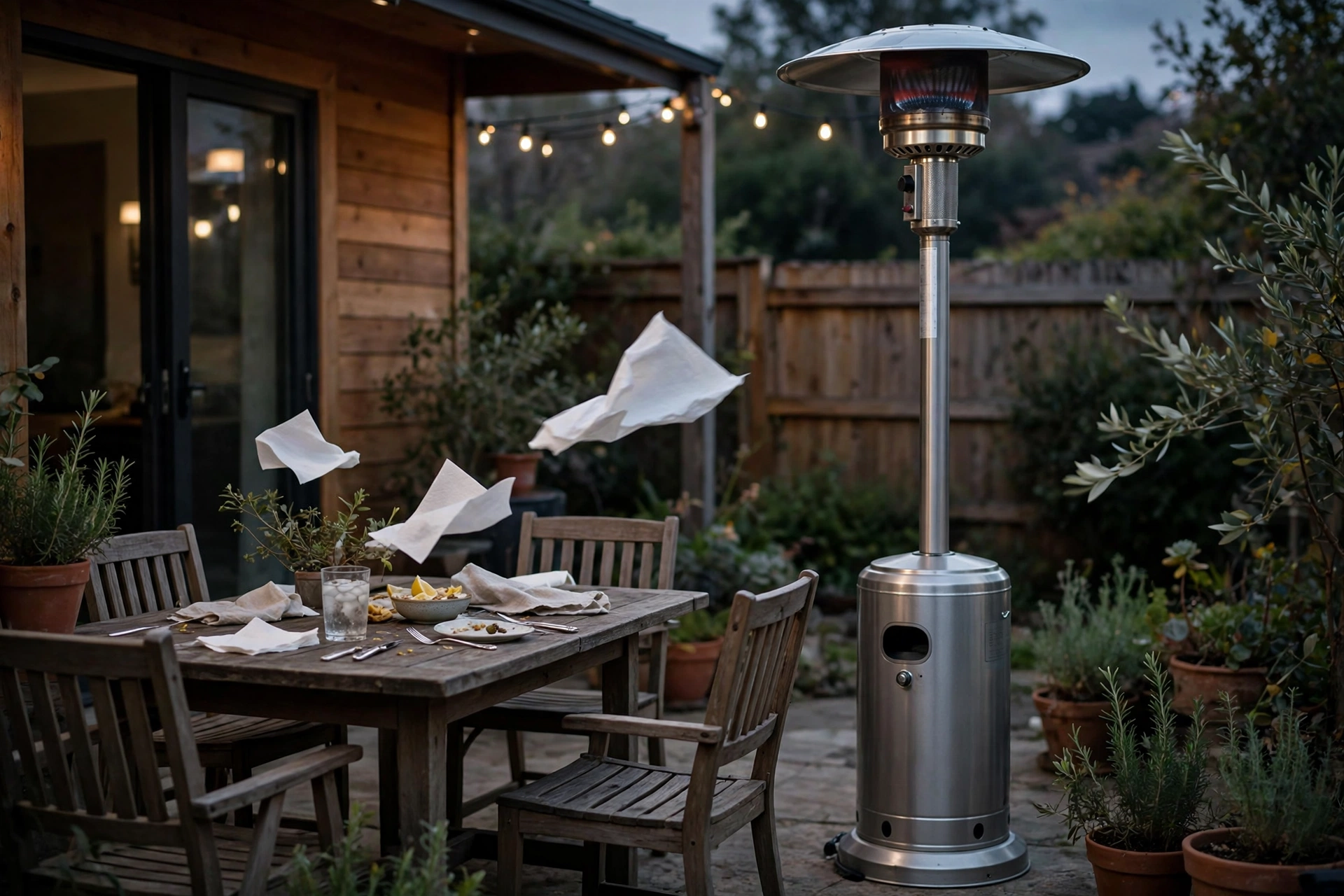
Wind attacks a patio heater twice. It strips the flame or cools the reflector so the heat never reaches the chairs, and it pushes on a tall, top-heavy unit until the base gives up. A heater for an exposed patio has to win both fights, not just post a big BTU number.
That narrows the field fast. The picks below either remove the flame from the equation entirely or put real weight low in the base, and each one is matched to a different kind of windy patio.
Why wind defeats a standard patio heater
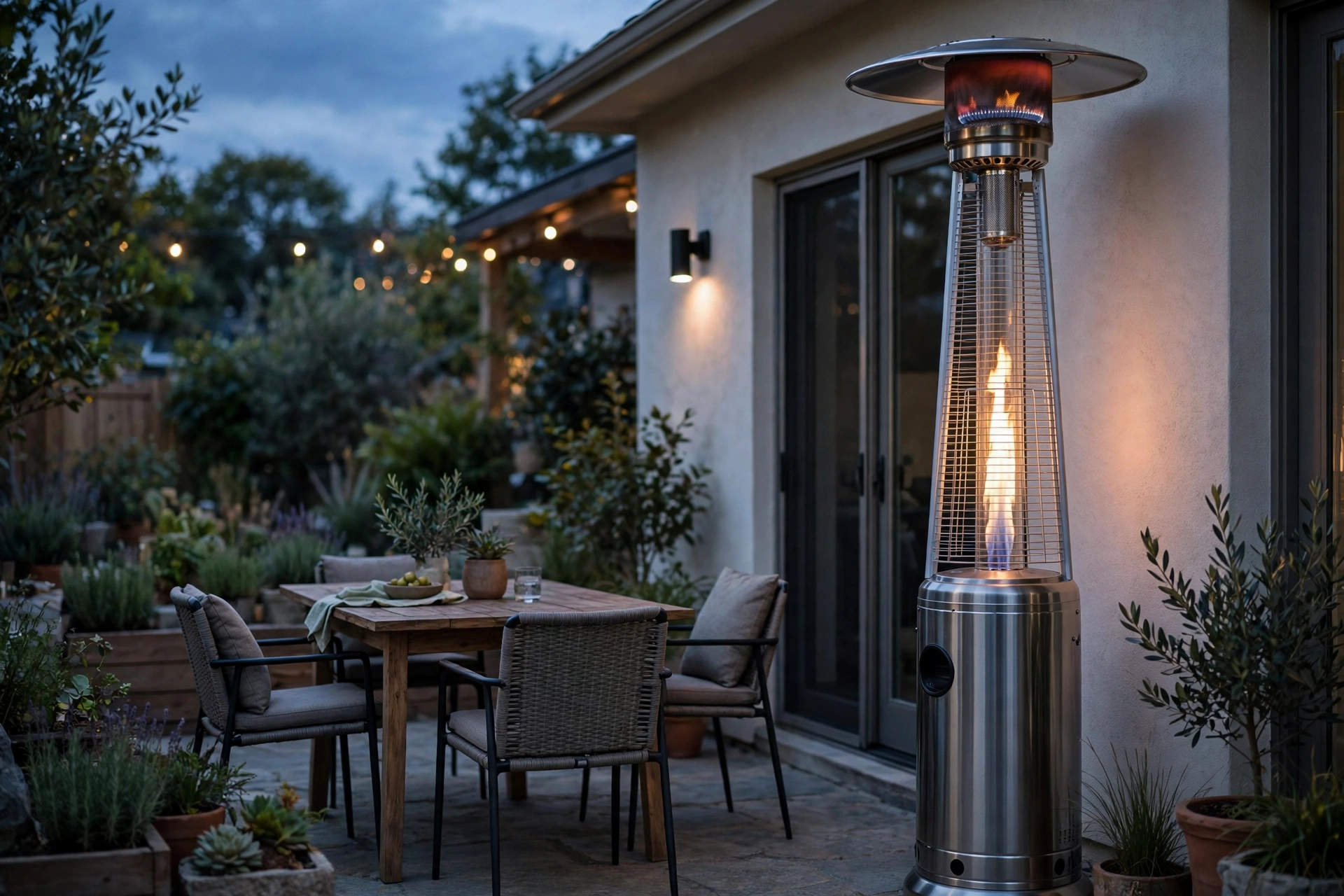
A freestanding propane heater carries its burner about seven feet in the air, under a wide reflector that catches gusts like a sail. The flame itself is the weak point: a steady crosswind lifts it off the burner, the thermocouple cools, and the safety valve shuts the gas off.
That shutoff is the heater doing its job, not breaking. If relighting has become a nightly routine, Why Won’t My Patio Heater Stay Lit? walks through the thermocouple, tilt switch, and regulator causes in plain terms.
Stability is the second problem, and it is a math problem. An 87-inch heater with a 33-inch reflector presents a lot of surface to a gust, while the base underneath it is often only about 18 inches across. Weight low in that base, or a mount that bolts the heater to a wall, is what changes the math.
The picks at a glance
| Heater | Type | Output | Wind answer | Base or mount |
|---|---|---|---|---|
| Bromic Tungsten Smart-Heat Electric 6000W | Electric infrared | 6,000 watts | No flame to blow out | Wall or ceiling mount |
| Hiland HLDS01-SSHST | Propane mushroom | 48,000 BTU | Burner cover, thermocouple, anti-tilt shutoff | Tank in base; base accepts added weight |
| Pyramid glass-tube heaters | Propane flame tube | About 40,000 BTU | Exposed flame column | Tall frame on a narrow base |
Best overall: Bromic Tungsten Smart-Heat Electric 6000W
The Bromic Tungsten Smart-Heat Electric removes the failure point instead of fighting it. There is no flame, no pilot, and no thermocouple waiting to cool down, so a gust has nothing to blow out. The dual infrared elements keep radiating through wind that would shut a propane burner down repeatedly.
Mounting solves the second fight at the same time. This heater bolts to a wall or ceiling on the included brackets, angled toward the seating, so there is no freestanding pole to tip and no base to weight down. At 56 inches wide, it covers a seating area the way restaurant patios use it: from above, aimed at people rather than at the open air.
The output is serious. Bromic rates the 6000W model for up to 160 square feet of coverage, and the dual elements can be controlled separately where the wiring supports it. Infrared also heats people and furniture directly instead of warming air that the wind immediately carries off, which is why a lower headline number here outperforms a bigger propane rating on an exposed patio.
The trade-off is the installation, and it is not small. The 6000W model runs on 220–240 volts and draws 25 amps, so most patios need a dedicated circuit and an electrician, and the heater itself costs several times what a propane tower costs. This is a permanent-install pick, not a buy-it-Friday, use-it-Saturday pick.
Pros: No flame for wind to blow out; wall or ceiling mount cannot tip over; 6,000 watts covering up to 160 square feet; elements controllable separately.
Cons: Needs a 220–240V dedicated circuit and professional installation; highest price here by a wide margin; fixed in place once mounted.
Bromic Tungsten Smart-Heat Electric Patio Heater, 6000W
Mounted infrared with no flame to blow out and nothing to tip over — the wind problem solved twice.
Runner-up: Hiland HLDS01-SSHST 48,000 BTU propane
Not every windy patio can take a hardwired heater, and renters and pergola-free yards still need an answer. The Hiland HLDS01-SSHST is the freestanding propane pick because its stability starts low: the 20-pound tank sits inside the base, and the low, wide base keeps its center of gravity down where the wind has the least leverage.
Whatever freestanding heater you run, weight low in the base is what resists a gust — a heater that lets you add ballast low, and a spot sheltered by a fence or wall, both matter more than another few thousand BTU.
Output is at the top of the freestanding class at 48,000 BTU with variable control, and the safety hardware matters in wind: a thermocouple and an anti-tilt device shut the gas down if the heater does go over or the flame fails. At 87 inches tall it needs overhead clearance, and the owner’s manual clearance for this heater family is three feet from the sides and three feet from the top.
The honest limit is the flame. Weighted and sheltered by a fence line, this heater handles a breezy patio well, but a hard gust across an open deck will still lift the flame and trip the thermocouple where the Bromic would keep radiating. The full trade-off between the two fuel types is laid out in Electric vs Propane Patio Heaters.
Pros: 48,000 BTU with variable control; the tank sits low in the base; thermocouple and anti-tilt shutoff; wheels for moving it into shelter.
Cons: Flame can still blow out in hard gusts; 87 inches tall needs clearance; a 20-pound tank runs about nine hours on high.
Hiland HLDS01-SSHST 48,000 BTU Propane Patio Heater
The freestanding pick for windy patios: 48,000 BTU over a low, tank-weighted base.
Not recommended for wind: pyramid glass-tube heaters
Pyramid heaters put on a good show. A flame column inside a quartz glass tube, roughly 40,000 BTU, and a patio that looks like a restaurant’s. On a windy site, that show is exactly the problem.
The typical pyramid stands about 91 inches tall on a base only about 21 by 12 inches, which is the worst stability ratio in the category: maximum height and sail area over a minimum footprint. The flame tube is also exposed to the wind along its whole length, so gusts distort the flame and throw what heat it makes sideways instead of down at the seating.
Buy one for a sheltered courtyard where the look is the point. Do not buy one as the heat source for an exposed, windswept patio, because it will spend windy evenings either shut down or lying against the fence.
Placement does half the work
Even the right heater loses to bad placement. Put a freestanding unit on the windward edge of the seating and the reflector sheds its heat downwind of the chairs; move it so the wind carries the heat across the seating instead, and the same heater feels a size larger.
A fence, a hedge, or the house wall on the windward side cuts the gust speed at the burner more than any feature on the heater itself. Keep the three-foot clearances from siding, railings, and overhead branches while doing it, and wheel a propane heater into the garage or against the house wall when a storm, rather than a breeze, is in the forecast.
For calmer patios where wind is an occasional nuisance instead of the defining condition, the broader field is covered in Best Patio Heaters for Extending Fall Evenings, including tabletop and lower-output options that make no sense out in the wind.
Bottom line
Buy the Bromic Tungsten Smart-Heat 6000W if the patio can take a mounted, hardwired heater: it is the only pick here that wind cannot blow out or knock over. Where a freestanding propane heater has to do the job, buy the Hiland HLDS01-SSHST and park it where a fence breaks the gusts.