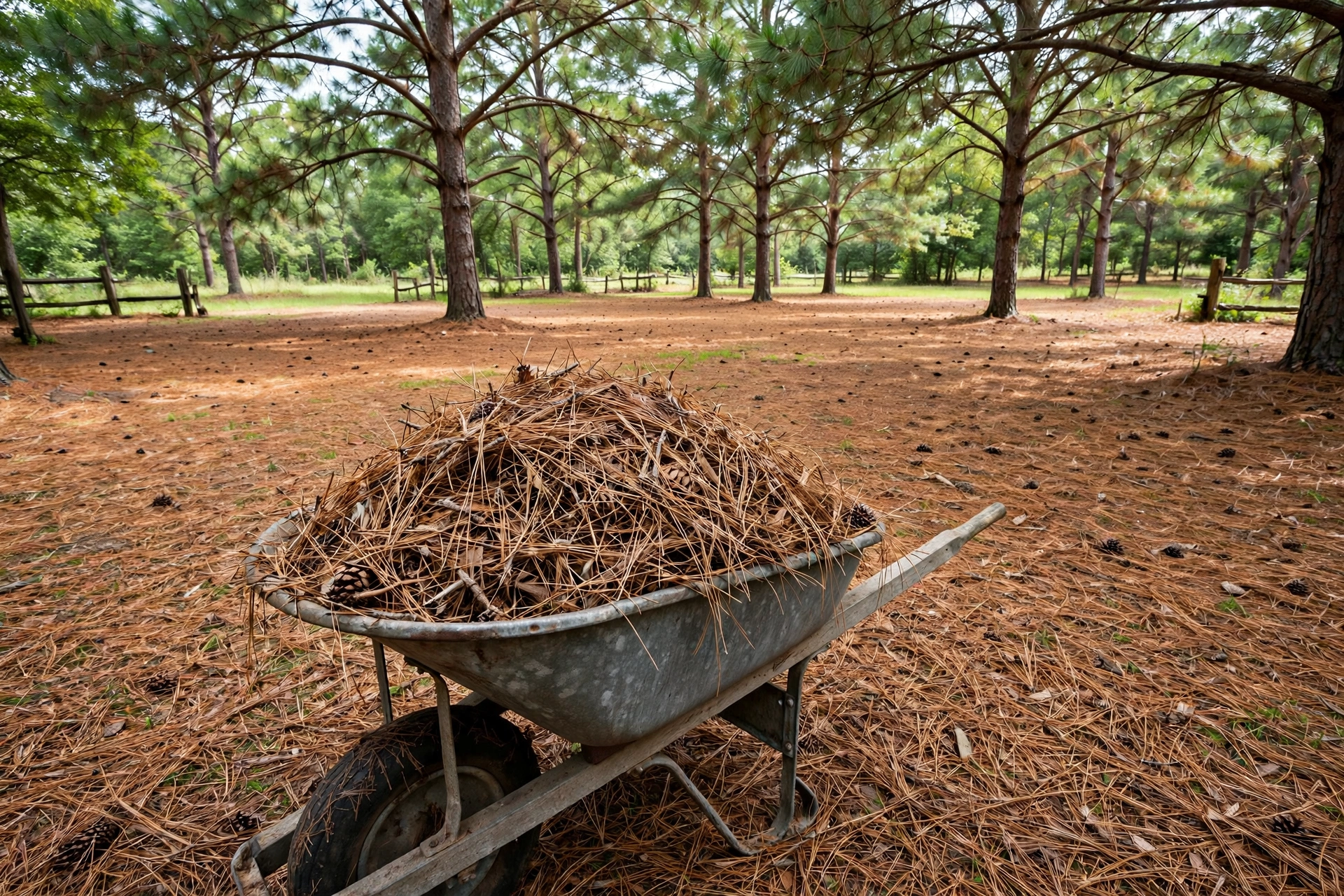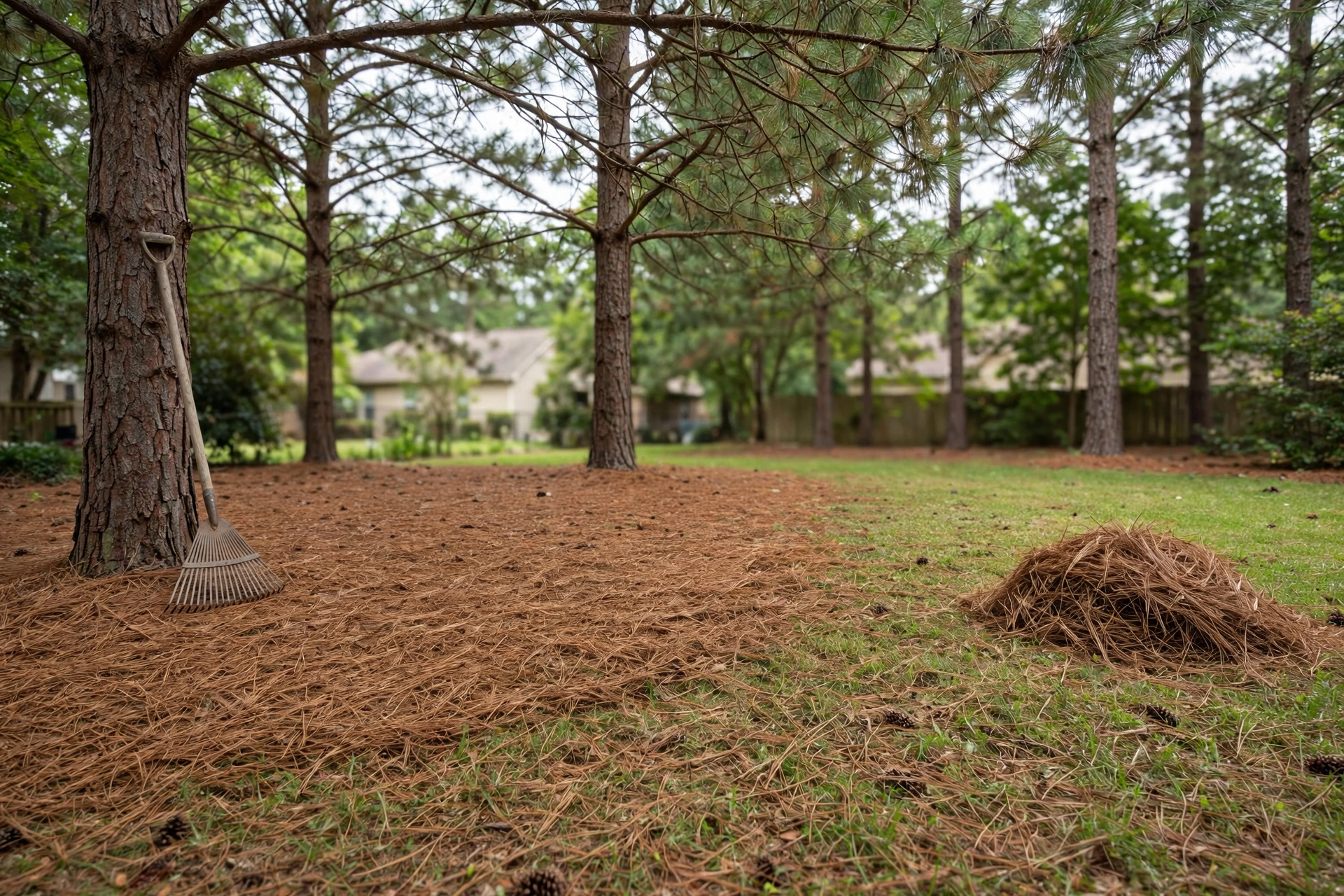
Buy the blower first and you will spend the season chasing needles that refuse to stay in a pile — they scatter across the driveway, slide under the shrubs, and drift back onto the lawn you just cleared.
That is the mistake: picking the tool that feels fastest instead of the one that actually removes the needles. A leaf blower is quick in the hand and satisfying for about ten minutes, right up until the pile you built falls apart and has to be raked anyway. A lawn sweeper is slower to set up and far less exciting to use, and it is the tool that finishes the job, because the needles end up in a hopper instead of in a pile that still needs a second tool to move.
Why pine needles punish both tools
Pine needles are thin, slippery, and light enough to mat into a layer that smothers the grass underneath, which is why the cleanup methods that work for maple leaves fall apart under a pine. A rake’s tines let needles slip through, a blower moves them without collecting them, and a sweeper’s brushes can clog when the mat is wet. The complete guide to pine needle cleanup lays out the full picture, including a time calculator for sizing the job to your yard.
Wet needles are the worst case for either tool, and they are the one condition where the choice matters most: a sweeper’s brushes clog on a soaked mat, while a blower just pushes wet needles into a heavier pile. If the needles are wet, wait for a dry day or pick them up with a rake first — the guide to wet pine needles covers the full answer.
Sweeper vs blower, side by side
The complete guide to pine needle cleanup times each method per 1,000 square feet, which is the only honest way to compare tools, since a small flat yard and a half-acre under mature pines are not the same job.
| Tool | How it clears needles | Time per 1,000 sq ft | Best yard | Weak spot |
|---|---|---|---|---|
| Push sweeper | Brushes lift needles into a hopper | 20–25 minutes | Small, flat lawns | Struggles with cones and wet mats |
| Tow-behind sweeper | Wide brushes sweep needles into a large hopper as you drive | 8–12 minutes | Medium to large lawns | Needs a riding mower or tractor |
| Leaf blower | Air pushes needles into piles you still have to collect | 15–20 minutes | Dry, open areas | Scatters needles; piles fall apart |
The table hides the real difference, which is what happens after the pass: the sweeper’s work is done when the hopper is full, while the blower’s work is only half done when the pile is built, because the pile still has to be raked, bagged, or tarped away.
Where the sweeper wins
Width is the sweeper’s advantage, and it is a big one on a pine-heavy yard: the Agri-Fab tow-behind sweeps a 44-inch path with a 25-cubic-foot hopper, and the Ohio Steel model covers a 50-inch path with a 26-cubic-foot hopper, so each pass clears a wide strip and the hopper holds enough needles to cut the number of trips to the compost pile. Those two models go head to head in the Agri-Fab vs Ohio Steel vs Brinly tow-behind comparison, and the best lawn sweepers for spring cleanup rounds out the wider field.
Push and tow-behind sweepers are not interchangeable, and picking the wrong one is the second mistake people make after buying the blower: a push sweeper suits a small flat lawn, while a tow-behind only makes sense if you already own a riding mower or lawn tractor to pull it. The push-vs-tow-behind comparison works through that choice in detail.
One setting decides whether a sweeper actually picks needles up or just rolls over them: brush height. Set the brushes too high and they skim over the mat; set them too low and they drag and stall on uneven ground. The Agri-Fab model carries an adjustable brush height for exactly this reason, and it is the first thing to check on any sweeper you are considering for pine needles — a fixed-height brush that works fine on leaves can leave half the needles behind.
Where the blower still earns its keep
The blower earns its keep in the gaps: it clears needles out of beds, from under shrubs, and off driveways and patios — the places a sweeper’s brushes cannot reach — and it moves dry needles onto the open lawn where the sweeper can collect them. Used that way, the two tools stop competing and start covering each other’s gaps.
If the blower is doing the whole job on its own, pick one built for needles rather than leaves: the best leaf blower for pine needles is chosen for the air volume and nozzle control that move a matted layer instead of just stirring it. And where cones and heavy debris join the needles, a lawn vacuum deserves a look — the leaf vacuum vs leaf blower comparison weighs that trade-off directly.
The bottom line
For most yards under pines, the sweeper wins — it clears more ground per pass, it collects instead of scattering, and the job is done when the hopper is empty rather than when the pile is built. Buy the sweeper first, keep the blower for beds, corners, and the driveway, and the needles stop being a season-long chase. The cost side of the same decision — rake, sweeper, or hiring it out — is worked through in the pine needle cleanup cost comparison.