Here is the mistake: buying the edger that looks serious instead of the edger that fits your yard. A powered edger on a 30-foot edge is a machine you fuel, charge, store, and maintain for a ten-minute job. A hand edger on 300 feet of neglected edge is an afternoon of stomping that ends with a sore back and a wavy line.
The right choice is not about which tool is better. It is about how much edge you have, how often you cut it, and whether you are creating an edge or just keeping one tidy. Get those three answers right and the tool picks itself.
The Two Families, Plainly
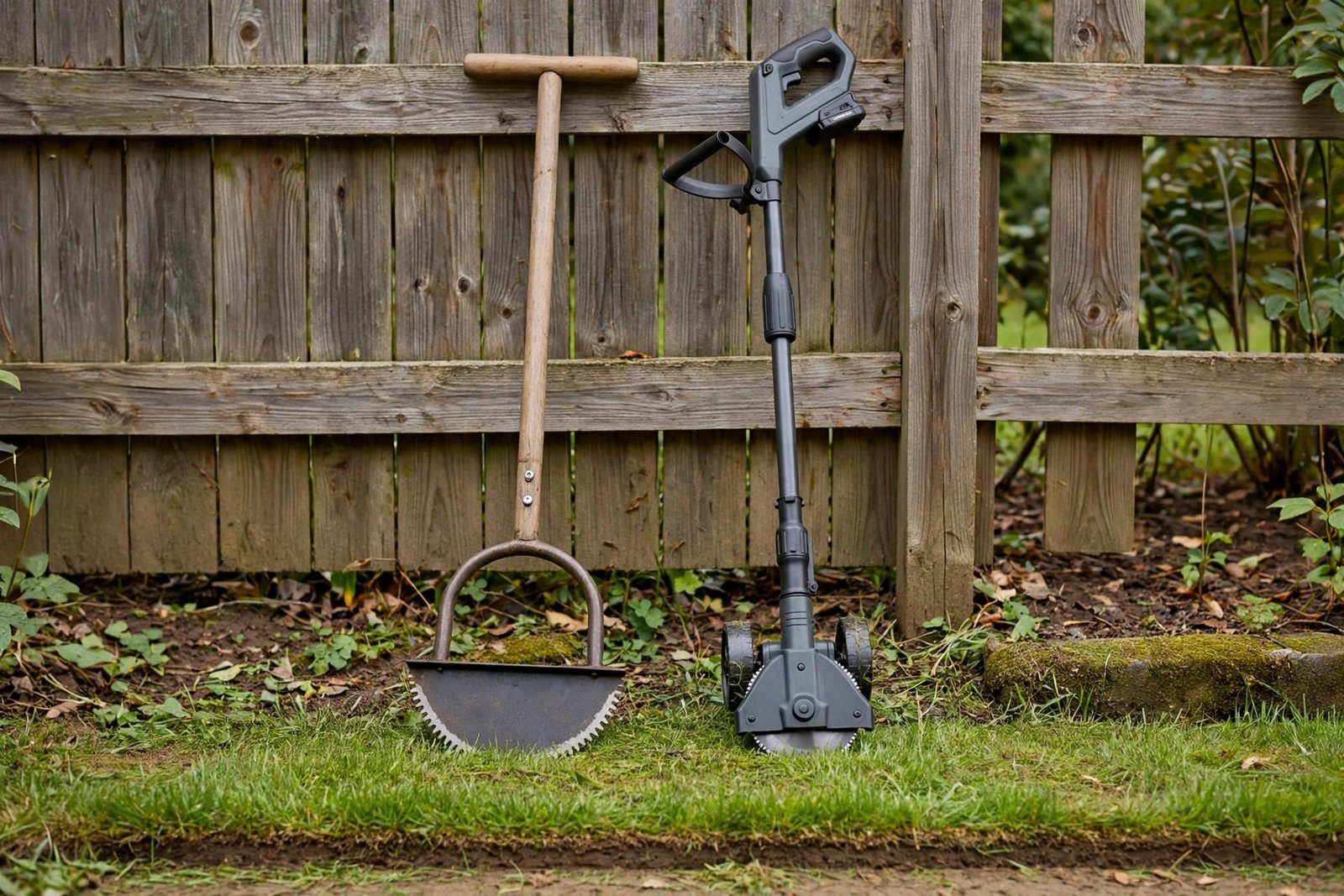
A manual edger is a blade you drive with your foot. The common half-moon edger is a crescent-shaped steel blade on a long handle, with a flat step on top for your boot. You set it on the line, press down, rock it slightly, and move along. A rotary hand edger works the other way: a toothed wheel rolls along the hard surface while its blade slices the grass that overhangs the edge.
A powered edger is a spinning steel blade on a motor. Gas, corded electric, and cordless models all do the same job: the blade cuts a narrow vertical groove where lawn meets path, driveway, or bed. You walk it along the edge and it does the cutting. The blade depth adjusts on most models. A Greenworks 60V cordless edger, for example, tops out at 1.75 inches of cutting depth, while its 8-inch edgers can cut deeper against a curb. Set the depth shallow for a tidy-up pass and deeper when you are recutting an edge that has crept over the concrete.
Then there are edging shears, the third tool people confuse with an edger. Shears trim the grass flopping over an edge that already exists. They do not cut a new line into soil. If your edge is already defined and you only need it neat, shears are the lightest option of all. This article is about the two tools that actually cut the line.
When the Manual Edger Wins
Short edges, cut often. If your total edging is a front walk, a short driveway apron, and a bed or two, a hand edger is faster overall. There is nothing to charge, nothing to fuel, and nothing to start. You grab it, cut the line, and hang it back up.
New edges and bed borders. A half-moon edger shines where a powered blade is clumsy: cutting a fresh edge along a flower bed, or recutting one that has gone soft and grassy. The foot pressure gives you control at curves, and you can see exactly where the blade lands. Work when the soil is moist, not baked hard. Even a sharp blade fights dry, compacted ground, and forcing it is how blades bend and edges wander.
Small budgets and small sheds. A manual edger is typically a 2 to 3 kg tool that leans in a corner and asks nothing of you all winter. No battery to store at the right charge, no fuel to stabilize, no spark plug to think about. Sharpen the blade now and then and it keeps working. Our guide to sharpening and replacing an edger blade covers the upkeep in a few minutes.
The trade-off is honest: the work is yours. On overgrown edges, where grass has run six inches onto the path and roots have matted, a hand edger is slow and tiring. It is a maintenance and line-cutting tool, not a reclamation tool.
When the Powered Edger Wins
Long edges, cut regularly. Driveways, long sidewalks, and corner lots add up fast. A powered edger holds a steady depth and a straight line at walking pace, and it does it the same way on the last ten feet as the first. That consistency is what you are paying for.
Overgrown edges. When the lawn has swallowed the edge of the driveway, a spinning blade chews through the mat in one pass where a hand tool takes three. Start shallow, make a second pass deeper if you need it, and let the guide wheel ride the hard surface so the cut stays true.
Hard, dry ground. Powered blades do not care much whether the soil is moist. If your soil sets like concrete in July, that alone can justify the motor. Just clear stones and debris from the line first. A spinning blade throws what it hits.
The trade-off is everything around the cut: charging or fueling, noise, storage space, and winter care. Gas models need the fuel system dealt with before storage, and cordless models need their batteries brought inside and stored partly charged. Our winterizing guide for lawn edgers walks through each power type. If you already own a string trimmer, check first whether turning it vertical covers your edging, as our gas vs cordless edger comparison explains before you buy a dedicated machine.
Manual vs Powered at a Glance
| Manual edger | Powered edger | |
|---|---|---|
| Best for | Short edges, bed borders, new lines | Long runs, overgrown edges, hard soil |
| Your effort | High: foot pressure every cut | Low: guide it and walk |
| Speed | Slow on long runs | Fast and consistent |
| Running cost | None after purchase | Fuel, electricity, or batteries |
| Upkeep | Sharpen the blade, keep it dry | Fuel, battery, blade, and winter care |
| Edge quality | Excellent control at curves | Very straight, very even depth |
The Decision in Thirty Seconds
Buy the manual edger if your edging totals under about 50 feet, you edge at least every few weeks in season, and most of your work is along beds and short walks. You will spend less, store less, and never troubleshoot a motor on a Saturday morning.
Buy the powered edger if you have a long driveway or sidewalk, edges that go months between cuts, or soil that turns to brick by midsummer. The motor earns its keep the first time you reclaim an edge instead of fighting it by hand.
Buy both, eventually, if you have long hard edges and soft bed borders. That is not upselling; it is the honest answer for a yard with both jobs. The powered edger runs the driveway, the half-moon edger cuts the bed lines, and neither tool does work it is bad at. Start with whichever job annoys you most, and add the other when the first one proves its worth.
Whichever you choose, keep the blade sharp and the line consistent. A sharp manual blade and a shallow, steady powered pass both beat a dull blade pushed too deep. If you are still deciding on a powered model, start with our budget-friendly lawn edgers roundup, and if your edges are more about the look of the beds than the cut itself, our DIY lawn edging ideas will help you shape them first.
What to Avoid
Do not buy a powered edger for a yard with almost no hard edges. A half-moon edger and shears will do that yard better for a fraction of the money. And do not buy a manual edger expecting it to rescue an edge that has not been cut all year. Clear the worst of it first, then maintain it with the hand tool. The wrong tool does not just waste money. It teaches you to skip the job, and skipped edges are how a tidy yard turns shaggy by August.