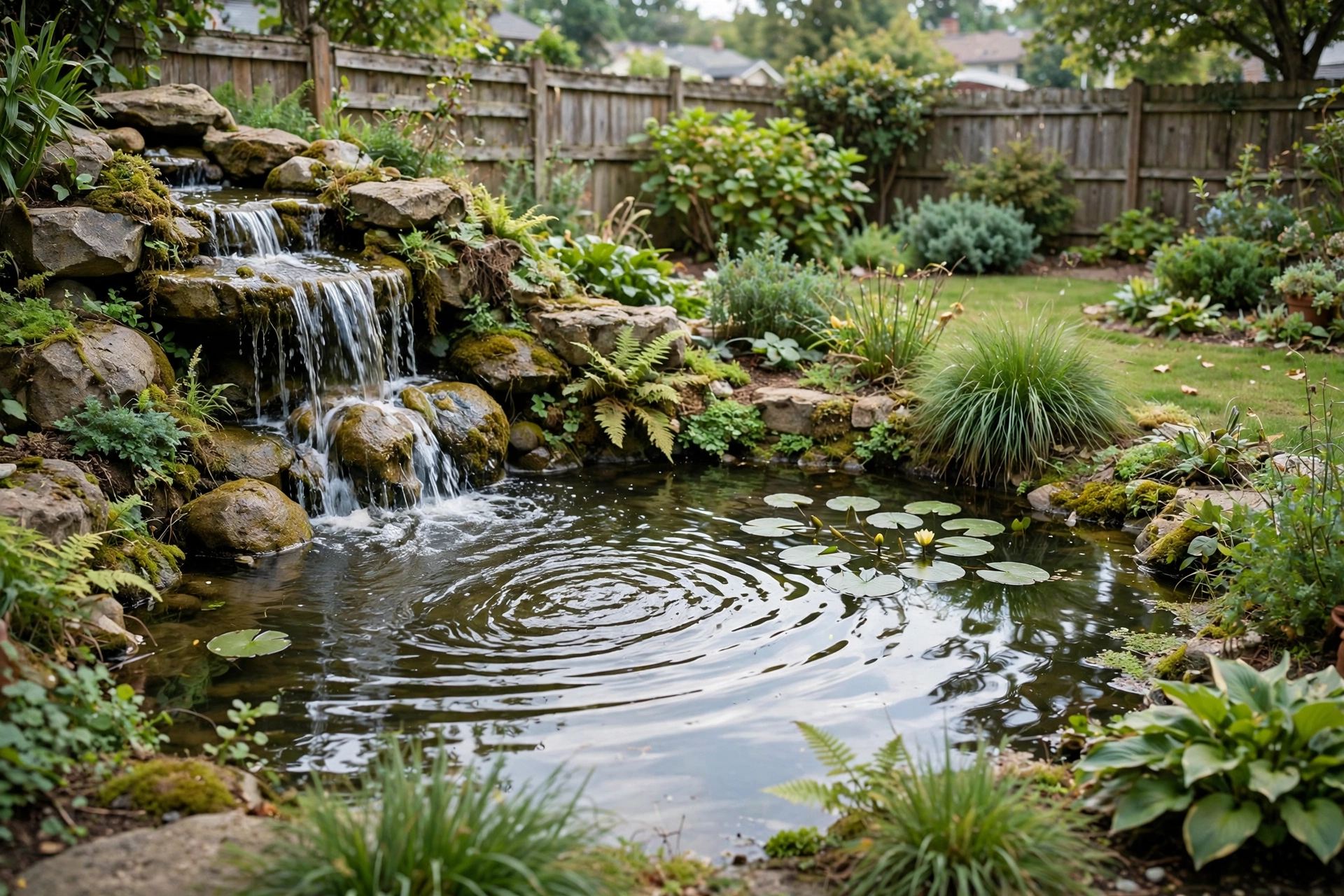
1,197 gallons. That is what a modest 10-by-8-foot pond, two feet deep on average, actually holds — and it is the number that decides your pump, not the big flow figure printed on the box.
A pump box advertises flow at zero lift. Your pond asks the pump to push water uphill to a filter or a small waterfall, and flow falls as that lift rises. This calculator works out your pond’s real gallons, then the flow the pump has to deliver at your lift height.
Pond Pump Sizing Calculator
Average depth is the depth across the pond, not the deepest spot. If you only know the deepest point of a bowl-shaped pond, enter it below instead and the calculator will estimate the average as 0.4 times that depth — an estimate, not a measurement.
The calculator needs JavaScript to run. The worked examples and size table below cover the same math by hand.
What do I type?
Measure the pond at the waterline. Length and width in feet are enough for a rectangular or oval pond, and a round pond needs only its radius — half the distance across.
Average depth takes a minute of honest probing. Push a marked stick down in several spots, add the readings, and divide by how many you took. Shelves and a deep sump average out, and that average is the number the math needs.
Lift height is the vertical climb from the pond surface to the highest point the water reaches — usually the filter outlet or the top of a waterfall. Horizontal distance along the ground does not count here; only the climb does.
What does this number mean?
The result is a pair of numbers, and you need both. The first is the flow your pond requires, in gallons per hour. The second is the lift, with a 10 percent allowance added for friction in the pipe and fittings — together they are the total dynamic head, the total resistance the pump works against.
Every pump has a chart, called a pump curve, that shows how much water it moves at each lift height. Find your lift on that chart and check the flow beside it. A pump rated at 1,200 gallons per hour on the box may deliver half of that at four feet of lift.
Match the pair, not the headline. If the chart shows at least your required flow at your lift, the pump is big enough. If it falls short at your lift, move up one size, however impressive the box number looks.
How the math works
For a rectangular pond, the calculator multiplies length by width by average depth to get cubic feet, then multiplies by 7.48 to get gallons. A round pond uses 3.14 times the radius squared, times average depth, times 7.48.
Required flow is the gallons divided by the turnover period you chose. A pond that turns over every two hours needs half its volume per hour; a fish pond on a mechanical filter needs its full volume every hour.
One acre-foot of water is 325,851 gallons, which is where the 7.48 comes from: an acre-foot spread over an acre is the same conversion, worked down to single feet.
Worked examples
A 10-by-8-foot pond, 2 feet deep on average. Volume is 10 × 8 × 2 × 7.48 = 1,196.8 gallons. At a two-hour turnover it needs 598.4 gallons per hour at its lift height. At a one-hour turnover it needs the full 1,196.8 gallons per hour.
A round pond, 5-foot radius, 2 feet deep on average. Volume is 3.14 × 25 × 2 × 7.48 = 1,174.4 gallons — nearly the same pond in a different shape, and it needs nearly the same pump.
The acre check. One acre of water averaging 5 feet deep is 5 acre-feet, and 5 × 325,851 = 1,629,255 gallons. Farm ponds live in a different pump class entirely, which is why this calculator is aimed at garden ponds.
The bowl estimate. A bowl-shaped pond with a deepest point of 3 feet averages about 1.2 feet (0.4 × 3). Using the full 3 feet instead would overstate the volume two and a half times and buy a pump far larger than the pond needs.
Common pond sizes
| Pond (length × width × average depth) | Gallons | Flow at 2-hour turnover | Flow at 1-hour turnover |
|---|---|---|---|
| 8 × 6 × 2 ft | 718.1 | 359.0 gal/hr | 718.1 gal/hr |
| 10 × 8 × 2 ft | 1,196.8 | 598.4 gal/hr | 1,196.8 gal/hr |
| 12 × 10 × 2.5 ft | 2,244.0 | 1,122.0 gal/hr | 2,244.0 gal/hr |
What this calculator does not do
This tells you the flow your pond needs at a stated lift — it does not size a waterfall stream, work out electrical costs, or say how many fish a pond can hold. Waterfall flow has no single Extension rule behind it, so the honest move is to size the circulation here and follow the waterfall manufacturer’s own chart for the spillway.
If your pond is a planted water garden with no fish, the two-hour turnover is the calmer choice and usually the cheaper pump. Add fish or a mechanical filter and the one-hour setting is the one to use, because the filter only cleans the water that actually reaches it.
Buy the pump whose chart clears your pair of numbers with a little room to spare. Pumps lose a step as impellers wear, and a small margin today is a pond that still turns over three summers from now.
Sources
- Penn State Extension, “Pond Measurements: Area, Volume and Residence Time” — https://extension.psu.edu/pond-measurements-area-volume-and-residence-time (fetched November 27, 2026)
- Texas A&M AgriLife Earth-Kind, “Construction Methods for Water Gardens” — https://aggie-horticulture.tamu.edu/earthkind/landscape/water-gardening/contruction-methods-water-gardens/ (fetched November 27, 2026)
- Texas Parks & Wildlife Department, “Estimating the Size of Your Pond” — https://TPWD.state.tx.us/landwater/water/environconcerns/nuisance_plants/manage/pondsize.phtml (fetched November 27, 2026)
- Mississippi State University Extension, Publication 3236, solar-powered groundwater pumping (total dynamic head definition) — https://extension.msstate.edu/publications/solar-powered-groundwater-pumping-systems-for-livestock-watering (fetched November 27, 2026)