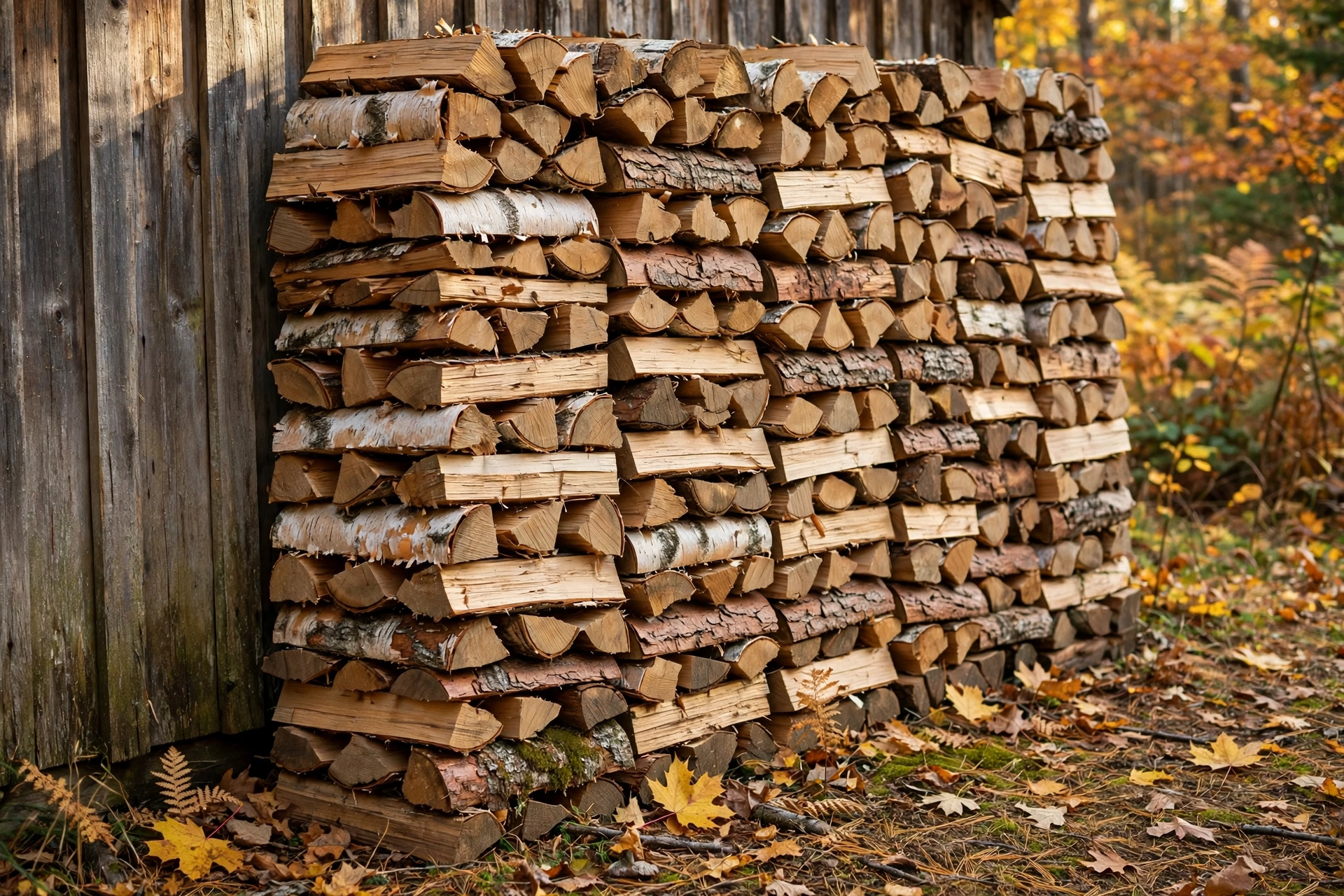
Two cords can fill the same space in the driveway, cost the same money, and look like the same honest stack of winter heat. One of them will still be warming the house long after the other has burned down to ash and good intentions.
The difference is the species, and the gap is wider than most buyers realize. The strongest wood on this table delivers nearly twice the heat of the weakest from a cord of the exact same size — so the bargain cord of light wood can quietly become the most expensive heat you buy all winter.
This table puts a number on that gap. It ranks 11 common firewood species by heat value, in million Btu per cord of seasoned wood, so you can judge a stack by what it will actually deliver before the truck backs in.
Heat value by species
Every figure is for seasoned wood — cut, split, and dried before burning — and a cord means 128 cubic feet of stacked wood, the classic 4-by-4-by-8-foot pile.
| Species | Heat value (million Btu per cord) | Source |
|---|---|---|
| Osage orange | 30.7 | Missouri Department of Conservation |
| Hickory | 29.1 | Missouri Department of Conservation |
| Black locust | 28.1 | Missouri Department of Conservation |
| White oak | 27.0 | Missouri Department of Conservation |
| Red oak | 25.3 | Missouri Department of Conservation |
| Ash | 23.6 | Missouri Department of Conservation |
| Elm | 21.4 | Missouri Department of Conservation |
| Shortleaf pine | 19.0 | Missouri Department of Conservation |
| Redcedar | 18.9 | Missouri Department of Conservation |
| Boxelder | 17.5 | Missouri Department of Conservation |
| Cottonwood | 16.1 | Missouri Department of Conservation |
What the ranking actually tells you
Heat per cord tracks density, because a cord is a measure of space rather than weight. The heavy hardwoods sit at the top of the table for a plain reason: a cord of Osage orange or hickory packs far more wood — and far more stored energy — into those 128 cubic feet than a cord of cottonwood does.
You can feel the ranking in your arms before a match is struck. A split of Osage orange lands in the stove with a heft that a same-size piece of cottonwood never has, and on a cold night it is still throwing heat when the lighter wood has already settled into the ash bed.
Run the price against the table before you buy, because price per cord is the wrong number on its own.
Say a dealer asks $300 for a cord of white oak and $220 for a cord of cottonwood. The oak works out to about $11 per million Btu, while the cottonwood runs about $13.66 per million Btu — the cheaper stack is the more expensive heat, and you would burn through it faster besides.
The conditions behind these numbers
These figures assume the wood has seasoned — cured for at least six months after cutting and splitting. Green wood carries too much water to burn efficiently, it delivers less heat than its row in the table promises, and it lays down creosote inside the flue, which is a fire risk rather than a bargain.
The table also ranks the wood, not your stove. How much of that heat stays in the house depends on the appliance burning it: an open fireplace sends nearly all of it up the chimney, while a high-efficiency wood stove puts far more of the same cord to work in the room where you actually live.
One absence is worth naming. Hard maple is a dense, high-heat wood that belongs in the conversation with the oaks, but it carries no figure in the source table behind this one, so it gets no row here rather than a guessed number.
Put the number to work
Once you know what a cord of your species holds, the firewood cord and heat-value calculator turns that figure into the cords your stove and your winter will actually call for. Work the species first and the stack count second, and the mid-January scramble for one more load mostly takes care of itself.
Dense wood is heavy wood, and it earns its keep only if it stays dry off the ground. The roundup of the best firewood racks for backyard fire pits covers the storage side — airflow underneath, a cover on top, and the stack close enough to the door that February trips stay short.
Bottom line
Buy the densest wood you can get at a fair price, judge every offer by cost per million Btu instead of cost per cord, and give it a full six months to season before it meets a match. Do that, and the stack in the driveway is heat you can count — not just wood you can measure.
Sources
Missouri Department of Conservation, “Home Heating,” Missouri Conservationist, January 2007 — https://mdc.mo.gov/magazines/conservationist/2007-01/home-heating — fetched November 18, 2026; verified again November 19, 2026.