Here is the mistake that costs people money under a pine: buying the cheaper rolling gatherer for a yard that drops cones by the wheelbarrow, then buying the sweeper anyway a month later — two tools, one job, and the first purchase wasted.
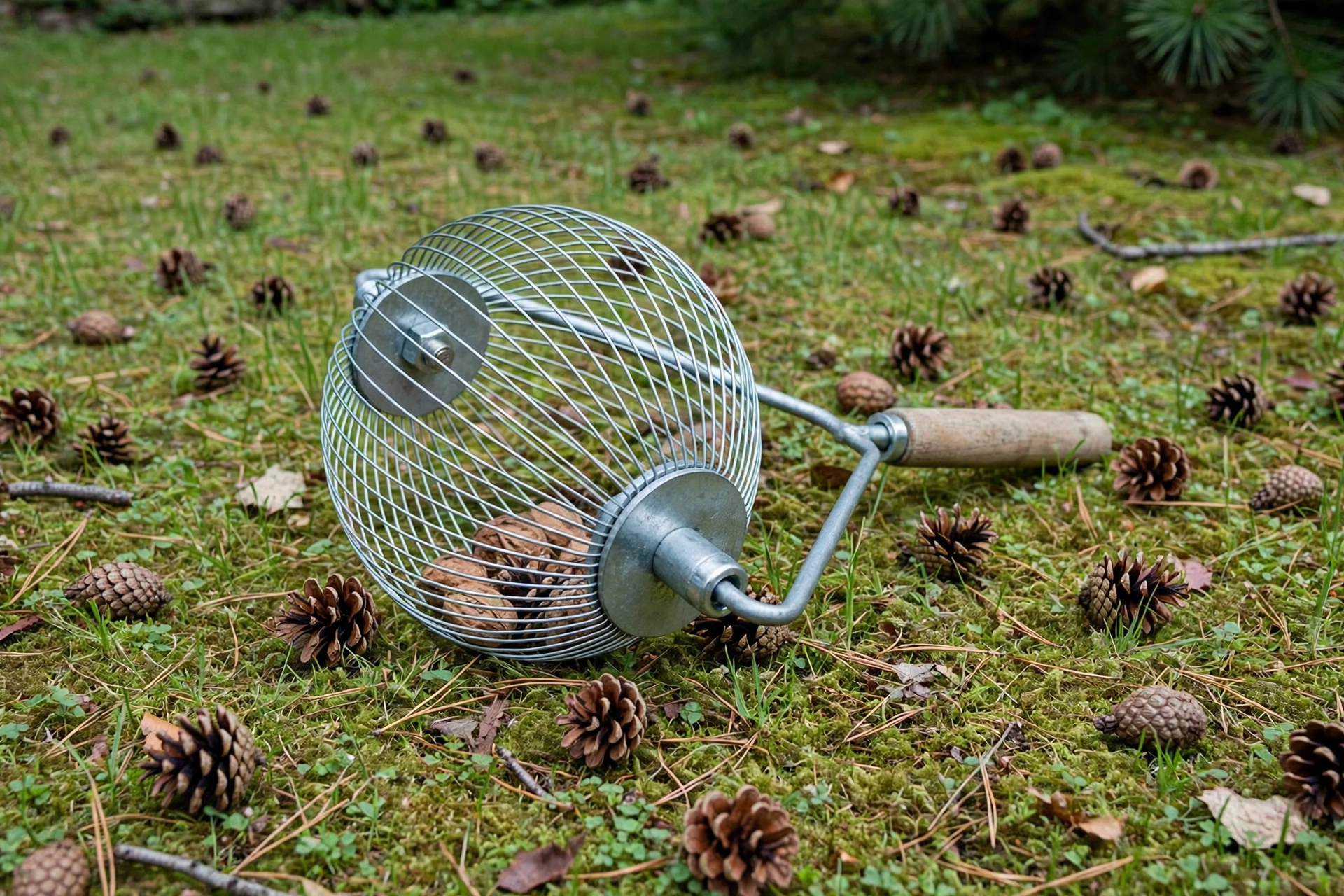
A rolling nut gatherer and a lawn sweeper both promise pine cone cleanup without bending, but they work in opposite ways. The gatherer traps individual cones in a wire cage as you walk. The sweeper brushes a wide path into a hopper as you push or tow. Which one wins depends on cone size, yard size, and how much storage you have, and it helps to read this alongside the full pine cone tools roundup.
Rolling nut gatherer vs lawn sweeper for pine cones, side by side
| Measure | Rolling nut gatherer | Lawn sweeper |
|---|---|---|
| How it picks up | Wire cage spreads and traps items in its size window | Rotating brush sweeps debris into a hopper |
| Cone size fit | Best for cones inside the cage window, about 1.5 in. and up on the large model | Handles a wider mix, including cones a cage skips |
| Speed | Walking pace, one narrow path | Wide path — 30 in. push, 44 in. tow-behind |
| Capacity | One cage at a time; empty into a bucket often | 12 cu. ft. push hopper; 28 cu. ft. on the 44-in. tow model |
| Storage | A handle in a garage corner | Real floor space, especially tow-behind |
| Misses | Very large cones; cones pressed into tall grass | Cones on very uneven ground; wet, stuck-down cones |
Where the gatherer wins
On a small lot with one or two pines, the gatherer is the honest winner. It starts the second you pick it up, it needs no hitching or assembly before each use, and it works between beds and around trunks where a wide sweeper cannot turn. The cage also sorts by size as it goes — grass and needles mostly stay on the lawn while cones go in the cage, so what you dump is mostly cones.
Mid-job, the rhythm is pleasant in a way a machine is not: roll, hear the cage fill, spread the wires over the bucket, roll again. On a quiet morning that is yard work at walking pace, not a project.
Where the sweeper wins
Scale changes the answer. A sweeper clears in one pass what a gatherer needs six passes to cover, and it takes leaves and grass clippings in the same pass, so a storm drop becomes one job instead of three. If you already own a tractor or ATV, the tow-behind version turns the worst cone week of the year into a short loop around the yard.
The sweeper is worse at precision. It needs room to run, it bounces over roots and ruts, and a cone wedged upright in thick grass can roll ahead of the brush. Expect a short grabber pass afterward for the stragglers, whichever machine you choose.
The cone-size test to do first
Pick up five typical cones. Line them up and look at the smallest and largest, because a cage that fits the average cone will still miss both ends of the range.
Count a square yard. If a single square yard holds more cones than you would enjoy picking up by hand, you are in sweeper territory on any yard bigger than a postage stamp.
Bottom line
Choose the rolling gatherer for a small yard, a single pine, and cones that fit its cage. Choose the sweeper for a big drop, a big lawn, or a mixed mess of cones, leaves, and clippings. The wrong choice is not a bad tool — it is a good tool matched to the wrong yard, so size the job before you spend.