Sixty-two days. That is the spread between Memphis International Airport, with 245 frost-free days on the NOAA 1991–2020 normals, and Crossville, with 183 — the Mississippi River lowland and the Cumberland Plateau of the same state, reading the same climate record.
A single Tennessee planting date would mistime one end of that spread or the other. Peas sown on Memphis timing in Crossville sit in cold ground for weeks, and tomatoes held to a plateau schedule in Memphis give away the longest season in the state, one that runs to November 16. Gardeners feel the gap in smaller ways too: a Knoxville frost that never reaches Chattanooga, a Nashville April that arrives a week behind Jackson.
UT Extension handles the spread by writing its home vegetable calendar for three regions — West, Middle, and East Tennessee — and every planting window here follows that calendar, region by region. The full national index is the planting calendars by state page; Tennessee’s eastern neighbor, with its own three-region chart, is the North Carolina planting calendar.
Three regions, three springs
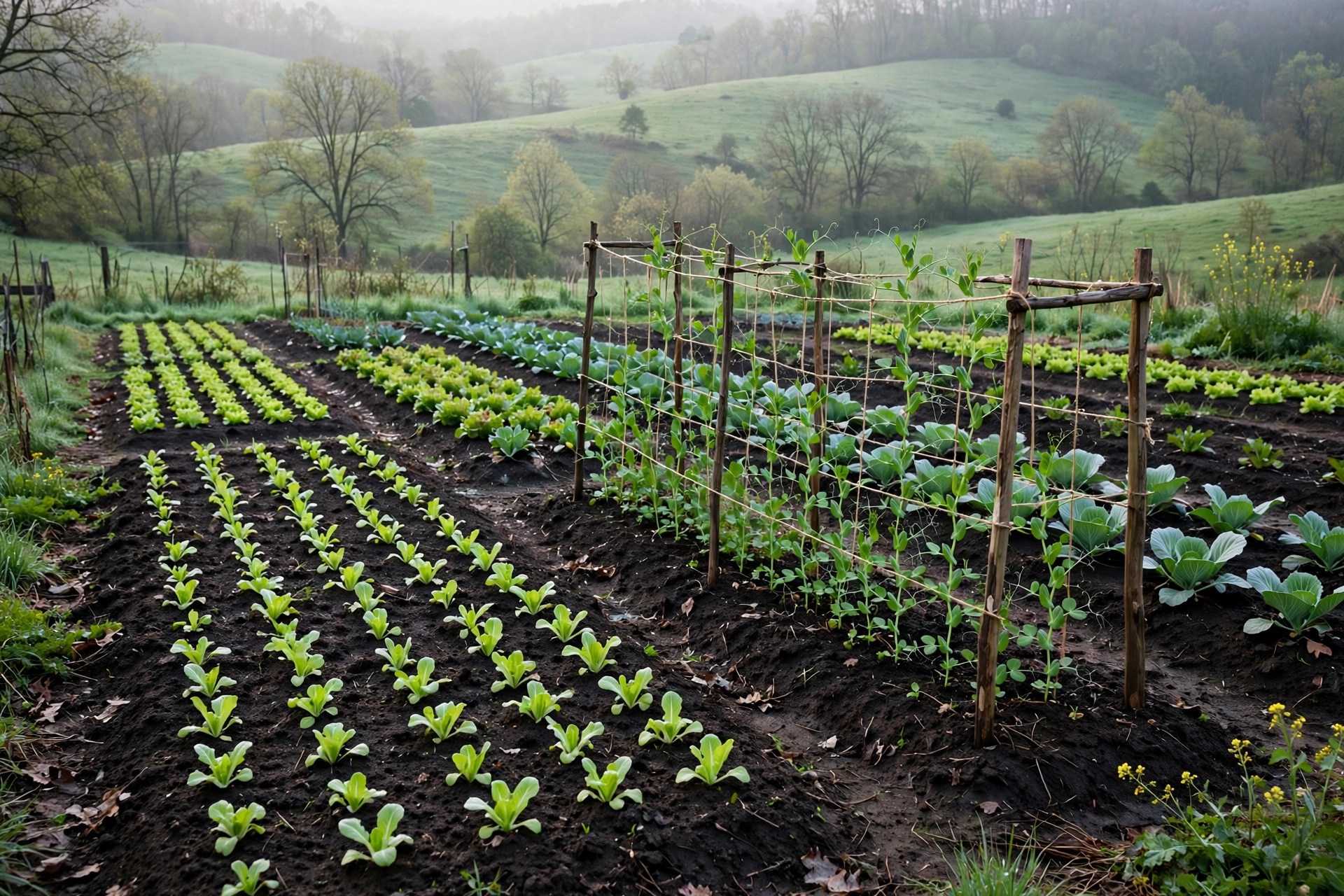
West Tennessee is the low ground along the Mississippi: Memphis, Jackson, and Dyersburg, where spring work starts first. Lettuce and Irish potatoes go in during early March, peas and potatoes are all seeded by late March, and the first beans and sweet corn are direct seeded in early April.
Middle Tennessee is the middle in timing as well as geography: Nashville, Clarksville, and Murfreesboro, with the Highland Rim slowing the edges. Early beans and sweet corn follow West Tennessee by about a week, warm-season transplants go in from mid-April once the frost-free date passes, and cucumbers are direct seeded in early May.
East Tennessee runs latest, and it splits internally. The valley floor around Knoxville and Chattanooga plants weeks ahead of the high ground at Crossville and Mountain City, where UT Extension’s safe spring date does not arrive until May 10 and May 26. East Tennessee gardeners direct seed peas, mustard, kale, and collards in early March when the soil can be worked, set seed potatoes from mid-March, and hold cucurbits until mid-May.
Frost dates at six Tennessee stations
The dates in this table are medians from the NOAA 1991–2020 normals: in half of years, the last spring freeze at 32°F came after the spring date shown, and the first fall freeze came before the fall date shown. A median describes the middle year in the record, and any one year can run earlier or later, which is why how frost dates actually work matters before a tender transplant goes in on the strength of one.
| Station | Last spring frost (50%) | First fall frost (50%) | Frost-free days |
|---|---|---|---|
| Memphis International Airport | March 16 | November 16 | 245 |
| Chattanooga Lovell Airport | March 24 | November 9 | 230 |
| Nashville International Airport | March 31 | November 3 | 217 |
| Knoxville McGhee Tyson Airport | April 1 | November 2 | 215 |
| Bristol Tri-City Airport | April 16 | October 24 | 191 |
| Crossville 7 NW | April 20 | October 20 | 183 |
UT Extension also publishes a more cautious set of dates in W 346-B: the day by which the chance of a later 32°F freeze has fallen to 10 percent. On that basis Memphis is April 9 in spring and October 30 in fall, Nashville is April 21 and October 10, Knoxville is April 28 and October 8, and Mountain City is May 26 and September 18. Tender transplants belong near the cautious dates; hardy peas and potatoes can work to the medians.
How the calendar’s dates work
UT Extension’s rule for cool-season crops is measured back from the frost-free date. Hardy crops — peas, potatoes, cabbage family transplants — are seeded or transplanted four to six weeks before it, and the less cold-hardy cool-season crops start two weeks before it. That one rule generates most of the March calendar: it puts West Tennessee transplants in the ground in early March and East Tennessee transplants in late March, without either region borrowing the other’s date.
Indoor starting times come from UT Extension W 346-B, Table 3. Broccoli, cabbage, and cauliflower need five to seven weeks from seeding to transplant size, lettuce needs four to six weeks, and cucumber and squash need only two to three weeks, which is why cucurbits are usually direct seeded instead. Tomatoes sit in the longer group: UT Extension’s calendar works on six to eight weeks, so a March seeding produces a May transplant. Counting back from your region’s transplant window is the whole method, and how planting calendars work walks through the arithmetic with days to maturity included.
Warm-season transplants wait for more than a date. UT Extension notes that tomatoes set out right at the frost-free date still grow slowly in cool soil, and that peppers and eggplants prefer warmer soil than tomatoes and are often planted later. Okra is the strictest case in the calendar: West Tennessee seeding waits until soil reaches the mid-60s, in late April.
Spring planting dates by region
Windows are UT Extension’s regional timing, stated as early, mid, or late month. Direct seed means seed sown in the garden; transplant means plants set out, whether bought or started indoors on the intervals above.
| Crop | How | West Tennessee | Middle Tennessee | East Tennessee |
|---|---|---|---|---|
| Peas (English and snap) | Direct seed | Late February–March | Early–mid March | Early March–early April |
| Kale, collards, mustard | Direct seed | Late February–March | Early March | Early March |
| Lettuce | Seed or transplant | Early March | Mid March | Late March |
| Irish potatoes | Seed pieces | Early March | Mid March | Mid–late March |
| Cabbage, broccoli, cauliflower | Transplant | Early March | Mid–late March | Late March |
| Beets | Direct seed | Early March | Mid March | Early April |
| Carrots | Direct seed | March | March | March |
| Snap beans | Direct seed | Early April | Mid April | Late April–early May |
| Sweet corn | Direct seed | Early April | Mid April | Late April–early May |
| Tomatoes | Transplant | Mid April | Late April | Early May |
| Peppers and eggplant | Transplant | Late April | Early May | Mid May |
| Cucumbers | Direct seed | Early May | Early May | Mid May |
| Summer squash | Direct seed | Early May | Early May | Mid May |
| Okra | Direct seed | Late April | Early May | Mid May |
| Sweet potatoes | Slips | Mid May | Late May | Late May–early June |
| Pumpkins | Direct seed | June | June | June |
Beans and corn carry one caution that UT Extension states plainly: gardeners often seed them a little before the frost-free date, and untreated seed and supersweet corn handle cold soil badly. A week gained in April is not worth a rotted stand and a second packet of seed.
What to plant, month by month
January. Order seed, starting with anything that will be grown as a transplant, and test the germination of leftover seed before counting on it. In the warmest parts of West Tennessee, the first cool-season transplants are seeded indoors late in the month.
February. Seed broccoli, cabbage, and cauliflower indoors early in the month for a late March or early April transplant date. The earliest warm-season transplants are seeded late in February into early March for early May setting, and West Tennessee soil can be prepared for early cool-season seeding when conditions allow.
March. The busiest cool-season month. West Tennessee plants lettuce, potatoes, and beets and sets out cabbage family transplants; East Tennessee direct seeds peas and leafy greens and sets seed potatoes from mid-month. Carrots go in across most of the state, succession seeding of leafy crops starts, and tomato seed for May transplants is sown by mid-month.
April. Finish direct seeding and transplanting cool-season crops before they have to mature in heat. Beans and sweet corn start in West Tennessee in early April and in Middle Tennessee in mid-April, warm-season transplants go in after each region’s frost-free date, and turnips are planted in East Tennessee from April into May.
May. Cucumbers are direct seeded in West and Middle Tennessee in early May and cucurbits follow in East Tennessee in mid-May, with okra’s early East Tennessee date in the same stretch. Peppers and eggplants go in after tomatoes, sweet potatoes are planted from mid-month, and succession seedings of beans and sweet corn begin. UT Extension’s word for the month is soil temperature: seedless watermelon and supersweet corn germinate poorly in cool ground.
June. Succession planting of beans runs to early June in West Tennessee and to late June in East Tennessee, and cucurbits can still be succession planted statewide. Pumpkins are timed backward from fall: a 100-day pumpkin seeded June 30 is expected around October 10. Watermelons, pumpkins, and sweet potatoes are the last warm-season plantings of the season.
July. Seed the transplants the fall garden will need. A six-week-old transplant wanted for late August is seeded in mid-July, late July is the point to start fall cool-season transplants in much of the state, and long-season Brussels sprouts should be planted by the end of the month. Late pumpkins go in early in July, on the same maturity arithmetic as June’s.
August. Transplant the fall crops that take the most days to mature, with East Tennessee transplants going in during early to mid-August. Direct seeded fall cool-season crops go in through the month, and late plantings of summer squash and cucumbers are still possible statewide.
September. Transplant and direct seed fall cool-season crops, and keep them watered while they establish. Cabbage, broccoli, and cauliflower should be transplanted by mid-September in West Tennessee, seeding of fall leafy crops wraps up in Middle and East Tennessee late in the month, and garlic planting opens statewide, running through November.
October. Seed and transplant the fall crops with the shortest days to harvest. Direct seeding of fall crops ends in West Tennessee in early to mid-October, garlic continues, and the first frosts reach parts of East Tennessee while West Tennessee is still harvesting warm-season crops.
November. Garlic planting finishes this month. Fall leafy crops and brassicas are harvested through frost, with row cover adding working room on cold nights, and soil tests taken now set up next spring’s fertilizer decisions.
December. Harvest the hardiest fall crops where they are still standing, review which varieties produced, and put the garden’s records in order while the details are still easy to recall. Seed catalogs are winter work with a purpose: the February indoor seedings arrive faster than they look from December.
The fall garden: counting back from the first frost
Tennessee’s second season is a cool-season garden planted in summer heat, and UT Extension times it with arithmetic worked from your own frost date. Take the crop’s days to harvest, add 10 days because fall growth is slower in shorter, cooler days, and count back from the date you want harvest to begin. Hardy crops get one more allowance: kale, collards, and the cabbage family can keep harvesting for a couple of weeks after the first frost.
Run the arithmetic for Memphis broccoli. The median first fall frost is November 16, and a hardy transplant can be harvested into late November, so count back 70 days — a 60-day broccoli plus the 10 fall days — from November 30. The last useful transplant date lands around September 21, and seed for a six-week-old transplant is sown around August 10. The same arithmetic in Crossville, with an October 20 median frost, pulls the transplant date into late August, which is why East Tennessee fall transplants go in during early to mid-August.
Beans, tomatoes, summer squash, and cucumbers get no frost allowance, because frost ends them. Their fall plantings are July and August work, sized so harvest is well underway before the regional first frost, and planting in waves through July keeps the pickings spread instead of arriving in one week. Gardeners who want the risk stated plainly before they gamble on a late tomato can read what happens if you plant too late — in Tennessee the answer is usually a plant that grows well and runs out of frost-free days in October.
Garlic closes the planting year. UT Extension places garlic planting from September through November across the state, for both hardneck and softneck types, and it is the one crop on this calendar that is planted in fall specifically to be harvested the following summer.
Start with the station nearest your garden. Memphis plants peas while Crossville is still frozen, and both gardens are right on time.
Sources
University of Tennessee Extension, W 436, 2024 Tennessee Home Fruit and Vegetable Calendar (Tennessee Extension Home Fruit and Vegetable Workgroup) — the governing source for the regional planting windows, month-by-month timing, indoor-start intervals, and the fall counting-back method: https://lawrence.tennessee.edu/wp-content/uploads/sites/116/2024/01/W436Garden-Calendar.pdf
University of Tennessee Extension, W 346-B, The Tennessee Vegetable Garden: Garden Planning, Plant Preparation and Planting (Natalie Bumgarner) — crop seasons, safe planting dates at a 10 percent freeze chance (Table 1), and transplant growing times and temperatures (Table 3): https://robertson.tennessee.edu/wp-content/uploads/sites/201/2026/08/W346-B.pdf
NOAA National Centers for Environmental Information, U.S. Climate Normals 2020: U.S. Annual/Seasonal Climate Normals (1991–2020) — the source of the median last spring and first fall frost dates and frost-free season lengths in the station table: https://doi.org/10.25921/4ek7-fk11