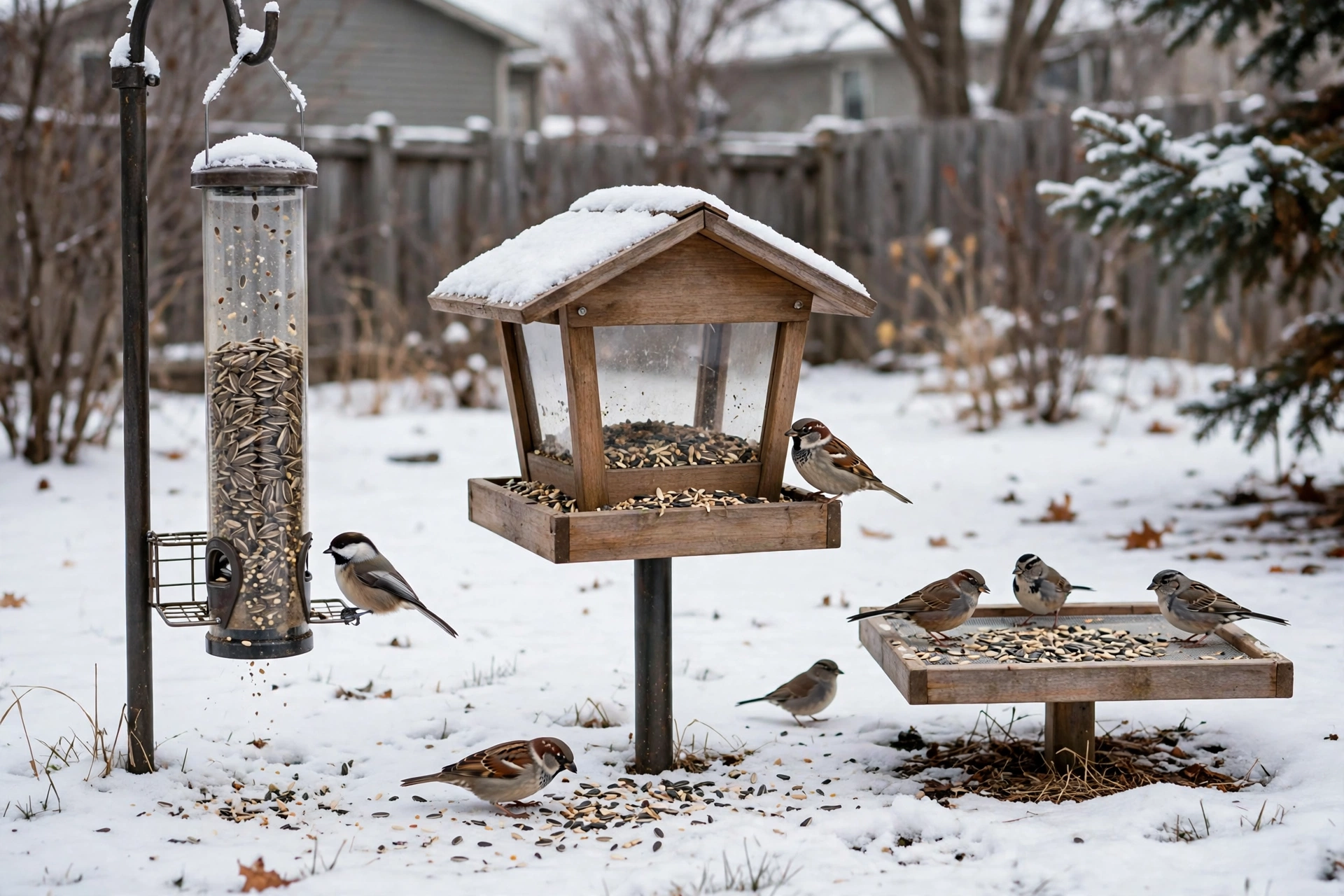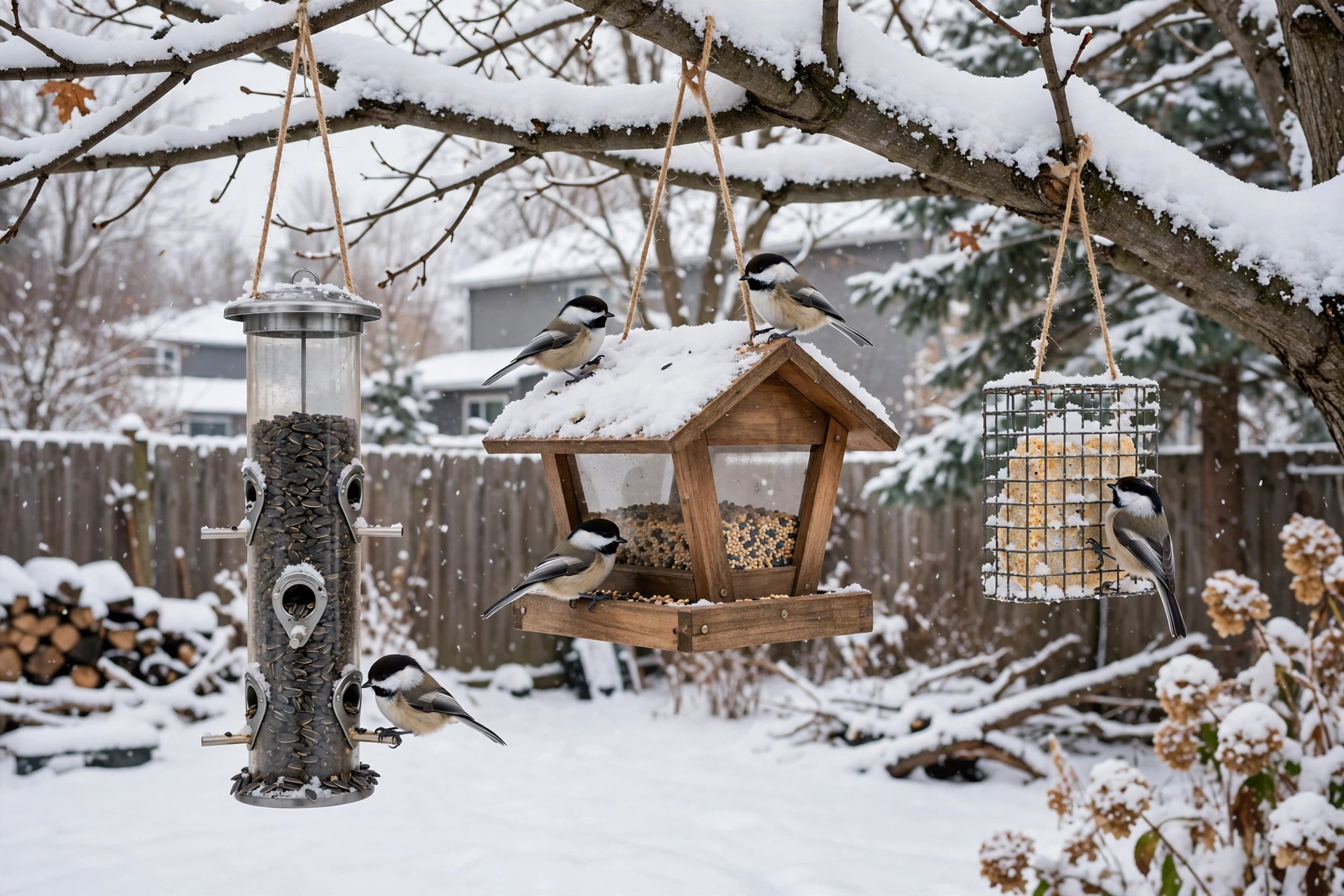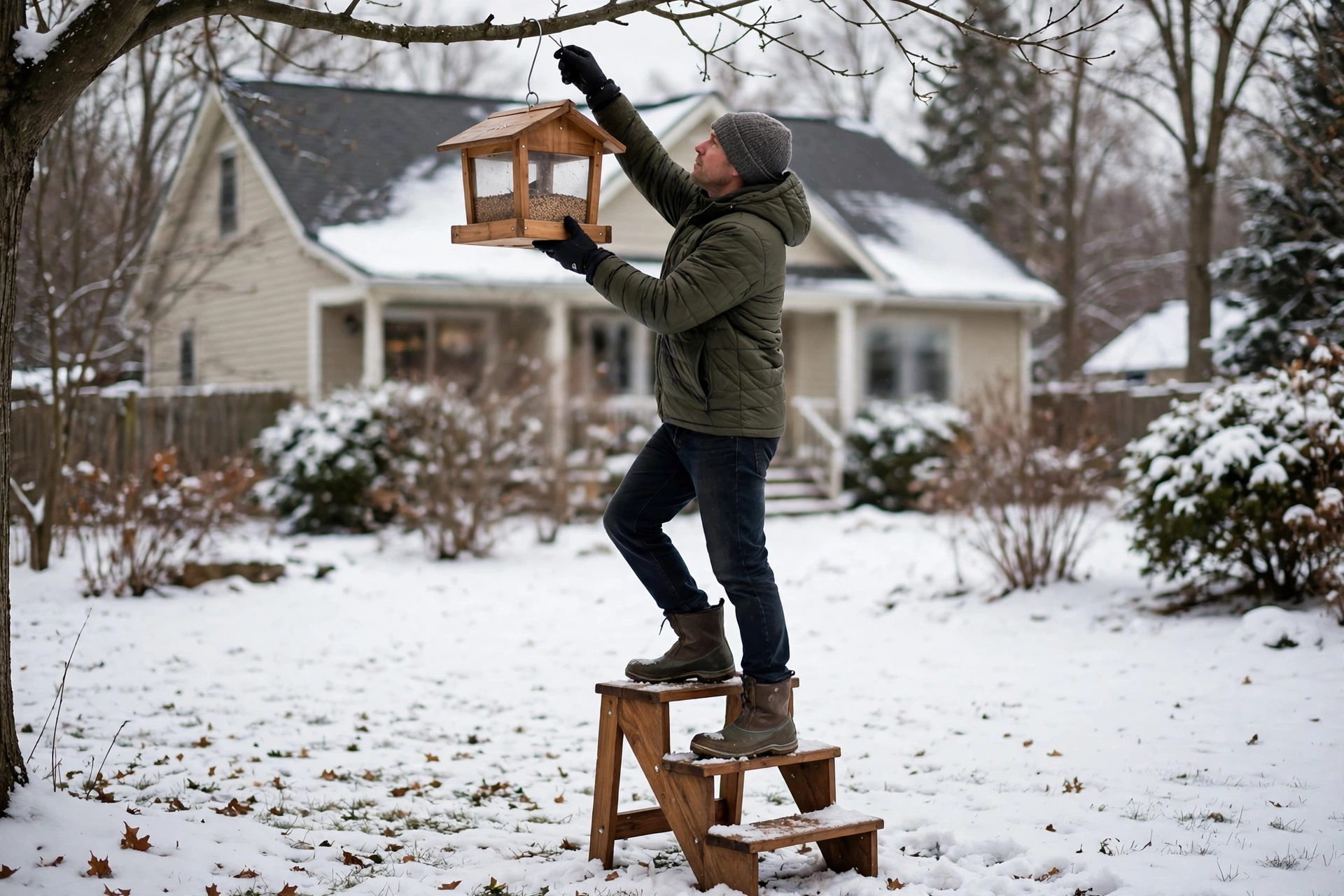
Where should you hang a bird feeder in winter? Hang it 5 to 6 feet off the ground, sheltered from the prevailing wind, near shrubs birds can retreat to, and either within 3 feet of a window or more than 30 feet from it.
That short answer covers the four risks winter placement has to manage at once: squirrels reaching the seed, wind emptying or soaking it, cats using cover to ambush, and birds hitting glass on the way out.
The details below turn those distances into a spot you can measure in your own yard. If you are still choosing a feeder, start with best winter bird feeders and then place the one you pick using these rules.
Height: 5 to 6 feet
Five to six feet puts the feeder above a cat’s easy jump and below a height that makes refilling a ladder job. In winter, that second point matters. You will fill and clean this feeder in gloves, sometimes on packed snow.
Measure to the feeding ports, not the top of the hook. A tall tube feeder hung from a high branch can sit at the right hook height and still put its lowest ports out of comfortable reach.
Keep the refill path in mind when you choose the spot. A feeder you can reach from a cleared path or deck edge gets maintained. One across an icy lawn often does not.
Distance from squirrel jump-off points
Squirrels launch sideways as well as down. Keep a hanging feeder 10 to 12 feet from fences, tree trunks, railings, and roofs that a squirrel can jump from.
When that distance is impossible, use a baffle and treat it as the main defense. On a pole, mount a wrap-around baffle below the feeder so squirrels climbing from the ground hit it and stop.
For a hanging feeder, a dome baffle above it blocks the drop from a branch. Either baffle only works if the jump-off distance is also handled, because a squirrel that can leap sideways past the baffle will do so.
Check the spot after the first week. Seed vanishing in a morning, with no birds at the feeder when you look, usually means a jump route you missed from ground level.
Shelter from the prevailing wind
Place the feeder on the sheltered side of the house, a fence, or a dense evergreen, away from the direction your winter wind usually comes from. Wind swings a hanging feeder, spills seed, and drives snow into the ports.
Shelter also helps the birds. Small birds burn a lot of energy staying warm, and a feeding stop out of the wind lets them eat without fighting the feeder’s movement at the same time.
Avoid a fully enclosed corner. Birds need a clear flight path in and out, and a feeder boxed in on three sides traps them if a hawk or cat appears.
Near cover, but not ambush cover
Birds want shrubs or an evergreen within a short flight, roughly 10 to 15 feet away. They feed, retreat to cover, scan, and return. A feeder in the middle of open lawn with no cover nearby often sits unused.
Cover becomes a problem when it touches the feeder’s immediate space. Dense brush right below or beside the feeder gives a cat a hidden launch point within pouncing range.
Keep low, dense growth trimmed back from the feeder pole itself. The goal is cover birds can reach in a second or two, with open ground directly under the feeder where a cat has nowhere to hide.
Ground-feeding birds complicate this slightly, since they prefer seed scattered near cover. Scatter a small amount on cleared ground near the shrub edge rather than moving the main feeder into the brush.
The window rule: within 3 feet or beyond 30 feet
Window collisions follow a simple distance rule. Place a feeder within 3 feet of the glass, or more than 30 feet away from it. The middle distance is the danger zone.
Within 3 feet, a bird leaving the feeder has not built up enough speed to hurt itself if it touches the window. Beyond 30 feet, birds are more likely to read the glass as a surface rather than a flight path, especially if the feeder is not lined up with a reflective pane.
A feeder 10 or 15 feet from a large window is the setup to avoid. Birds flush from it at full speed, straight toward a reflection of the yard behind them.
If your best watching window forces that middle distance, move the feeder, not the rule. A suction-cup window feeder at under 3 feet is often the better answer for that window.
Visibility, dry seed, and eaves
Put the feeder where you can see it from a window you actually sit near. Watching tells you when seed is low, when ice has blocked a port, and whether squirrels have found a route in.
Hanging a feeder under eaves can keep seed drier, but use caution. Eaves drip, and a drip line that lands on the feeder soaks seed faster than open snowfall does. Check where meltwater falls on a sunny winter afternoon before you commit to a spot under the roof edge.
Roof overhang also shortens the distance to a wall and window, so re-check the 3-foot and 30-foot rule for that exact position. Dry seed is not a gain if the placement creates a collision risk.
Once the feeder is up, watch it for three or four days before you call the spot settled. If birds approach and veer off, cover is too far or the wind is hitting it. If seed disappears without birds, look for a squirrel route. The feeder type changes the details slightly, and tube vs hopper vs platform bird feeders covers which styles need the most shelter.
Start with the measured setup: 5 to 6 feet up, 10 to 12 feet from any jump-off point, a baffle on the pole, shrubs a short flight away with open ground underneath, and the window rule obeyed. That spot, on the sheltered side of the yard and visible from indoors, is the one to hang your feeder in this winter.