This site contains product affiliate links. We may receive a commission if you make a purchase after clicking on one of these links.
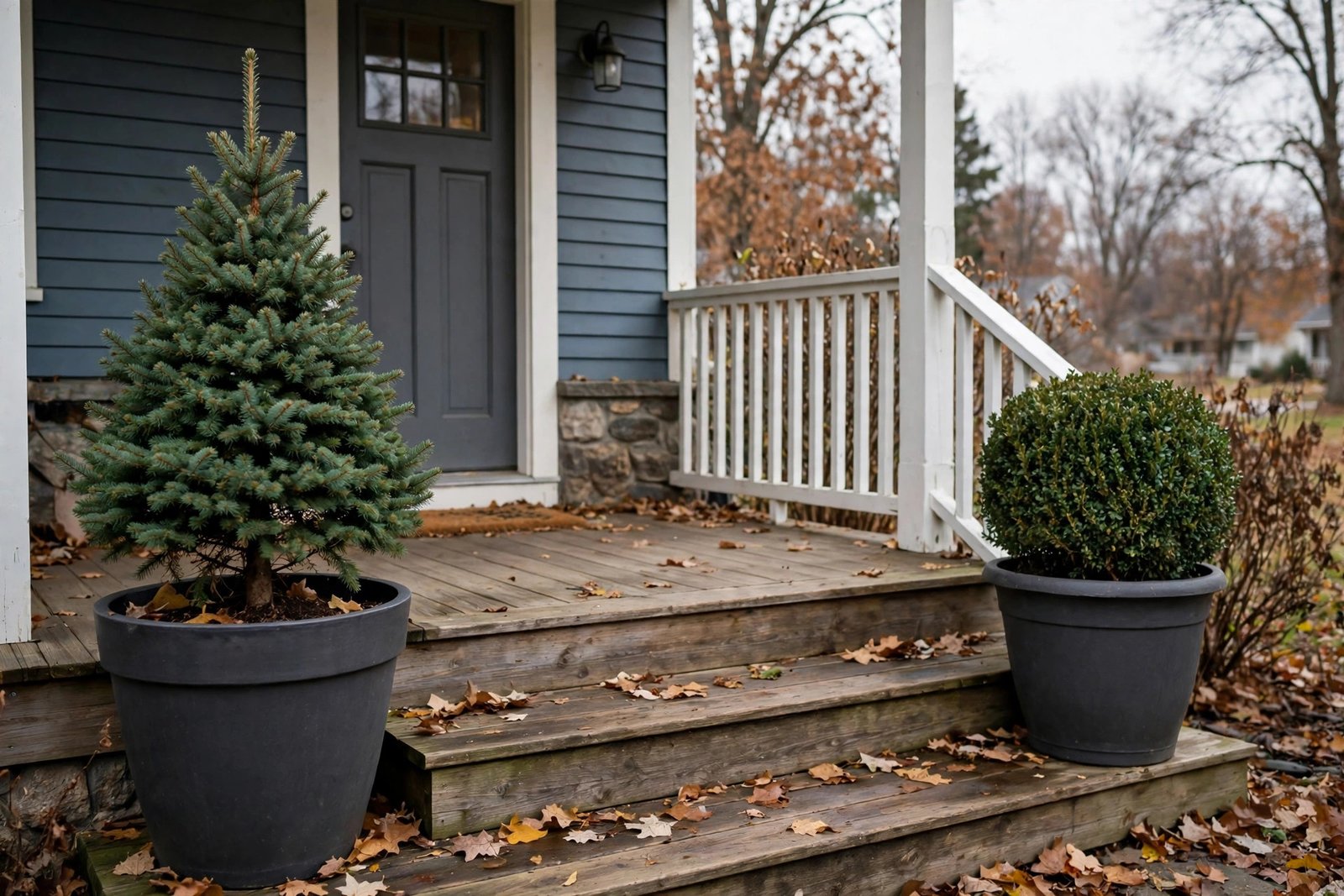
You stand on the porch in early November with two empty pots, a bag of potting soil, and a decision. Drag the pots to the garage and look at a bare porch until April, or plant them for the one season nobody plants for. Winter containers work. They just follow different rules than summer ones, and the first rule is the one that kills most of them.
Why a pot is not the ground
A plant’s hardiness zone rating assumes its roots are in the ground. Ground soil holds heat. A pot does not.
Roots in an above-ground container can sit at the same temperature as the winter air. Penn State Extension’s guidance is blunt about what follows: go two zones colder with containerized plants. A plant rated hardy to Zone 4 behaves like a Zone 6 plant once its roots are in a pot on your porch.
That single rule decides everything else in this piece. In Zone 4, a plant rated to Zone 2 can sit out the winter in a pot with basic protection. A plant rated to Zone 4 cannot. It needs help, or it needs the garage.
The fix starts before the first hard freeze. Water the pot well before the soil freezes, while the plant can still drink. A dry root ball freezes harder and thaws drier, and evergreens keep losing moisture through their needles all winter, even while dormant.
The pot matters as much as the plant
Two things kill container plants in winter: frozen roots and wet roots. The pot controls both.
Size first. Bigger pots hold more soil, and soil is insulation. A large, thick-walled pot protects a root ball far better than a small, thin-walled one. If you are choosing between a 12-inch pot and an 18-inch pot for the same shrub, take the 18-inch one and don’t look back.
Material second. Clay, ceramic, and glazed pottery are the pots most likely to crack outdoors in a freeze. Penn State Extension says so plainly, and anyone who has swept up a shattered terracotta pot in March believes it. Resin, fiberglass, thick plastic, and wood handle freeze-thaw cycles without complaint.
Drainage always. A pot that holds water in November holds ice in January. Drainage holes must be open, and the pot should sit on feet or a riser so water can actually leave. A saucer left under an outdoor pot all winter is a small ice rink with a plant in it.
Double-walled resin planters earn their keep here. The air pocket between the walls buffers the root ball against the coldest nights, and the resin itself will not crack when the temperature swings forty degrees in a day, the way a January thaw followed by a cold snap does in the Upper Midwest.
Novelty Countryside Square Tub Planter, 18-Inch
Frost-resistant resin with drill-out drainage marks, sized for a shrub that stays out all winter.
If you already own clay pots you love, you don’t have to retire them. Use them as the outer sleeve: set a planted plastic nursery pot inside the clay one, and lift the inner pot out before the deep freeze. The clay stays pretty, and the plant stays alive.
Three evergreens that earn the winter
Not every evergreen belongs in a winter pot. The ones that do share two traits: they are rated at least two zones hardier than your zone, or you are willing to protect them, and they hold their shape without fuss when nobody is watching.
| Plant | In-ground zone | In a Zone 4 pot | Winter job |
|---|---|---|---|
| Dwarf Alberta spruce | Zones 2–8 | Leave it out | The cone shape holds snow the way a postcard promises. Give it wind shelter if your porch faces the prevailing wind. |
| Korean boxwood | Zone 4 | Huddle it | Group the pot with others, mulch over the rim, and screen it from drying wind. ‘Green Velvet’ and similar Korean hybrids are the Zone 4 choices. |
| Inkberry holly | Zone 5 | Shelter it | A garage, shed, or buried pot. Left fully exposed in a Zone 4 pot, it is a zone too tender to trust. |
The dwarf Alberta spruce is the easy one. Monrovia lists it hardy to Zones 2–8, which means a Zone 4 winter in a pot still leaves two zones of margin. It grows slowly, keeps its cone without shearing, and looks intentional sitting by a front door in February, when everything else in the yard has given up.
Boxwood is the classic porch shrub, and it is the one people get wrong. A common boxwood rated to Zone 5 will not thank you for a Zone 4 winter in a pot. Buy the Korean hybrids rated to Zone 4, and still give them the huddle treatment below. The reward is a green ball on the porch in March, when the neighbors’ pots are still empty.
Inkberry is the honest warning in the table. It is a beautiful native holly, and it is rated a zone too tender for an unprotected Zone 4 pot. Plant it in a pot you can move, and move it. Pretending the zone rating doesn’t apply to containers is how good shrubs die.
The huddle, and the garage option
For everything that isn’t a Zone 2 plant, protection is simple and unglamorous. Penn State Extension lists three methods, and all three work.
Group them. Push the pots tight together against the house or a fence, water them in, and cover pots and all with straw, shredded leaves, or bark mulch. Pots insulate each other. A lone pot on an open porch is the coldest arrangement there is.
Bury the pot. Sink the whole pot into the ground and cover it with soil or mulch. The surrounding earth does the insulating, and you lift the pot back out in spring. This is the most reliable method for a plant you care about, and the least photogenic. Do it in the back garden, not by the front door.
Move them under cover. An unheated garage, shed, or cold frame holds a few degrees above the outside air, and that small difference is often the whole difference. Check the soil now and then — dormant plants need very little water, but “very little” is not “none.” Do not overwater a dormant plant in a dark garage, or root rot will do what the cold couldn’t.
Evergreens kept outside benefit from a wind screen or an anti-desiccant spray, per Penn State. Wind dries needles faster than cold kills roots, and a burlap screen on the windward side costs almost nothing.
When spring comes, take the covers off gradually. A plant that spent four months under mulch does not want full sun and wind on the first warm day. Give it a week of partial exposure, the way you’d ease back into anything after a long winter.
What to skip
Skip the tender perennials. Lavender, rosemary, and Russian sage are lovely plants that die in pots at temperatures their in-ground selves would shrug off. If you love them, they live in the ground or they come inside. A pot on a Zone 4 porch is not a compromise they accept.
Skip the fall fertilizer. Feeding a plant in October tells it to grow, and soft new growth is the first thing a freeze kills. The plant is shutting down. Let it.
Skip the saucers, the daily watering, and the urge to check for growth in January. Winter containers are a patience project. You do the work in November, and the payoff arrives in April, when the spruce is still green and the boxwood is still a ball and the porch never looked dead at all.
For the timing behind all of this — when the first and last frosts actually land in your zone — the Minnesota frost dates by zone guide lays out the windows. And if your summer containers are still sitting out full of spent annuals, the deck storage boxes roundup covers where the empty pots and the potting soil go for the winter. Cold snaps themselves are covered in how to protect your plants from frost, and the broader seasonal calendar lives in the Minnesota planting calendar.