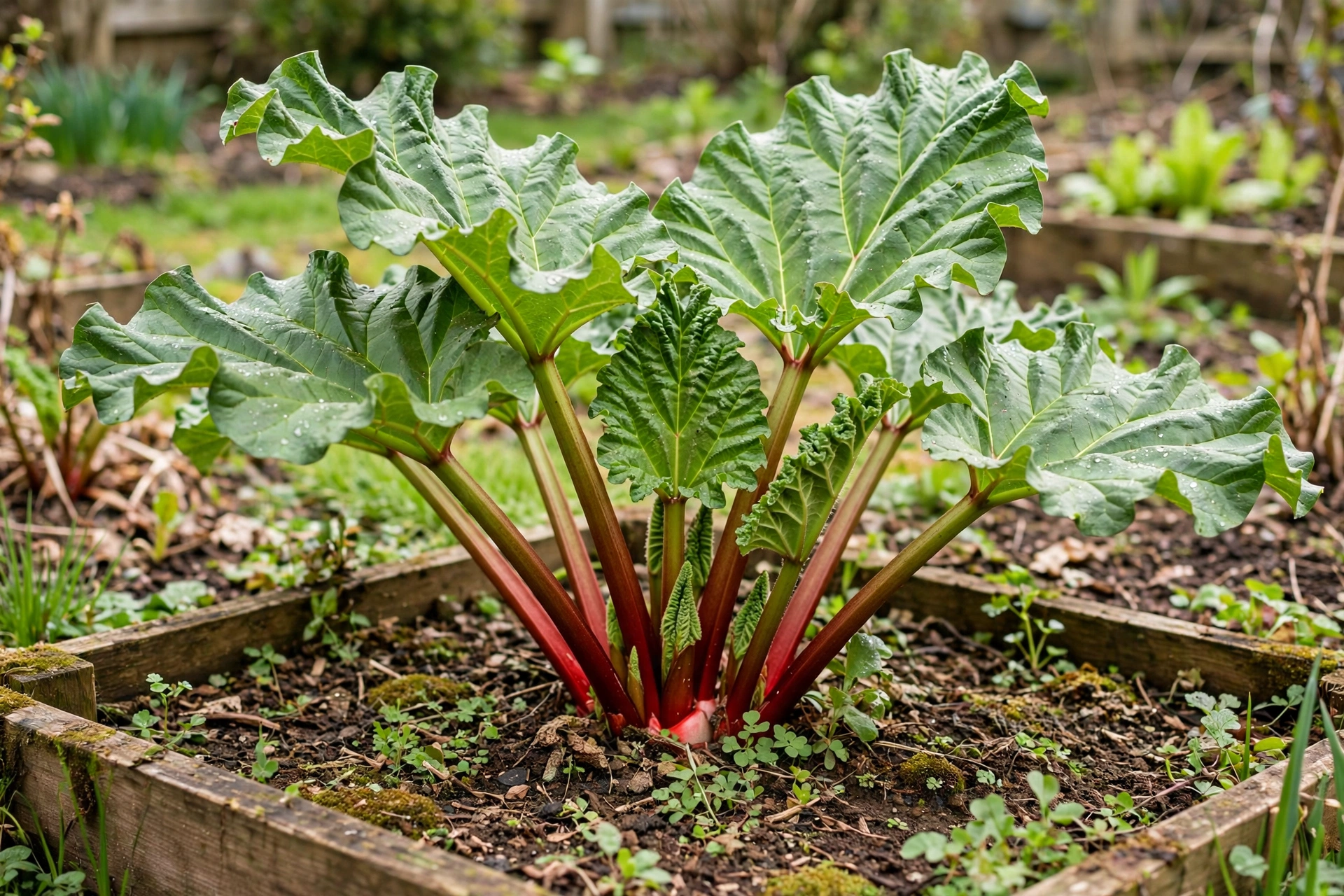
By November the rhubarb bed has gone quiet. The big leaves have collapsed, the stalks are gone, and all that is left is a crown you cannot see. That quiet is useful: a dormant crown is the easiest one to judge, and the fall lull is the right moment to decide whether next spring brings a division.
Rhubarb is a long-lived edible perennial, and it does not ask for much. But a crown left alone for years stops behaving like one plant and starts behaving like a crowd, and the harvest shows it first.
How to tell it is time
Divide when the stalks get thinner year over year, when the plant throws many small stalks instead of fewer thick ones, or when the center of the crown goes hollow and stops producing. The University of Maine Extension puts the cycle at every 4 to 5 years, or whenever the plant starts producing small stalks instead of large ones. A crown still throwing thick stalks from edge to edge does not need dividing yet, no matter how old it is.
When to divide
Early spring is the preferred window: divide before the leaves develop, while the crown is still mostly dormant, so the leaves that do emerge get a full growing season to rebuild the crown’s reserves for winter. Fall division also works, once frost has killed the foliage and the plant is dormant again — which means a November bed like the one above is a genuine option, not a consolation prize.
What not to do: divide in summer, while the plant is in full leaf and actively feeding itself. Summer divisions lose too much foliage to support the roots you just cut, and recovery drags.
The division, step by step
Dig the whole crown. Work a spade around the crown and lift it intact. Shake off enough soil to see the buds on top of the root mass and the natural weak points between them.
Cut along the natural separations. Use a sharp spade or knife, and follow the weak points where the crown already wants to come apart. Each piece needs 1 to 2 healthy buds and at least a 2-inch cross section of storage root for each eye, with a good share of roots attached. Pieces smaller than that may grow, but they take far longer to become productive.
Replant at the same depth, 3 feet apart. Set each division so the buds sit just below the soil surface, at the depth the crown grew at before. South Dakota State Extension spaces divisions 3 feet apart, and that room matters: a rhubarb plant fills its space fast, and crowding is what started this job in the first place.
Water in, then leave it alone. Water the divisions well, mulch lightly, and resist the urge to harvest hard. New divisions need their first season to rebuild roots, so take few or no stalks the first year after dividing and let the plant keep its leaves.
One safety note, and the rest of the bed
Only the stalks are food. The leaves go on the compost, never on the plate. That rule does not change when you divide; it just comes up more often, because division leaves you holding a pile of leaves.
Rhubarb is the edible member of a dividing bed that also holds ornamentals. The fall-division decision guide at should you divide perennials in fall covers which plants share this window and which should wait, and how to divide astilbe covers the fibrous-rooted neighbor that needs a different cut.
Bottom line
Divide rhubarb every 4 to 5 years, in early spring before the leaves develop or in fall after frost has finished them, into pieces with 1 to 2 buds and a solid root section each, spaced 3 feet apart. Give the divisions a quiet first year, and the bed pays you back with thick stalks for the next several springs.