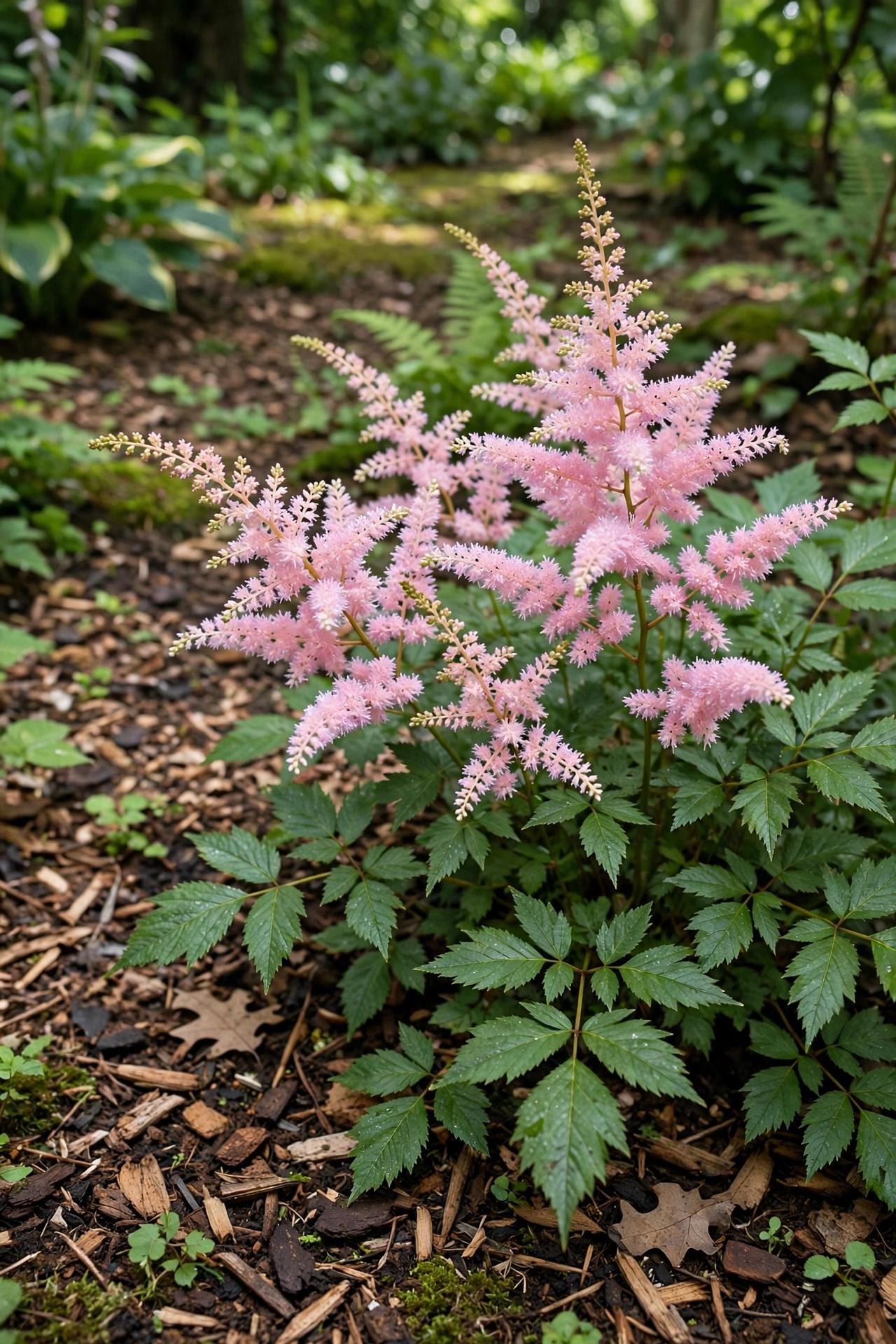
Your astilbe blooms at the edges and goes bare in the middle, and the plumes get shorter every year. That hollow center is not a watering problem. It is a crowded crown, and the fix is division.
Astilbe clumps grow outward from the crown, and the oldest growth in the middle eventually runs out of steam. Dividing resets the plant: fresh divisions with young roots, planted at the right depth, come back stronger than the clump you started with.
How to tell it is time
Divide when you see one of these signs: the center of the clump is bare or woody while the edges still bloom, the plumes are noticeably smaller than they used to be, or the clump has grown so dense that water runs off instead of soaking in. Clemson Extension puts the usual cycle at every 3 to 4 years, and only when the plant needs it — a clump still blooming hard edge to edge can wait another season.
When to divide
Early spring or fall are the windows. Spring division, before the new foliage unfolds, gives the divisions a full growing season to root in. Fall division works too, after bloom has finished and the plant is winding down, but in cold climates spring is the safer bet: fall divisions need time to settle before the ground freezes, and a late fall split can go into winter half-rooted.
Never divide in the heat of summer or while the plant is in full bloom. The roots dry out faster than they can recover, and you trade a crowded clump for a stressed one.
The division, step by step
Water the day before. Moist soil lifts cleanly. Dry soil crumbles off the roots and tears them.
Dig the whole clump. Work a spading fork around the crown, well outside the drip line of the foliage, and lever the root ball out intact. Astilbe roots are dense and fibrous, so expect a heavy, matted ball.
Cut, do not tear. Shake or rinse enough soil free to see the crown, then cut through it with a sharp knife or spade. Each division needs 3 to 4 eyes, the small buds on the crown, plus a good share of roots. Discard the woody center pieces that have no live buds.
Replant at the same depth. Set each division so the crown sits at the same height it grew at before, no deeper. Astilbe wants dappled shade and soil that stays consistently moist, so water the divisions in well and mulch lightly to hold that moisture through the first weeks.
Aftercare and what to expect
Keep new divisions watered through their first season, especially in dry spells. Astilbe is a moisture lover, and a division that dries out in its first month is the one that fails. Expect lighter bloom in the first year after dividing; the plant is spending its energy on roots, and the full plume show returns the following season.
The same timing logic covers the rest of the dividing bed. If astilbe is on your list, read whether to divide perennials in fall before you start, and compare the fibrous-root technique here with dividing bearded iris and dividing Siberian iris, which need different cuts for different root systems. Rhubarb, the edible perennial in the same bed, has its own rules — see how to divide rhubarb before you touch that crown.
Bottom line
Divide astilbe every 3 to 4 years, in early spring or fall, into pieces with 3 to 4 eyes each, replanted at the same depth in moist, lightly shaded soil. The hollow center is the signal, not the sentence: one afternoon with a sharp knife gives you several young plants and a clump that blooms edge to edge again.