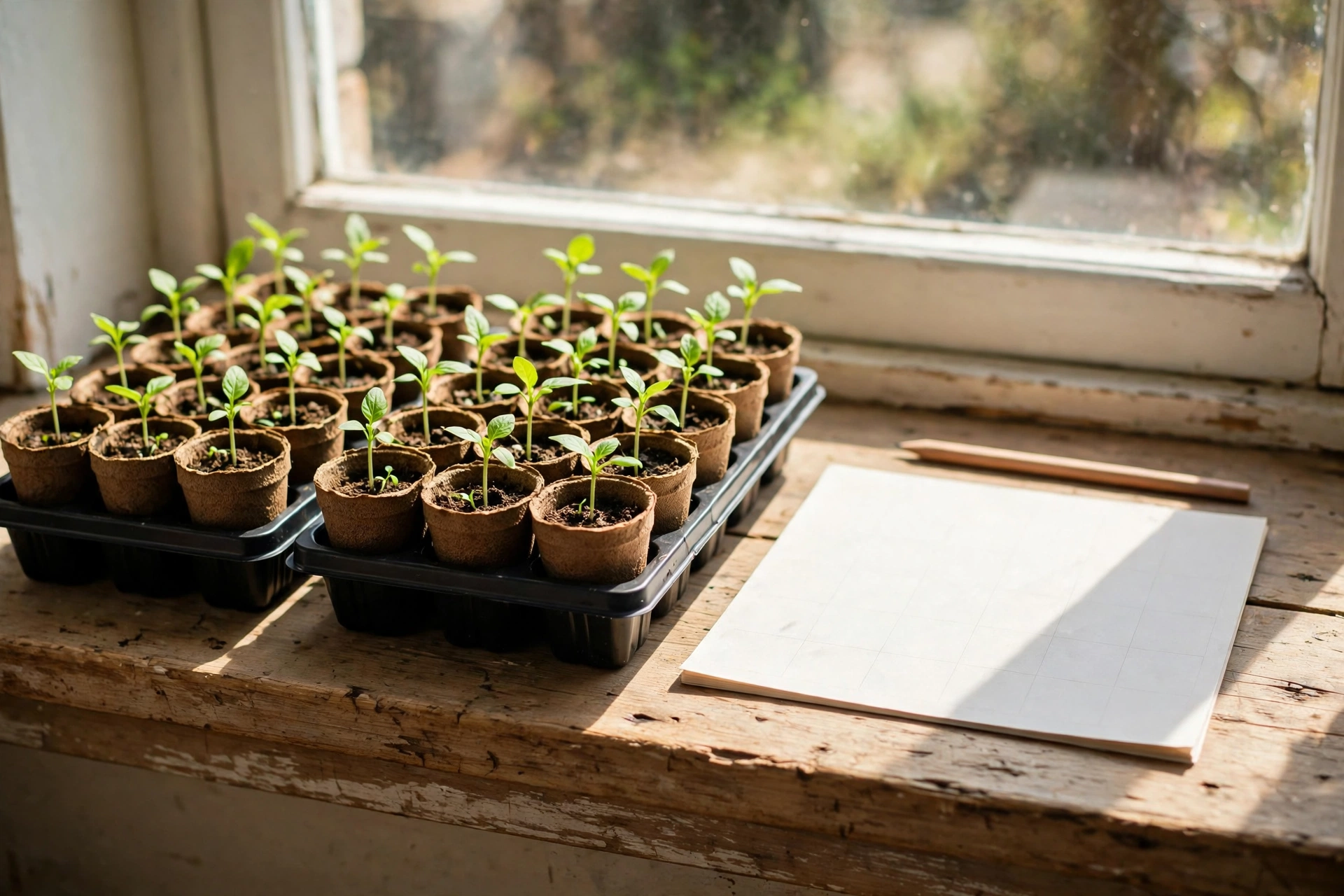
The seed packets are in, the windowsill is already crowded, and the real question is the one nobody prints on the packet in plain English: when do I actually start these?
Enter your last frost date, pick your crops, and get your indoor sow dates and transplant dates. This calculator works from your average last spring frost date — the last spring day your area usually sees freezing temperatures — and counts back from there, using the same week ranges the university extension guides publish.
Use the calculator
Type in your average last frost date, tick the crops you plan to start indoors, and press the button. Warm-season crops go out after frost; cool-season crops go out before it.
The last spring day your area usually sees 32°F. If you do not know yours, the section below tells you where to look it up.
Warm-season crops — move out after frost
Cool-season crops — move out before frost
Waiting for warm soil? (warm-season crops only)
Warm-season crops want warm soil — 65°F or warmer. If your soil runs cold, push transplanting back a week or two; the sow dates move later by the same amount. Cool-season crops go out before frost either way, so this choice does not change their dates.
Fill this in to add a fall sowing window for each crop, counted back from your first fall frost.
What to type in
Your average last frost date is the anchor for everything on this page. It is an average, not a promise — some years frost comes later, some years earlier — so treat the dates it gives you as a plan to work from.
If you do not know your date, look it up three ways: the NOAA frost-date normals for your town, your county Extension office, or the Old Farmer’s Almanac frost-date lookup. Any of the three will do. Carrots, beets, and peas are not in the crop list on purpose — they go straight in the garden and are never started indoors.
What your dates mean
Each crop gets four dates. The sow window is a range on purpose: sow at either end and you are inside what the guides allow. The move-outside date is a single day, with the rule beside it — on your last frost date, a week or two after it for warm soil, or three weeks before it for cool-season crops.
Harden-off day comes a week before moving day. That is the day to start setting plants outside in a sheltered spot for a few hours, then longer each day, watering less as you go. The first harvest window counts from the day the plants go outside, not from the day you sow the seeds — count from sowing and you will read six to ten weeks early.
Spacing and seed depth sit beside each crop’s dates, so you can plan the bed while the seeds are still in the tray.
Don’t start too early
The New Jersey guide says it plainly, and it is worth repeating here: don’t start plants too early. Plants that are started too early become elongated, pale green, and weak. A seedling that spends too long in a small pot is worse than one started a week late.
If your seedlings are already stretching toward the window, that is the same problem showing up early — here is why seedlings go leggy and how to fix them. And when moving day comes, harden your seedlings off first — a week outside in stages, not straight from the windowsill to the open garden. Tomatoes need a little extra care here: cut back the water while they harden off, and know that a cold snap can mark the fruit.
Warm soil matters
Warm-season crops want soil at 65°F or warmer before they go out. Cool-season crops are fine at 50°F or warmer. A soil thermometer pushed two inches into the bed in the morning tells you the truth — a warm afternoon air temperature does not.
If the soil is still cold on your last frost date, wait. That is what the warm-soil delay above is for: it pushes the move-out date back a week or two, and the sow dates move back with it, so your seedlings are not sitting in pots past their prime.
Crops to sow straight in the garden
Carrots, beets, and peas should always be seeded directly in the garden — they do not take to transplanting. Beans and corn are in the same spirit: they transplant poorly, so sow them straight in the garden after frost if you can. If you do start them indoors, use peat pots or pellets so the roots are never disturbed.
The full chart
Every crop the calculator covers, with the weeks to grow, the season, the days to maturity, and when each one moves outside. Weeks to grow come from Rutgers Cooperative Extension’s New Jersey guide; the Georgia figures — tomatoes 6 weeks, peppers and eggplants 8 weeks — sit inside those ranges.
| Crop | Weeks to grow | Georgia figure | Season | Days to maturity | Move outside |
|---|---|---|---|---|---|
| Tomato | 6–8 | 6 weeks | Warm | 70–90 | On last frost (+0/1/2 wk delay) |
| Pepper | 8–10 | 8 weeks | Warm | 65–80 bell; 65–95 hot | On last frost (+0/1/2 wk delay) |
| Eggplant | 8–10 | 8 weeks | Warm | 75–90 | On last frost (+0/1/2 wk delay) |
| Squash, summer | 2–3 | — | Warm | 40–55 | On last frost (+0/1/2 wk delay) |
| Cucumber | 2–3 | — | Warm | 50–65 | On last frost (+0/1/2 wk delay) |
| Melons | 2–3 | — | Warm | 80–90 (cantaloupe) | On last frost (+0/1/2 wk delay) |
| Pumpkin | 2–3 | — | Warm | 85–120 | On last frost (+0/1/2 wk delay) |
| Okra | 2–3 | — | Warm | 55–65 | On last frost (+0/1/2 wk delay) |
| Broccoli | 6–7 | — | Cool | 60–80 | 3 weeks before last frost |
| Cabbage | 6–7 | — | Cool | 70–120 | 3 weeks before last frost |
| Cauliflower | 6–7 | — | Cool | 60–75 | 3 weeks before last frost |
| Brussels sprouts | 6–7 | — | Cool | Not in the UGA chart | 3 weeks before last frost |
| Collards | 5–7 | — | Cool | 55–85 | 3 weeks before last frost |
| Lettuce | 5–6 | — | Cool | 60–85 | 3 weeks before last frost |
| Kale | 4–6 | — | Cool | 50–70 | 3 weeks before last frost |
| Celery | 10–12 | — | Cool | Not in the UGA chart | 3 weeks before last frost |
| Leeks | 10–12 | — | Cool | Not in the UGA chart | 3 weeks before last frost |
| Onions | 10–12 | — | Cool | 100–120 (dry bulb) | 3 weeks before last frost |
| Beans, snap | 2–3 | — | Warm | 50–60 | Direct-sow recommended |
| Corn, sweet | 2–3 | — | Warm | 65–90 | Direct-sow recommended |
Days to maturity, spacing, and seed depth
The University of Georgia’s Vegetable Planting Chart (Circular 963) gives days to maturity, spacing, and seed depth for each crop. Days to maturity count from the day the seed goes in the ground or the transplant goes in the garden — never from the day you sow indoors. Georgia planting dates in the original chart are not shown here; this calculator uses your own frost date instead.
| Crop | Days to maturity | Spacing (rows × plants) | Seed depth |
|---|---|---|---|
| Beans, bush | 50–60 | 36″ × 2–4″ | 1″–1½” |
| Beets | 55–65 | 18–36″ × 2″ | ½” |
| Broccoli | 60–80 | 36″ × 12″ | — (transplant) |
| Cabbage | 70–120 | 36″ × 12″ | — (transplant) |
| Cantaloupe | 80–90 | 60″ × 36″ | 1″ |
| Carrot | 70–95 | 18–36″ × 2–3″ | ¼” |
| Cauliflower | 60–75 | 36″ × 12″ | — (transplant) |
| Collards | 55–85 | 36″ × 8–16″ | ½” |
| Corn, yellow/white/bi-color | 65–90 | 36″ × 12–18″ | 1″–1½” |
| Cucumber, slicing/pickling | 50–65 | 60″ × 12″ | ½”–¾” |
| Eggplant | 75–90 | 36″ × 24″ | — (transplant) |
| Kale | 50–70 | 36″ × 8–16″ | ½” |
| Lettuce | 60–85 | 18–36″ × 8–12″ | ⅛” |
| Okra | 55–65 | 36″ × 12″ | 1″ |
| Onion, dry bulb | 100–120 | 18–36″ × 3–4″ | — |
| Peas, garden / edible pod | 60–70 | 36″ × 2″ | 1″–2″ |
| Pepper, bell | 65–80 | 36″ × 24″ | — (transplant) |
| Pepper, hot | 65–95 | 36″ × 24″ | — (transplant) |
| Pumpkin (all types) | 85–120 | 72″ × 48″ | 1″ |
| Radish | 25–30 | 24″ × 1″ | ½” |
| Spinach | 40–45 | 18–36″ × 2″ | ½”–¾” |
| Squash, summer (zucchini) | 40–55 | 36″ × 24″ | 1″–2″ |
| Squash, winter | 85–120 | 60″ × 36″ | 1″–2″ |
| Tomato, determinate/indeterminate/cherry/grape | 70–90 | 48″ × 24″ | — (transplant) |
| Turnip | 40–60 | 18–36″ × 2″ | ½” |
| Watermelon | 80–90 | 72″ × 36–48″ | 1″–2″ |
Worked examples
Tomatoes, last frost April 15. Tomatoes move out on the last frost date, April 15, and take 6–8 weeks indoors. April 15 minus 42 days is March 4; minus 56 days is February 18. Sow between February 18 and March 4. The Georgia figure of 6 weeks lands on March 4, the late end of the range.
Tomatoes, last frost May 15. This is the worked example in the New Jersey guide itself. May 15 minus 42 days is April 3; minus 56 days is March 20. Sow between March 20 and April 3. The guide’s own prose rounds this to “mid-March to April 1” — the calculator shows the exact dates.
Peppers, last frost January 15, 2027. Peppers take 8–10 weeks indoors and move out on the last frost date. January 15 minus 56 days is November 20, 2026; minus 70 days is November 6, 2026. Sow between November 6 and November 20, 2026 — note the year. A January frost date means starting seeds the previous November.
Tomatoes, first harvest. Say your last frost is April 15 and you wait one week for warm soil, so the tomatoes go out April 22. Tomatoes take 70–90 days from transplanting. April 22 plus 70 days is July 1; plus 90 days is July 21. Expect the first tomatoes between July 1 and July 21.
Fall beans, first frost November 15. The Georgia calendar’s rule: count back days to maturity plus 18 days for harvest. Snap beans take 55 days, so 55 plus 18 is 73 days. November 15 minus 73 days is September 3. Plant on or before September 3.
Where different sources give different numbers
Not every guide agrees, and this page does not hide that. Here is what each one says, so you can see where the calculator’s ranges come from.
Tomatoes: Georgia’s garden calendar gives 6 weeks. Georgia’s field report and the New Jersey guide give 6–8 weeks. A Georgia county blog and Oregon State give 5–7 weeks. The calculator shows 6–8 weeks, with the 6-week figure marked inside the range.
Peppers: Georgia’s garden calendar gives 8 weeks. The Georgia county blog gives 7–9 weeks. The New Jersey guide gives 8–10 weeks. The calculator shows 8–10 weeks, with the 8-week figure marked inside the range.
Eggplant: Georgia’s garden calendar gives 8 weeks; the New Jersey guide gives 8–10 weeks. The calculator shows 8–10 weeks.
Squash: every guide agrees on 2–3 weeks.
Broccoli and cabbage: the New Jersey guide gives 6–7 weeks; North Dakota State gives 10 weeks. The calculator uses 6–7 weeks. Lettuce is the same story on a smaller scale — New Jersey gives 5–6 weeks, North Dakota State gives 8.
When cool-season crops go out: North Dakota State puts broccoli and cabbage out 3 weeks before the last frost. New Jersey’s lettuce example plants about 4 weeks before the last frost. The calculator uses 3 weeks before the last frost.
Harvest windows count from the day the plants go outside, not from sowing day. Every crop on this page follows that rule.
A few numbers you may see elsewhere did not check out, so they are not on this page. A guide sometimes credited to “Delta Libraries” could not be located. A Portland April 15 last-frost date runs past even the one-in-ten-years date in the national normals. And an eggplant range of 6–9 weeks appears in no university guide we could find.
How to find your last frost date
Three places will give it to you: the NOAA frost-date normals for your town, your county Extension office, or the Old Farmer’s Almanac frost-date lookup. Use the average for your area, not the earliest or latest year you remember — and remember the Georgia dates in the university calendar are for middle Georgia, not for your town. This calculator uses your date, not theirs.
Start with tomatoes and peppers — they are the crops where getting the date right pays off most. Trust the range — sow anywhere inside it; that is what it is for. Sow at the early end if your windowsill is bright and warm, at the late end if it isn’t, and you will have sturdy plants ready when the frost date arrives. If you want the timing for one crop in more detail, here is when to start tomato seeds indoors.
Sources
University of Georgia Cooperative Extension — Vegetable Garden Calendar, Circular 943 (reviewed by Bob Westerfield). https://extension.uga.edu/publications/detail.html?number=C943 — fetched Nov 6, 2026; tomato and pepper figures re-confirmed on the UGA-hosted page Nov 7, 2026.
University of Georgia — Vegetable Gardening in Georgia, Circular 963, Vegetable Planting Chart (June 2009). https://openscholar.uga.edu/record/22903/files/VegetablePlantingChart.pdf — fetched Nov 6, 2026.
UGA CAES Field Report — Starting your spring vegetable garden from seed (compiled by Emily Cabrera). https://fieldreport.caes.uga.edu/features/vegetable-garden-seed-starting/ — fetched Nov 6, 2026.
Rutgers Cooperative Extension — Starting Vegetable Seeds Indoors, Fact Sheet FS787 (February 2014). https://extension.rutgers.edu/fs787 — fetched Nov 6, 2026.
UGA Extension Towns/Union County blog — Plant It? (Jacob Williams, Feb 2021). https://site.extension.uga.edu/townsandunionag/2021/02/plant-it/?cat=1 — fetched Nov 6, 2026.
Oregon State University Extension, Columbia County — Diggin’ in the Dirt: Starting Your Seeds (Chip Bubl, April 15, 2021). https://oregonnews.uoregon.edu/lccn/2018260012/2021-04-15/ed-1/seq-9/ocr.txt — fetched Nov 6, 2026.
North Dakota State University Extension — How to Succeed at Seed Starting, H1139. https://www.library.nd.gov/statedocs/NDSUExtensionService/h1139.pdf — fetched in full Nov 7, 2026.