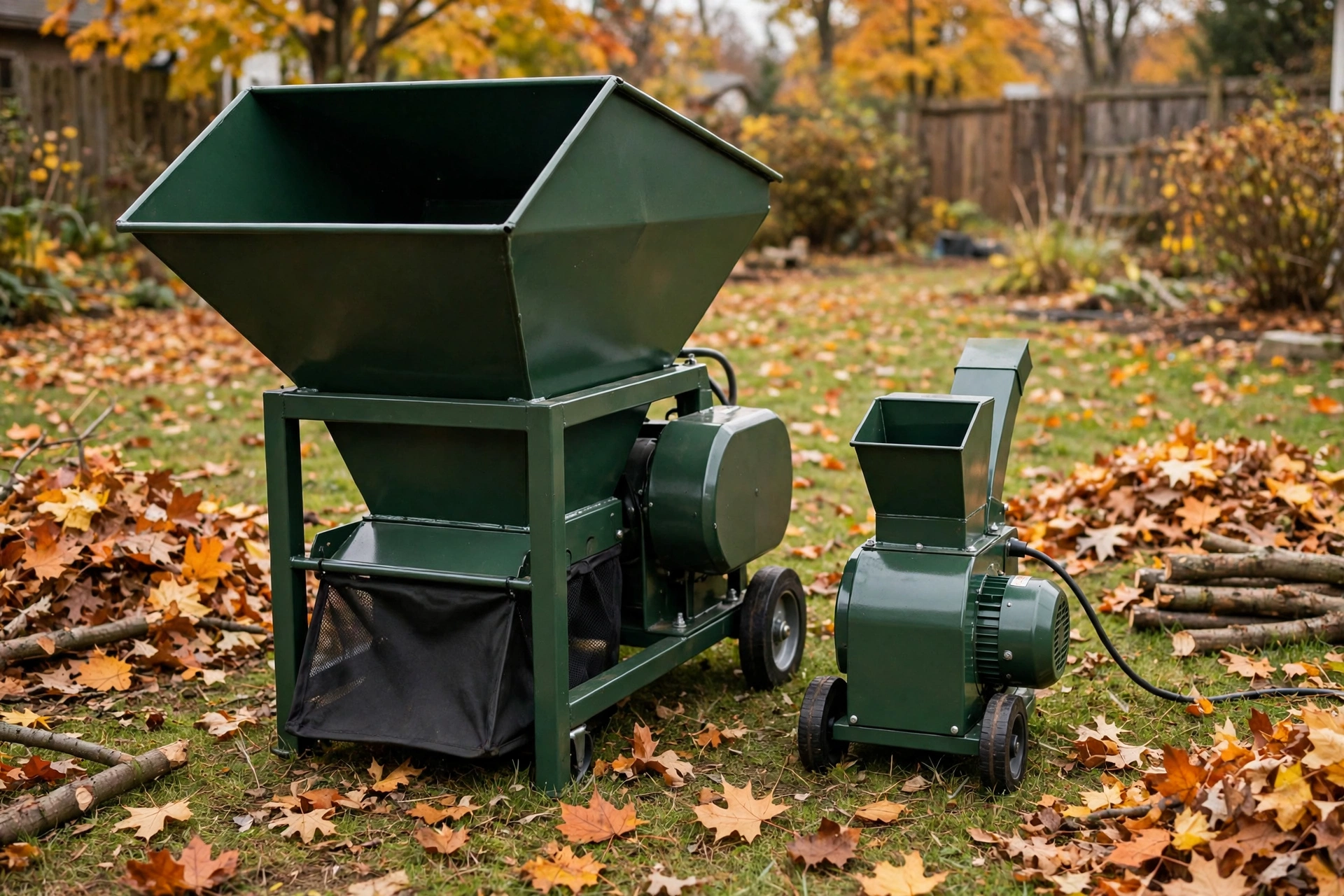
The wrong machine costs you twice: the price on the box, and every Saturday you spend fighting a tool that was built for a different job. A leaf mulcher turns a season of leaves into a bag of mulch you can spread on the beds, while a wood chipper turns storm branches into chips, and feeding either machine the wrong material means it stalls, clogs, or sits unused while the pile grows. Match the machine to the pile you actually have, and the cleanup stops being a fight.
What a Leaf Mulcher Actually Does
A leaf mulcher is a stationary shredding station. You carry leaves to it, feed them through a wide hopper, and spinning cutting line or a metal impeller tears them into fine shreds that drop into a bag or a bin below. The best electric models move a lot of material: the WORX WG430 processes up to 53 gallons of leaves a minute, and the Sun Joe SDJ616 up to 55 gallons, though both figures describe dry leaves fed steadily rather than a soaking pile dumped in all at once.
What comes out is the point. Shredded leaves pack down to a fraction of their volume: the WORX turns 11 bags of leaves into one, the Sun Joe 16 into one, and the Flowtron LE-900 up to 30 into one on its finest setting. That is why a mulcher earns its keep when your problem is volume — a curb full of bags, a compost pile that needs fine material, or beds that want mulch.
What a mulcher cannot do is the part people skip over. Anything woody thicker than a pencil will stall it, wrap the cutting line, or break the mechanism, so sticks, twigs, and pine cones go elsewhere. Our roundup of the best leaf mulchers and shredders for pine needles and wet leaves compares the three electric models above and explains which one handles damp piles best. A sweeper gathers the pile and a mulcher shrinks it, so if you are still raking by hand, our lawn sweeper roundup covers the gathering half first.
What a Wood Chipper Actually Does
A chipper is built for the woody stuff a mulcher refuses. You feed branches into a narrow chute, steel blades or a flywheel chop them into chips, and the chips pile up for paths or beds. The cutting diameter is the number that matters: a 15-amp electric chipper like the Sun Joe CJ603E handles branches up to 1.7 inches thick, while a gas chipper-shredder like the Earthquake K32, with a 212cc engine, takes branches up to 3 inches.
That capacity comes with trade-offs a mulcher never asks you to make. A chipper is heavier and louder than a mulcher, and it needs more floor space. A gas model needs fuel, oil, and a level spot away from the house, and even an electric one wants a clear feed area and somewhere for the chip pile to go. They also work slowly on leaves, because every handful has to fit a narrow branch chute built for wood, not volume.
A chipper earns its keep after storms, on properties with trees that drop limbs, or anywhere the brush pile is the problem rather than the leaf pile. If your yard drops a few twigs a year and a mountain of leaves every October, a chipper is the wrong answer to the right question.
Leaf Mulcher vs Wood Chipper: Side by Side
| Feature | Leaf Mulcher | Wood Chipper |
|---|---|---|
| Best for | Leaves and pine needles in volume | Branches and storm debris |
| Eats | Dry and damp leaves, grass clippings, pine needles mixed with leaves | Branches up to 1.7 inches (electric) or 3 inches (gas) |
| Chokes on | Anything woody thicker than a pencil | A season of leaves fed through the branch chute |
| Power | 13-amp electric, corded | 15-amp electric or 212cc gas |
| What comes out | Fine shreds for beds and compost | Wood chips for paths and beds |
| Storage | Breaks down or nests in a corner of the garage | Needs floor space, plus fuel and oil for gas models |
The table makes the split plain. The mulcher wins on leaves, the chipper wins on wood, and neither one covers the other’s job. The machines overlap only on the small stuff — dry leaves and thin twigs — and that overlap is where most buying mistakes happen.
Which One Fits Your Yard
Count your piles before you count your budget. If the yard is mostly leaves, with a few pencil-thin twigs mixed in, buy the mulcher and rake the twigs into the brush pile by hand. If the yard drops limbs every storm and the leaf fall is light, buy the chipper and let the leaves go to the curb or the compost bin whole.
If you genuinely have both problems — big trees dropping limbs and a heavy leaf fall — buy the mulcher first. Leaves come every year and limbs come after storms, so a mulcher you use ten weekends a year beats a chipper you use twice. Rent a chipper for the storm weekends instead of owning one that sits in the garage eleven months a year.
One more check before you order: measure the cord run for an electric model. A 13-amp mulcher needs a heavy-duty cord kept as short as the job allows, because a long, thin cord drops voltage, the motor runs hot, and the machine shreds slower. If your leaves usually arrive damp, our guide to shredding wet leaves without clogging your mulcher covers the feeding technique that keeps the machine running, and our pine needle cleanup guide covers the full sequence from sweeping to shredding when needles are part of the pile.
The Mistake That Costs the Most
The most expensive mistake is buying a third machine that pretends to be both. Combination blower-vacuum-mulchers like the WORX WG509 Trivac are handy for dry leaves, with a 350 CFM blower and an 18:1 mulching ratio, but the vacuum only handles dry material. Best Buy’s own listing warns that water from wet leaves can seep into the motor and void the warranty. A combo tool that cannot touch a damp pile is a fair-weather tool, and fall weather is rarely fair.
The same logic applies to the cheapest chipper you can find. A small electric chipper that tops out under an inch of branch diameter will stall on the first real limb you feed it, and a stalled chipper with a jammed chute is a worse afternoon than no chipper at all. Buy the capacity your biggest branch needs, not the price your budget wants. Electric and gas models split on noise, power, and upkeep, and our electric vs gas leaf mulcher comparison lays out that trade-off before you choose a power source. If you are still deciding between mulcher models, our guide to choosing a leaf mulcher walks through capacity, reduction ratio, and wet-leaf handling.
Bottom Line
For most suburban yards, the leaf mulcher is the machine that earns its keep. Leaves arrive every fall, mulchers are cheaper to run and store, and the shredded leaves go straight onto beds or into compost. Buy the chipper when branches are the recurring problem — after storms, under big trees, or on a wooded lot — and rent it when they are only an occasional one. Either way, buy the machine that matches the pile you already have, not the pile you hope to have someday.