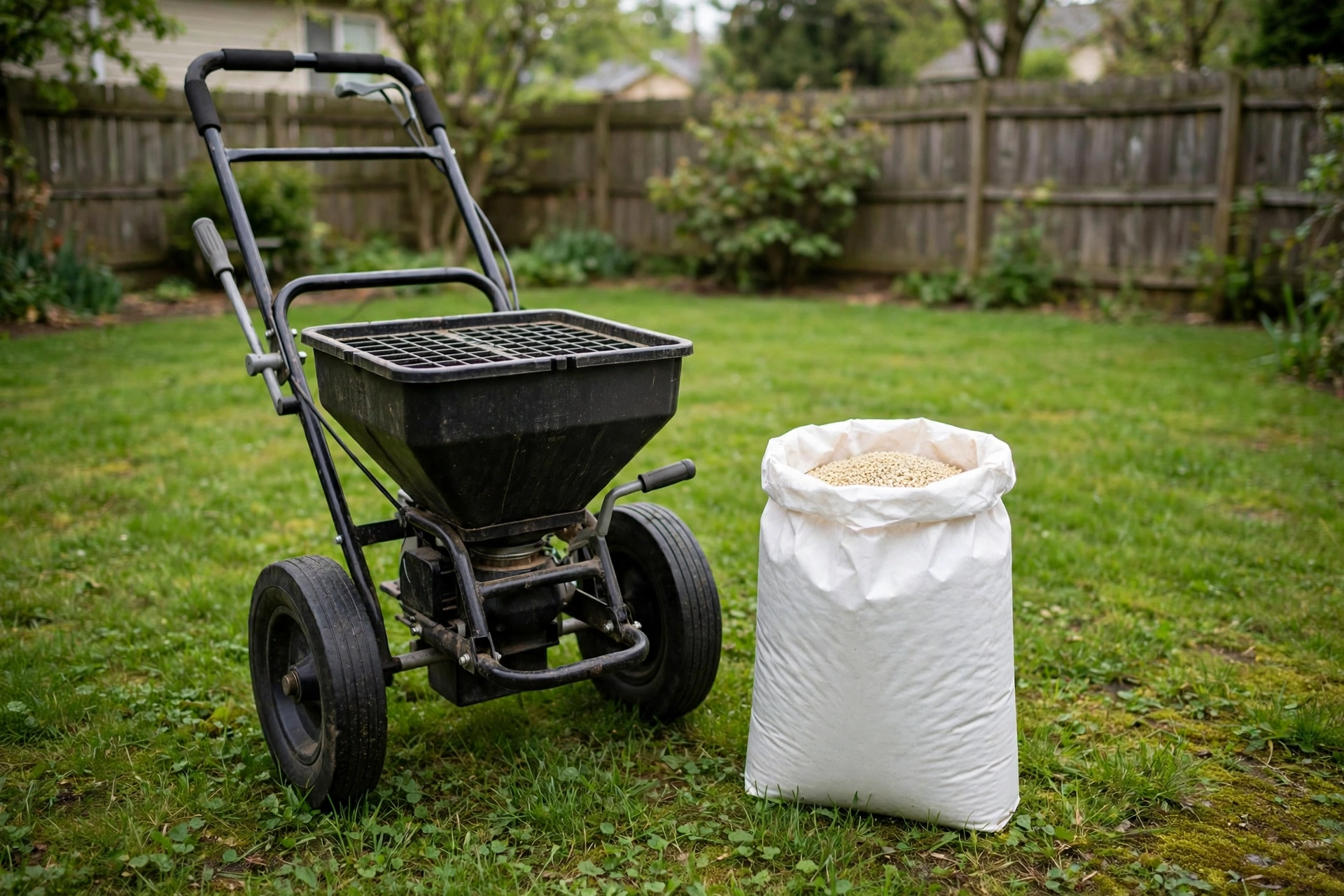
You buy the big spreader first, because bigger feels safer, and then you spend every feeding wrestling it around a front walk that is narrower than the spreader itself. The wheels catch the edging, the hopper still holds half a bag when you run out of lawn, and the leftover granules sit in the garage until they clump into a brick.
That is the mistake this article fixes. A small lawn needs a spreader sized to the yard, one that empties in a single pass and stores on a shelf when the job is done.
What Size Spreader Fits a Small Lawn
A typical small lawn runs 3,000 to 5,000 square feet, which means the right spreader holds enough product to cover the whole yard in one fill. Refilling halfway through a feeding is where the trouble starts, because the second load goes down heavier on the half you already covered while the first half waits.
The math is straightforward once you know the feeding rate. A standard feeding delivers 1 pound of nitrogen per 1,000 square feet, so a 5,000-square-foot lawn needs the product for 5,000 square feet per feeding, and a 3,000-square-foot lawn needs the product for 3,000. Buy the spreader that matches that number, not the one built for a yard twice your size.
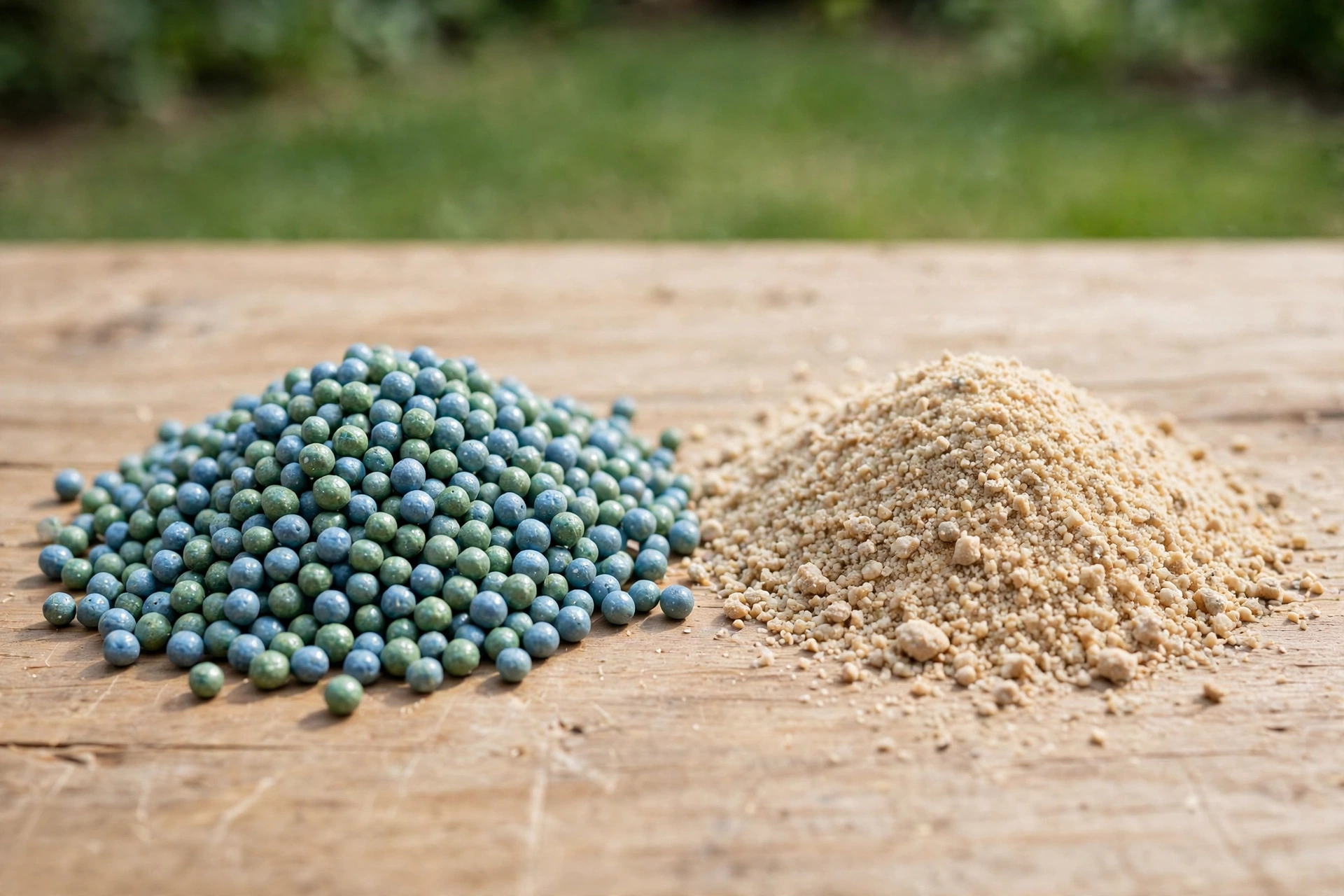
Coverage is the first filter, but it is not the only one. A walk-behind spreader that holds 5,000 square feet of product is the right call when your lawn is mostly open turf with straight runs, while a handheld spreader earns its keep on narrow side yards, tight corners, and strips between the driveway and the fence. If you are still deciding between granular and liquid feeding, the comparison in liquid vs granular fertilizer will help you settle the form before you settle the spreader.
Compare the Three Picks
| Spreader | Coverage per Fill | How It Spreads | Best For |
|---|---|---|---|
| Scotts Turf Builder EdgeGuard Mini | Up to 5,000 sq ft | Walk-behind broadcast, pre-calibrated, with an EdgeGuard shield | A whole small lawn in one fill |
| Scotts Wizz | Up to 2,500 sq ft | Battery-powered handheld, 23 settings, broadcasts up to 5 ft | Small lawns, spot feeding, and tight spaces |
| Scotts Whirl | Up to 1,500 sq ft | Hand-powered crank handheld | Small patches and quick touch-ups on a budget |
Best Overall: Scotts Turf Builder EdgeGuard Mini
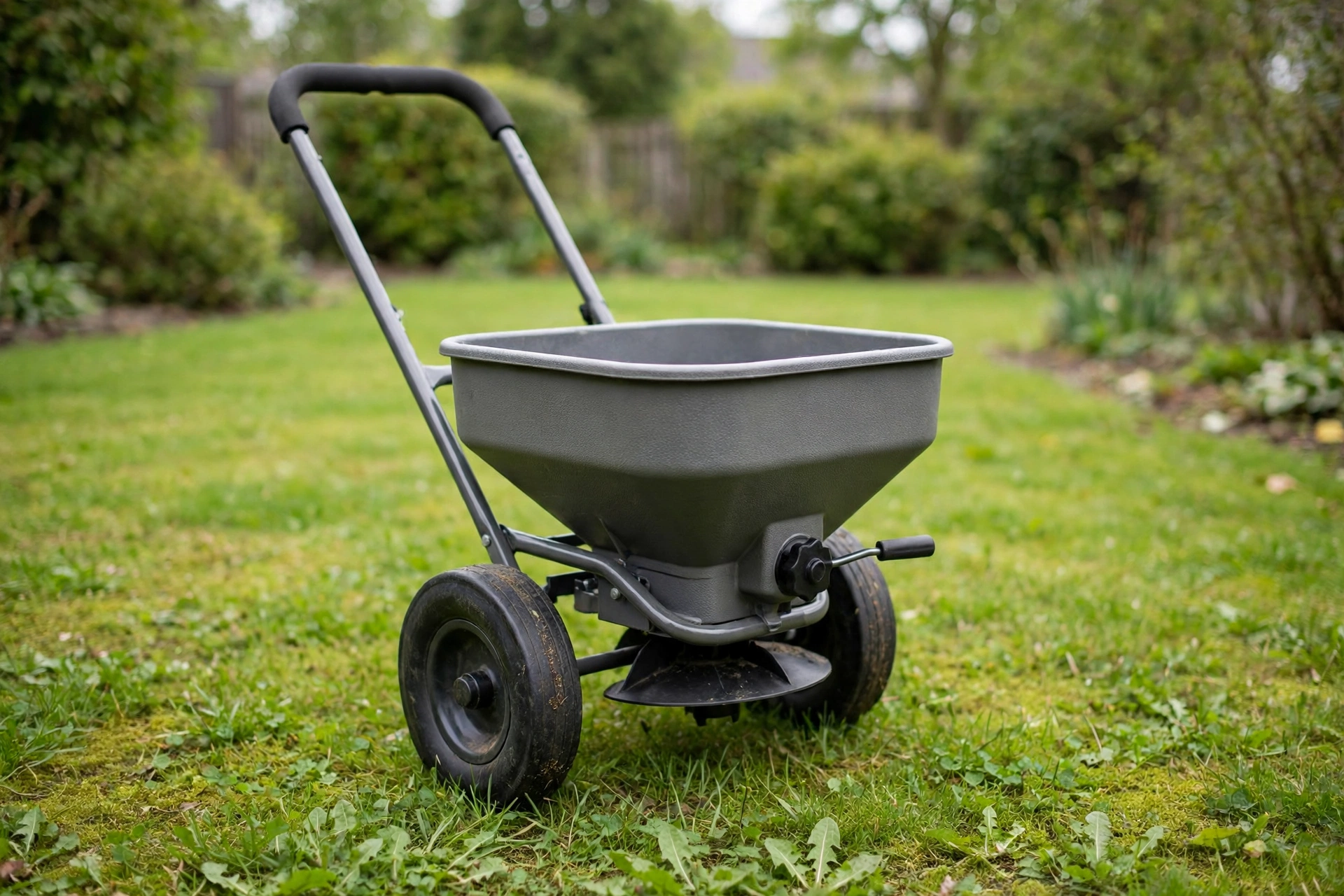
The EdgeGuard Mini is the spreader for a small lawn that still wants a proper walk-behind tool. It holds up to 5,000 square feet of Scotts product, which covers a typical small lawn in one fill, and it comes pre-calibrated so the rate is set before you start walking.
The EdgeGuard shield is the feature that matters most on a small lot, because it keeps granules off the driveway, the walkway, and the patio while you work the edges.
Owners rate it 4.5 stars from 33,070 ratings on Amazon, which is the kind of broad, settled feedback that tells you the design has been through plenty of real yards. The trade-off is honest: it is still a walk-behind spreader, so it needs garage floor space and a lawn with enough open turf to justify pushing it.
Pros: covers a small lawn in one fill; pre-calibrated; EdgeGuard shield keeps product off hard surfaces.
Cons: takes up more storage space than a handheld; overkill for a lawn under 1,500 square feet.
Scotts Turf Builder EdgeGuard Mini
Covers a typical small lawn in one fill, pre-calibrated, with a shield that keeps granules off hard surfaces.
Best Handheld: Scotts Wizz
The Wizz is the pick when your lawn is small enough that pushing a walk-behind spreader feels like bringing a wheelbarrow to fill a flowerpot. It runs on 4 AA batteries, holds up to 2,500 square feet of product, and broadcasts up to 5 feet, which is plenty of reach for a front yard, a side strip, or a back lawn broken up by beds and paths.
Its 23 spreader settings are the reason it works across more jobs than a one-setting handheld. You can dial it down for a narrow strip along the fence and open it up for the open stretch of turf, instead of guessing with a single fixed opening and hoping the rate comes out even.
The trade-off is coverage. At 2,500 square feet per fill, a 5,000-square-foot lawn needs a refill halfway through, so the Wizz is best as the main spreader for a genuinely small lawn or as the second spreader for edges and tight spots on a bigger one. Whatever spreader you use, the technique in how to apply fertilizer without burning your lawn is what keeps a feeding from turning into striped or scorched turf.
Pros: battery-powered and easy to carry; 23 settings for different areas; broadcasts up to 5 feet.
Cons: needs a refill on a 5,000-square-foot lawn; runs on AA batteries you have to keep on hand.
Scotts Wizz
Battery-powered handheld with 23 settings and a 5-foot broadcast for small lawns and tight spaces.
Best Budget: Scotts Whirl
The Whirl is a hand-powered crank spreader, and that simplicity is the whole point. There are no batteries to buy, no motor to maintain, and nothing to charge before a feeding, which makes it the cheapest way to spread granular fertilizer on a small patch of lawn.
It holds up to 1,500 square feet of product, so it fits a small front yard, a new patch of seed, or a section of lawn that needs a touch-up after a repair. For that size of job, the crank gives you enough control to keep the granules where they belong without overthinking the settings.
The trade-off is effort and capacity. Cranking by hand across a full 5,000-square-foot lawn is slow work, and the 1,500-square-foot capacity means several refills, so the Whirl earns its place as a budget second spreader or the only spreader a very small lawn needs. If your feeding plan leans on slow-release granules, the comparison in slow-release vs quick-release fertilizer will help you pick the product to put in it.
Pros: no batteries or charging; simple crank design; the lowest-cost way into granular feeding.
Cons: hand-cranking a large lawn is slow; 1,500-square-foot capacity means frequent refills.
Scotts Whirl
Hand-powered crank spreader with no batteries to buy, sized for small patches and quick touch-ups.
What Not to Buy
Do not buy a big tow-behind spreader, or any broadcast spreader built to hold 100 pounds or more, for a small lawn. It is too wide for the paths and gates a small yard actually has, too heavy to store in a garage that already holds a mower and a bike, and the product left in the hopper between feedings goes stale long before you need it again.
The same logic applies to any spreader bought on capacity alone. A hopper that holds three feedings’ worth of product sounds efficient until you realize you are storing fertilizer in the spreader instead of in its sealed bag, and a spreader that cannot turn inside your side yard will spend its life parked while you feed by hand anyway.
Bottom Line
Buy the Scotts Turf Builder EdgeGuard Mini if your lawn runs 3,000 to 5,000 square feet and you want one fill, one pass, and clean edges. Reach for the Wizz when the lawn is smaller or broken into tight spaces, and keep the Whirl for patches and touch-ups where simple and cheap beats fast. The wrong size spreader costs you a season of wrestling and wasted product, while the right one disappears into the job and lets the lawn do the talking.