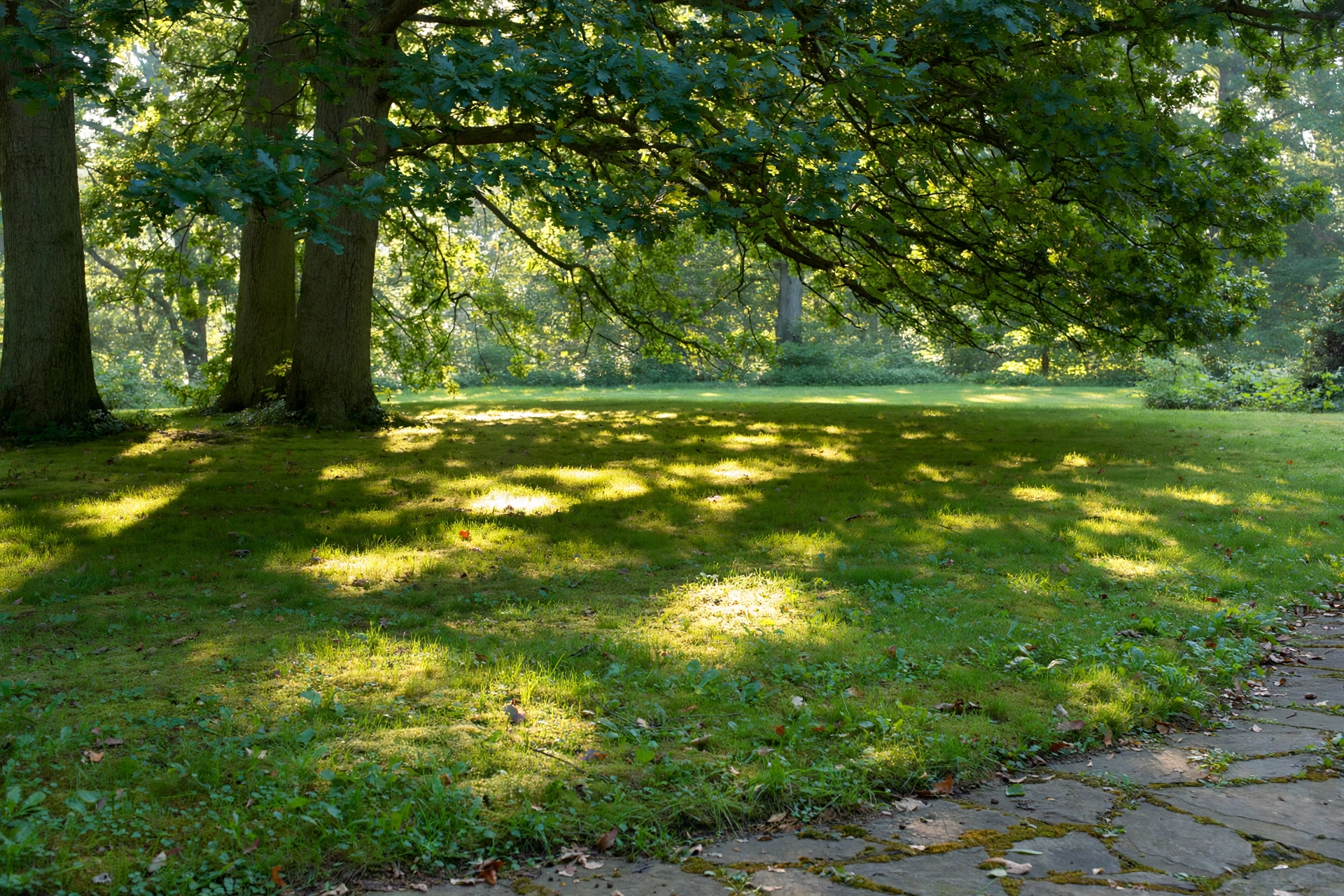
You know the patch. Every spring you rake it, reseed it, water it — and by August it is thin again, the same bare spot under the same tree while the rest of the lawn looks fine. The mistake is not the seed or the watering. It is the grass itself, because most lawn grasses need sun the way a tomato plant does, and no amount of care makes a sun grass thrive in shade. The fix starts before the bag of seed, with picking a grass that can actually live where the light is.
This table rates fifteen common lawn grasses for shade tolerance, from Excellent down to Very poor, using the ratings published by three university Extension services. Cool-season grasses come first, then warm-season grasses, and every row keeps the rating word its own source used — so read the row itself and pick the grass that matches the light your yard actually gets.
How much shade is too much?
No turfgrass grows in complete shade, and there is a floor worth knowing before you buy seed. If a spot gets under 50 percent open sunlight, or under four hours of sunlight a day, it is too shady for any grass — plant a ground cover there instead, such as English ivy, ajuga, liriope, or pachysandra, or spread mulch and call it a bed. The honest way to judge a spot is to watch it through a day and note, hour by hour, whether it sits in sun or shade, since the light changes with the season and the trees.
As a rule of thumb, bermudagrass needs at least eight hours of sunlight to hold, zoysiagrass needs at least six, and anything under six hours calls for tall fescue or a planting that is not grass at all. That is why the same grass that carpets your sunny front yard can fail twenty feet away under the maple, where the light is the thing that changed.
The table
Cool-season grasses
| Grass | Season | Shade tolerance | What to know |
|---|---|---|---|
| Fine fescue (creeping red, chewings, hard fescue) | Cool | Excellent | The best shade tolerance of the cool-season grasses. Creeping red fescue wilts in summer heat and picks up disease in humid areas, so it suits mild summers or light-maintenance spots. (Oklahoma State) |
| 50% Kentucky bluegrass + 50% fine fescue (mix) | Cool | Excellent | The top-rated shade mix by weight. (NC State) |
| 80% tall fescue + 10% Kentucky bluegrass + 10% fine fescue (mix) | Cool | Excellent | The recommended shade mix, seeded at 6 lb per 1,000 sq ft. (NC State) |
| Tall fescue | Cool | Good | The workhorse shade grass. Marginal in the coastal plain, where it needs good air movement, drainage, and low traffic. (NC State) |
| Kentucky bluegrass | Cool | Good | Pair it with tall fescue — 80% tall fescue and 20% bluegrass by weight is the standard shade mix. Less shade-tolerant than tall fescue, but more disease-tolerant. (NC State; Oklahoma State) |
| Perennial ryegrass | Cool | Good | Good shade tolerance, but weaker than tall fescue and Kentucky bluegrass under disease, heat, and drought stress. (Oklahoma State) |
Warm-season grasses
| Grass | Season | Shade tolerance | What to know |
|---|---|---|---|
| St. Augustinegrass | Warm | Excellent | The most shade-tolerant warm-season grass. Needs about 4 hours of direct sun, or a full day of filtered light. (Mississippi State) |
| Manila zoysiagrass (Zoysia matrella) | Warm | Good | A step below St. Augustinegrass. Proven shade cultivars include Cavalier, Diamond, Zeon, and Zorro. (Mississippi State) |
| Japanese zoysiagrass (Zoysia japonica) | Warm | Good | Needs at least 6 hours of sunlight. Proven cultivars include Meyer, El Toro, and Palisades. (Mississippi State; Oklahoma State) |
| Centipedegrass | Warm | Medium | Handles light pine-tree shade. A step below zoysiagrass. (Mississippi State; NC State) |
| Carpetgrass (broadleaf and common) | Warm | Medium | Tolerates light shade, but rarely the first choice for a home lawn. (Mississippi State) |
| Seashore paspalum | Warm | Poor | Poor shade tolerance; not a shade pick. (Mississippi State) |
| Bahiagrass | Warm | Poor | Poor shade tolerance; needs sun. (Mississippi State) |
| Bermudagrass | Warm | Very poor | Needs the most light of any lawn grass — at least 8 hours of sun. Even its best cultivars, Celebration and TifGrand, are only fair among bermudas and still a poor shade choice. (Mississippi State; Oklahoma State) |
| Buffalograss | Warm | Very poor | Very poor shade tolerance; needs sun. (Mississippi State) |
These ratings come from Extension guides written for Mississippi, North Carolina, and Oklahoma, so treat them as relative rankings for your region rather than a guarantee for any one yard — and remember that the cultivar you pick within a species matters as much as the species itself.
Keeping shade grass alive
Picking the right grass gets you halfway there, and the rest of the job is mowing it the way shade grass needs to be mowed. Mow at the top of the grass’s recommended height, so the plant keeps the most leaf it can for making food out of weak light — in shade, at least 3 inches for tall fescue and other cool-season grasses and at least 2 inches for bermudagrass, zoysiagrass, or St. Augustinegrass. The full heights by species are in Reference Table: Recommended Mowing Heights by Grass Species. Mow the shady patches less often than the sunny ones, too, since every pass of the mower is traffic on a plant that is already stressed.
Feed a shade lawn lightly, about half the nitrogen a sunny lawn gets, and time it the way the grass wants it — Reference Table: When to Fertilize Cool-Season vs Warm-Season Lawns has the timing. Water less than you would a sunny lawn, since shade stays cooler and dries slower, but watch for wilting all the same: tree roots drink from the same soil your grass does, and a thirsty shade lawn under a big tree may still need a drink. Rope off the shady spots or reroute the foot traffic where you can, and never mix cool-season and warm-season grasses in the same shaded area — they need different care on different schedules, and neither one wins.
If you are still choosing the grass for a shady spot, start with What Grass Grows Under Pine Trees, which walks through the same decision tree by tree — then come back here for the rating that settles it.
Bottom line
Match the grass to the light you actually have: fine fescue or a fescue mix where cool-season grass grows, St. Augustinegrass where warm-season grass grows, and a ground cover — not a different grass — wherever the spot gets under four hours of sun a day. Plant the right grass once, and the patch stops coming back every spring.
Sources
Mississippi State University Extension, “Selecting and Managing Turfgrass for Shade” (Publication 2892, 2024; J. McCurdy and C. Baldwin) — https://extension.msstate.edu/sites/default/files/publications/P2892_web.pdf — fetched November 14, 2026.
NC State Extension, “Selecting and Managing Lawn Grasses for Shade” — https://content.ces.ncsu.edu/selecting-and-managing-lawn-grasses-for-shade — fetched November 14, 2026.
Oklahoma State University Extension, “Managing Turfgrass in the Shade in Oklahoma” — https://extension.okstate.edu/fact-sheets/managing-turfgrass-in-the-shade-in-oklahoma — fetched November 14, 2026.