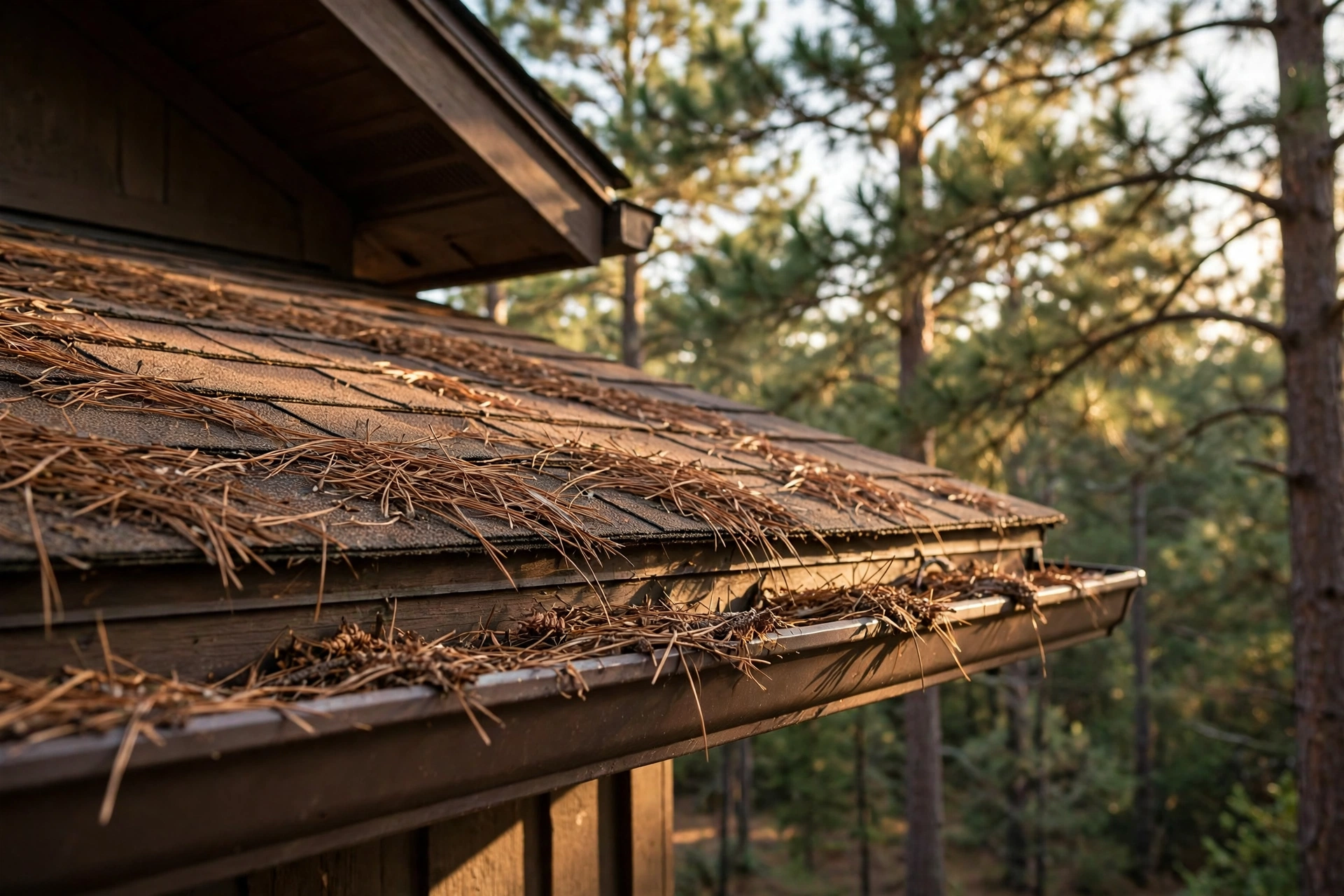
Most people install gutter guards and stop climbing the ladder, which is exactly when the needles start winning. They mat on top of the mesh, the mat sheds water over the edge instead of into the gutter, and the overflow you bought the guards to prevent comes back wearing a different cause.
Guards do not end gutter cleaning. They move it from inside the trough to the top of the mesh, which is a much easier job — if you do it before the mat turns into a thatch. Here is how to keep the guards working, what to do when a section needs to come off, and the mistakes that turn a ten-minute job into a Saturday.
The mistake: treating guards as set-and-forget
A gutter guard is a filter, not a lid. Water has to pass through the mesh, and anything the mesh catches stays on top of it until wind or a brush moves it along. Under pines, that means a thin layer of needles after every heavy shed, and a thin layer becomes a mat if you leave it through a wet month. The mat does two things at once: it slows water into the gutter, and it holds moisture against the mesh, which speeds up corrosion on cheaper guards and invites moss on any of them.
The fix is boring and cheap, which is why people skip it. A quick brush-off once or twice a year — after the spring shed and after the fall drop — keeps the mesh open and the water moving. Under heavy pines, add a mid-summer check, because a July thunderstorm will find a matted guard faster than you will.
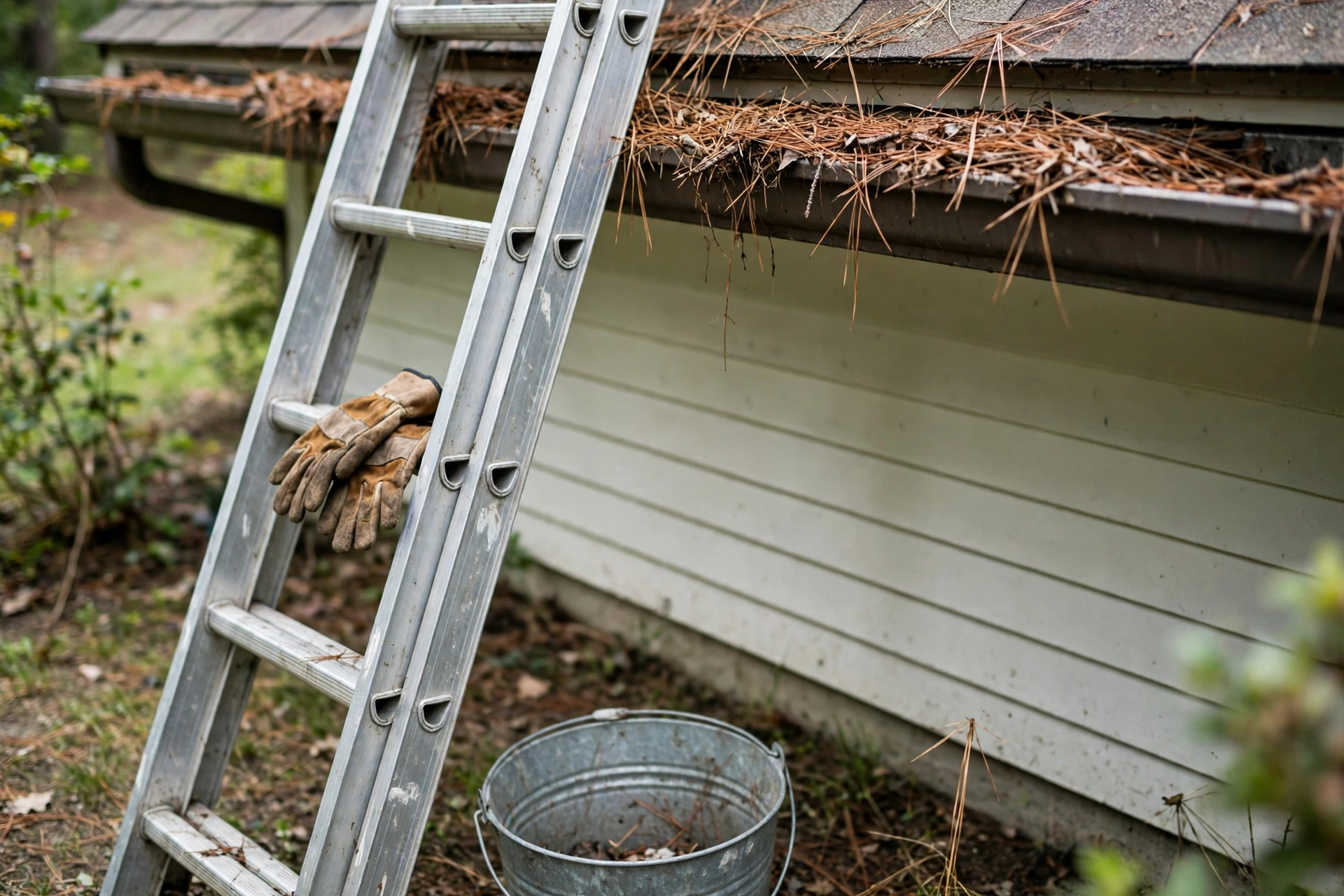
What you need
- A sturdy extension ladder, set on level ground, with the top resting against the fascia — not the gutter lip.
- Work gloves. Dry needles are sharp enough to cut, and wet ones hide whatever else the roof washed down.
- A soft-bristle brush with a long handle, or a telescoping brush made for gutters.
- A garden hose with an adjustable nozzle.
- A bucket and a scoop for anything that did get into the trough.
- A drill, if your guards are screwed down and a section needs to come off.
Clean from the ground first
Start with the easy pass. A leaf blower with a gutter-cleaning attachment, or a telescoping wand on the hose, will clear loose needles off the mesh without a ladder. Work from one end of a run toward the downspout, and keep the nozzle angled so debris blows off the roof edge, not back onto it.
This pass handles the loose stuff. It will not move a matted layer, and it will not tell you whether water is actually getting through. That is what the ladder is for.
Brush the mesh, then flush the trough
From the ladder, brush along the top of the guard in short strokes toward the downspout end, working one section at a time. A soft-bristle brush is the right tool here: a wire brush or a metal scraper will snag micro-mesh and leave a tear that needles pour through. If the mat is wet and stuck, hose it lightly first to loosen it, then brush.
Once the mesh is clear, run the hose into the gutter at the end farthest from the downspout and watch the water come out below. A steady stream means the trough and downspout are open. A trickle means something got past the guard, and that is when a section has to come off.
When to remove a section
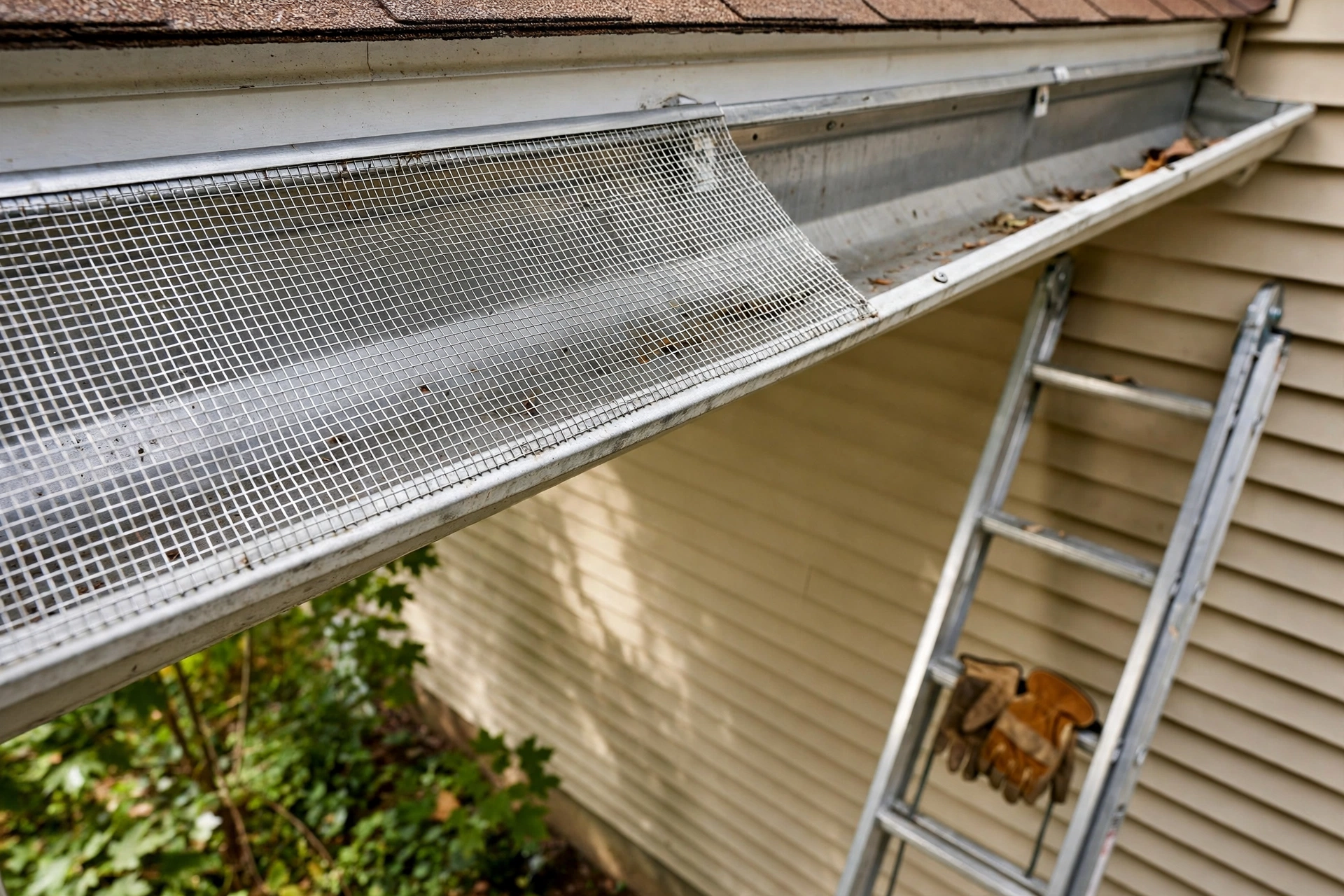
Most screwed-down micro-mesh guards, like the Raptor kit, are held by self-tapping screws through the front lip, in 4-foot panels. Removing one takes a drill and two minutes: back the screws out, lift the panel, and set it somewhere it will not slide off the roof. Scoop the trough, flush it with the hose, and screw the panel back down in the same holes.
Do not force a panel that will not lift. Some guards slide under the first course of shingles, and prying them free can crack a shingle or tear the mesh. If a panel is tucked under shingles, clean around it from above and flush from the open end instead.
How often to clean guarded gutters
| Situation | How often | What to do |
|---|---|---|
| Light pines, few trees | Once a year, in fall | Brush the mesh, flush the trough |
| House ringed by pines | Twice a year, spring and fall | Brush the mesh, flush, check downspouts |
| Heavy shed or storm | Within a week of the storm | Clear the mat before the next rain |
| Water overflowing the edge | Right away | Brush, flush, and lift a panel if flow stays slow |
What not to do
Do not aim a pressure washer at the mesh. The concentrated stream dents aluminum panels and can tear stainless mesh at the seams, and a torn guard is worse than no guard because it hides the hole. Do not lean the ladder against the gutter itself, and do not reach sideways from the ladder to clear one more section — move the ladder instead. And do not clean guards in the rain to save a trip: wet shingles, wet rungs, and a hose are a bad combination.
The one thing that undoes the fix
A guard only works if water can get through it, and the mat is the thing that stops the water. Brush the mesh twice a year, flush after the fall drop, and lift a panel whenever the downspout runs slow. That is the whole job, and it is the difference between guards that last twenty years and guards that get ripped out in frustration after three. For the full picture — picking the right guard in the first place, and putting it on yourself — see the best gutter guards for pine needles and how to install gutter guards yourself. And if the needles are coming from the roof itself, start with keeping pine needles out of your gutters before they reach the guard at all.