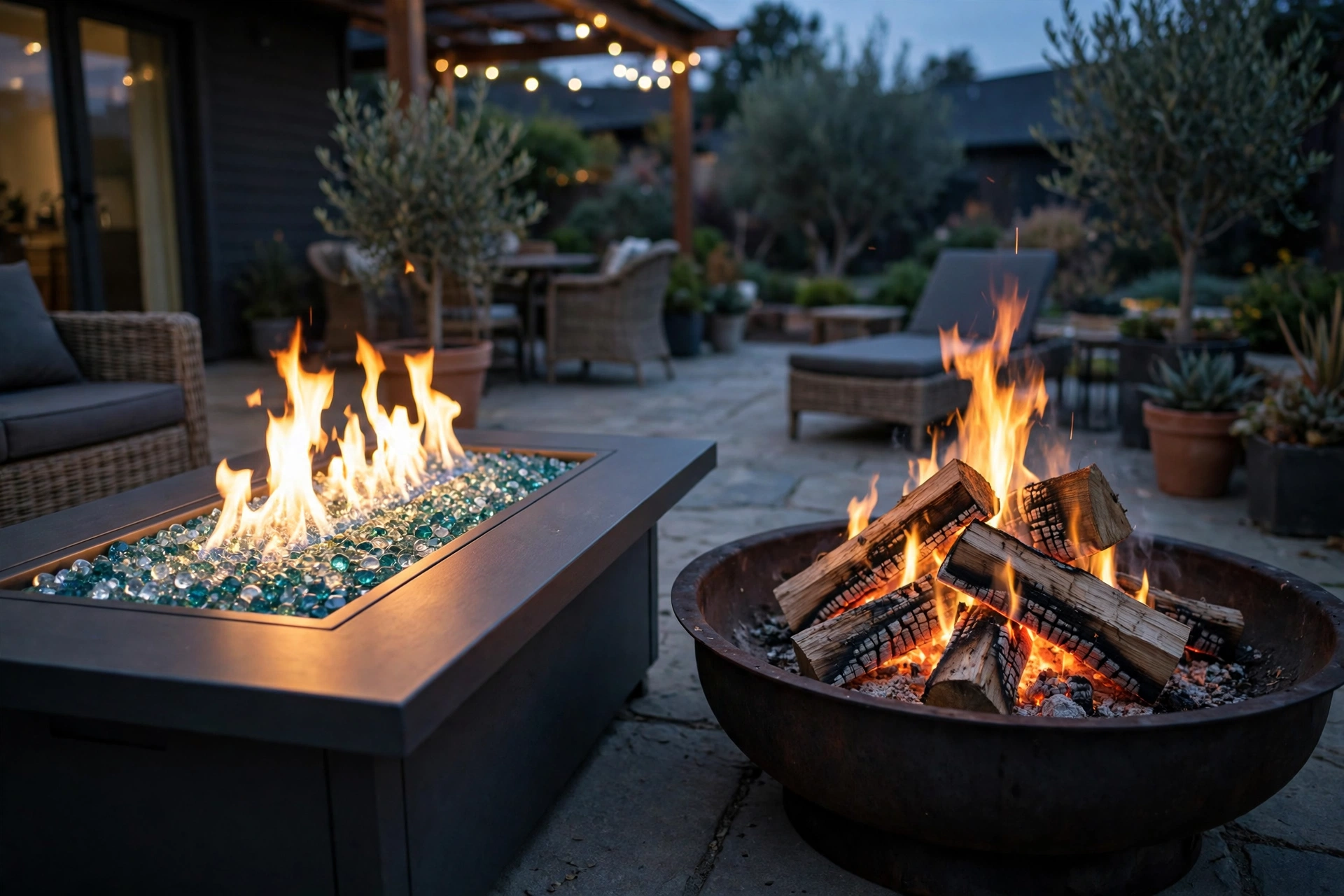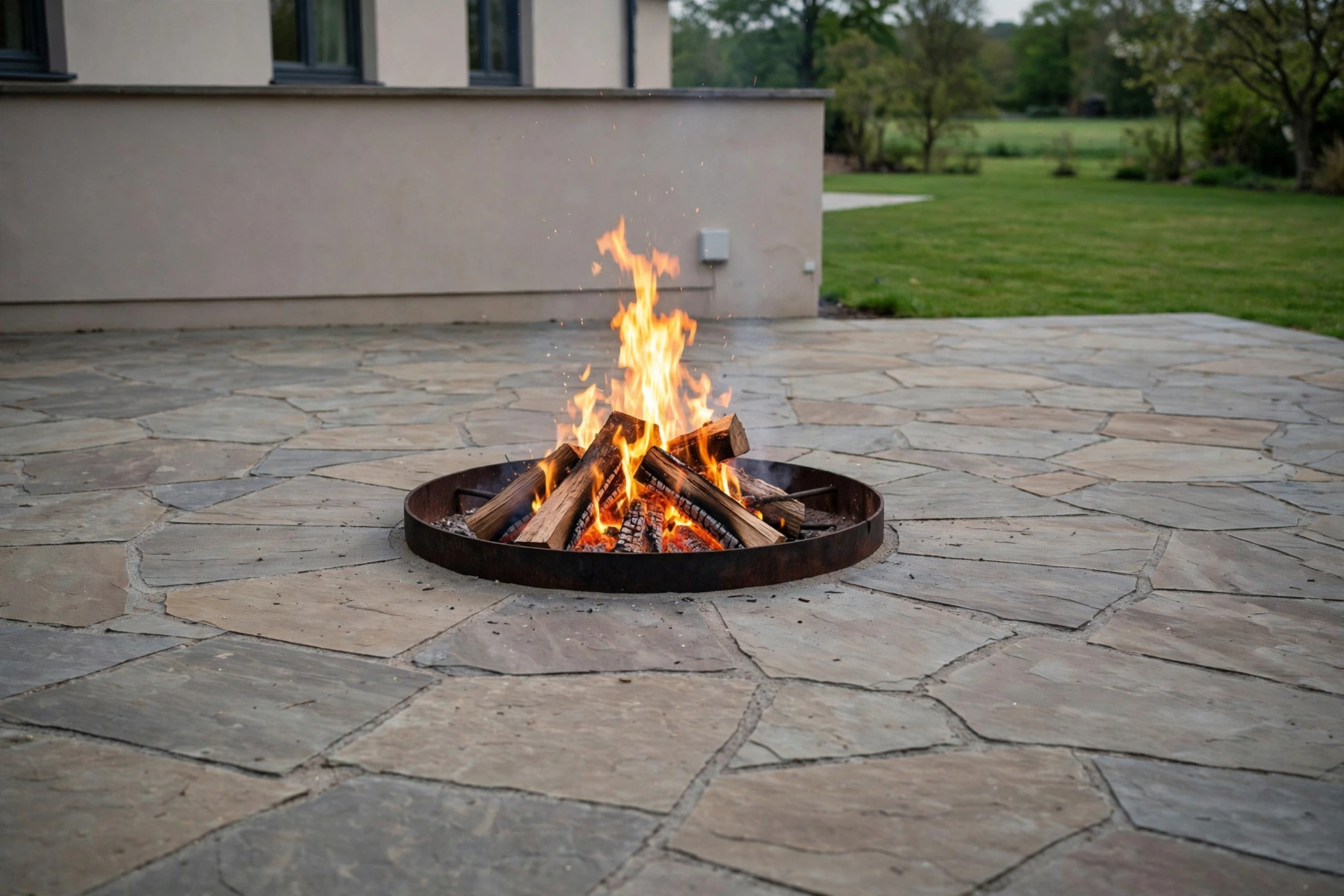
How far should a fire pit be from your house? It is the right question to ask before the pit arrives, because the answer decides where the patio furniture goes, whether the spot you have in mind is usable at all, and what happens the first night the wind picks up with a fire already lit.
A pit placed too close is not a small mistake you live with. Heat and embers work on siding, fences, and deck boards every single burn, and a gust can carry a spark farther than the flames ever reach. Measure first, and the fire stays a pleasure instead of a worry.
The number: ten feet, measured from the pit’s edge
Keep a fire pit at least 10 feet from anything that can burn. That is the National Fire Protection Association’s guidance for fire pits, and it covers more than the house wall: the garage, a shed, a wooden fence, a pergola, and the low branches overhead all count as things that can burn.
Measure from the outside edge of the pit, not from the center of the fire. On a 36-inch pit, measuring from the middle quietly steals a foot and a half of the clearance you thought you had.
Ten feet is the floor, not the target. Where the yard allows it, a wood-burning pit is better off at 15 to 20 feet, because wood throws sparks in a way a propane flame never does. Our comparison of patio heater vs fire pit for a small patio works through what fits when the yard cannot give a pit that much room.
When the rule in your town is bigger than ten feet
Local fire codes sit on top of the general guidance, and many are stricter. Model fire code puts portable outdoor fireplaces at 15 feet from a structure and open recreational fires at 25 feet, and plenty of cities and homeowner associations set their own numbers on top of that.
The stricter number wins, every time. A two-minute check of your city or county fire code before you build or buy is cheaper than moving a finished patio, and it is the version an insurer will care about if anything ever goes wrong.
What else the distance has to cover
Overhead counts. Heat rises straight up, so a pit that clears the house wall can still sit too close under eaves, a pergola roof, or a tree canopy. If something overhead could catch or trap heat, the pit does not belong under it at any distance.
The surface matters as much as the gap. Set the pit on concrete, pavers, stone, or gravel, never directly on a wood or composite deck and never on dry grass. Radiant heat travels down as well as out, which is why our guide to using a fire pit on a wood deck reaches the verdict it does.
People need a smaller circle of their own. Keep seating back far enough that knees and blankets stay out of spark range, and hold children and pets at least 3 feet from the pit while it burns. A spark screen, covered in our guide to fire pit spark screens, buys extra margin on windy nights.
Before the first fire, walk the circle
Stand at the pit and turn slowly. Anything wooden, dry, or stored within the circle — the firewood stack included — moves out of it. Keep a hose, a bucket of water, or an extinguisher within reach, and never leave a burning pit alone.
Fuel choice belongs in the same check. Dry, seasoned wood sparks less than the odds and ends people feed a pit, and our guide to what you can burn in a fire pit sorts the safe fuel from the kind that throws embers across the yard.
The short answer
Ten feet from anything that can burn is the minimum, measured from the pit’s edge, and 15 to 20 feet is the smarter target for a wood fire when the yard has it to give. Check your local code, use the bigger number, and place the pit once, in the right spot, instead of moving it after the first scorch mark.