Does the half-used bag of fertilizer in the garage still work, or is it just taking up space by the door?
It is the question every spring cleaning asks, usually while somebody is holding a bag with last year’s date on it and a clump problem inside it. The short answer is that the fertilizer itself almost certainly still works. The longer answer depends on what kind it is and how it was stored, and that is what this post settles.
Granular Fertilizer Does Not Really Expire
The nitrogen, phosphorus, and potassium in a bag of granular fertilizer are minerals and stable salts. They do not break down on a shelf the way food or medicine does, and a dry bag kept sealed can stay effective for years.
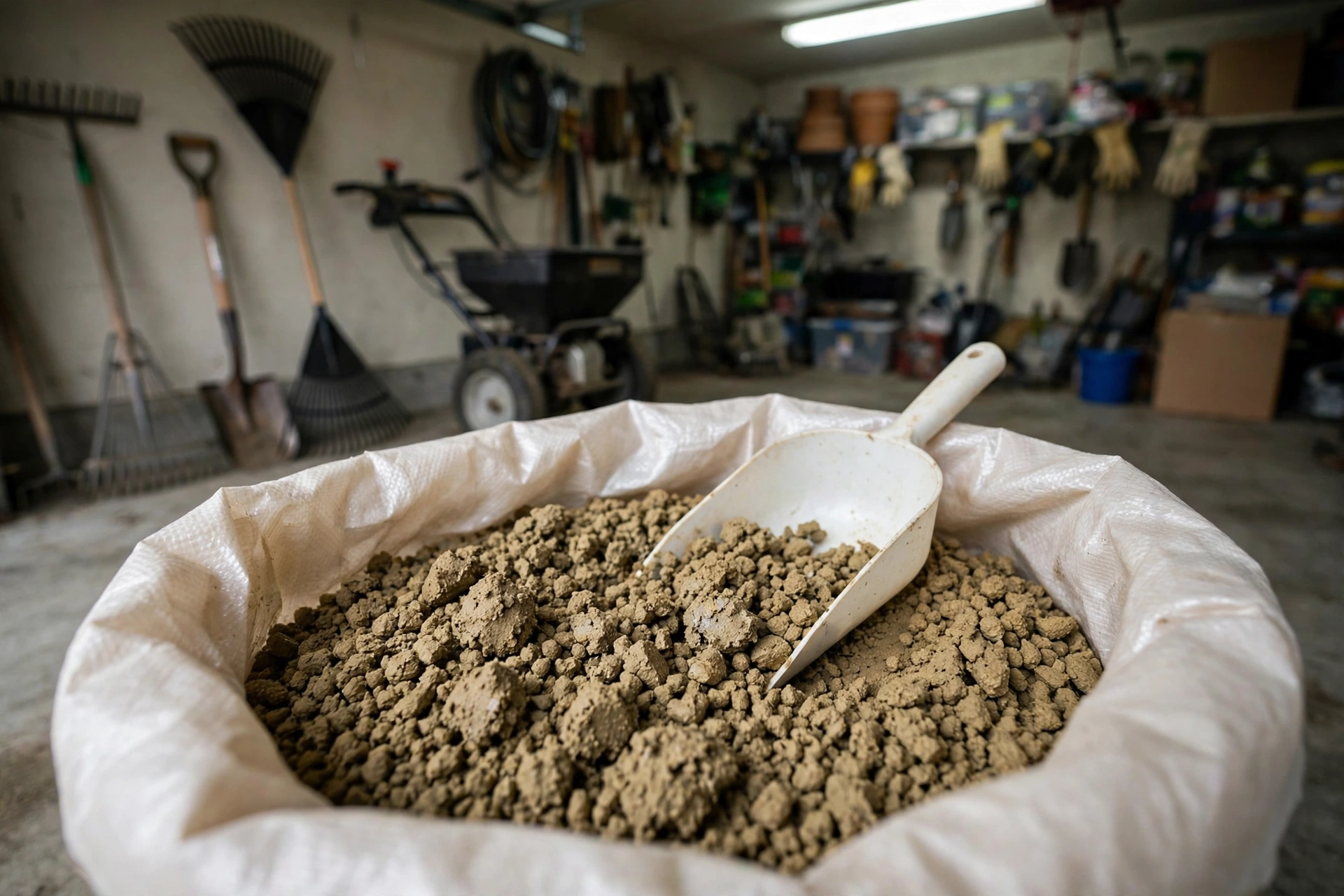
What changes is the bag’s condition, not its chemistry. Fertilizer salts are hygroscopic, which means they pull moisture out of the air. An open bag in a humid garage drinks that moisture all summer, and the granules fuse into clumps or one solid brick. The analysis on the label is still in there. It is just harder to spread evenly.
How to Handle a Clumped Bag
Drop the bag flat on the driveway a few times, or work the lumps apart with a gloved hand or the back of a spade. Granules that crumble back into individual pieces spread fine.
The one real cost of clumping is calibration. A spreader metered for free-flowing granules delivers an uneven rate when half the load is gravel-sized chunks, and uneven rates are how lawns get stripes. If the bag will not break down past pea-sized lumps, it is better used on garden beds, where you spread by hand and can see the coverage, than run through a broadcast spreader. How the product form behaves in the spreader is part of the liquid vs. granular fertilizer comparison.
The Exceptions: Liquids and Weed & Feed
Liquid fertilizers have a shorter useful life. Concentrates can separate, grow crystals that will not redissolve, or lose strength over a few seasons. Shake the jug hard. If it pours smooth and uniform, use it. If crystals sit at the bottom after shaking and warming the jug to room temperature, the product is done.
Weed & feed products are the true exception to the whole question. The fertilizer half keeps; the herbicide half does not. The weed-control chemicals in a combined product lose potency over time, so an old bag of weed & feed may feed the lawn perfectly while doing very little to the weeds. If weed control is the point of the application, buy that product fresh and use plain fertilizer from the old bag on a different day. Timing those two jobs apart is covered in how to apply fertilizer without burning your lawn.
How to Store an Open Bag So It Stays Good
Seal it. Roll the top down and clip it, or pour the remainder into a lidded plastic bin. The bin is the better answer in a humid climate, because it also keeps the bag off the floor and out of the reach of a tipped-over watering can.
Keep it off concrete. A shelf or a pallet, for the same reason as any stored lawn material: floors carry moisture, and the bottom of the bag is where clumping starts.
Keep it dry and shaded. A garage or shed corner away from the door, where rain does not blow in and sun does not bake the bag through a window.
Stored that way, an open bag in the garage smells faintly sharp and chemical when you unclip it, and pours like gravel. That is exactly what good stored fertilizer is like. A bag that smells musty or pours like damp sand has been drinking moisture, and it goes to the garden beds instead of the spreader. When it is time to run it, the best fertilizer spreaders for small lawns covers the settings side of the job.
The Answer to Take to the Garage
Use the bag. Dry granular fertilizer does not expire in any way that matters to a lawn, clumps break up, and the only products worth replacing on age alone are weed & feed combinations and separated liquids. Seal what is left in a bin, off the floor, and it will be ready next season too.