This post contains affiliate links. If you buy through them, we may earn a commission at no extra cost to you.
Two packets. That is the entire parsnip shelf at Botanical Interests, and it makes this the shortest variety decision in the root bed — provided you know what separates them, because the wrong one costs you a row for four months.
Plant All American first if your beds are healthy and you want the bigger root. Choose Javelin instead when canker has marked your parsnips before, or when part shade is what the bed gets.
The short answer
Both varieties are Pastinaca sativa, both sow the same way — a group of 3 seeds every 3 inches, half an inch deep, in rows 18 inches apart — and both need frost before they taste like much, because cold turns their stored starch into sugar.
Where they split is shape and insurance. All American is the broad-shouldered root, up to 12 inches long and 3 inches across the top, and it can thicken in as little as 95 days. Javelin is the slimmer hybrid, up to 10 inches with shoulders up to 2.5 inches, at a fixed 110 days, and it carries the canker resistance.

All American — the big root, the long packet
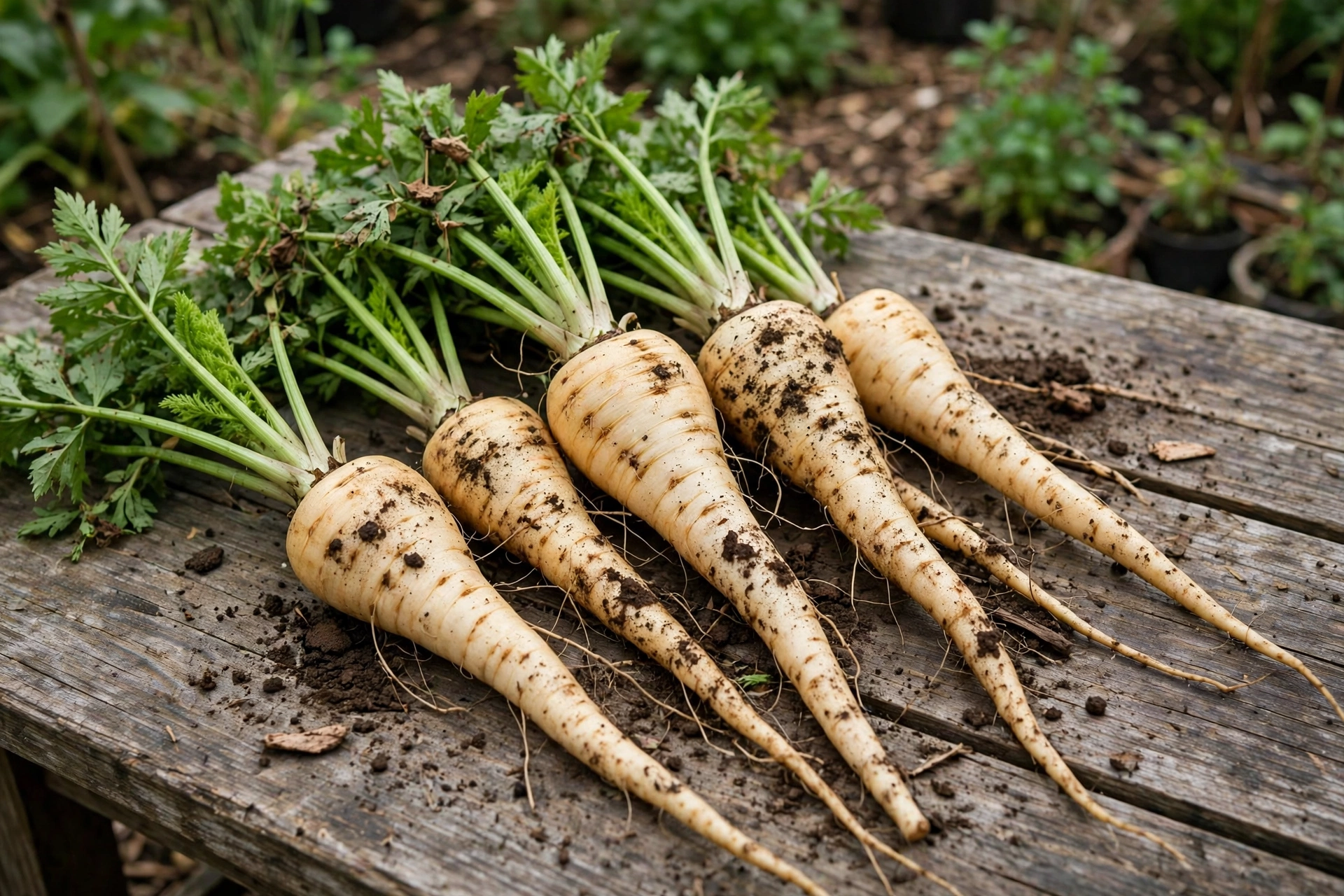
All American is the older style of parsnip, creamy-white and tapered, with foliage that looks like carrot tops gone broad. The packet lists 95 to 125 days, and the early end of that range is the point: this variety thickens sooner than most, which matters when your fall frost arrives on the early side.
The numbers behind it are generous. One packet sows up to 28 feet of row, the roots run up to 12 inches, and it asks for full sun and nothing exotic — sow about 4 months before your average first fall frost, in soil at 50 to 70°F, and expect seedlings in 10 to 25 days.
Growers rate it 4.3 out of 5 across 16 reviews, the larger sample of the two varieties here. I would plant this one in a clean bed without a second thought, and its trade-off is plain: no named disease resistance, so a bed with a canker history is a gamble it does not cover.
- Pros: thickens in as little as 95 days; roots up to 12 inches; one packet sows up to 28 feet; $2.69.
- Cons: full sun only; no canker resistance named on the packet.
All American Parsnip Seeds
The big, early root: 95–125 days, up to 12 inches, and a packet that sows 28 feet.
Check Price at Botanical InterestsJavelin — the hybrid with canker resistance
Javelin is a hybrid bred for the problem All American ignores. Its packet names excellent resistance to canker, the dark, rough patches that scar parsnip shoulders and shorten how long roots can sit in the ground, and that resistance is what lets you leave Javelin in the bed longer with less risk.
The root is the slimmer of the two, up to 10 inches long with shoulders up to 2.5 inches across, and the plant tolerates part shade where All American wants full sun. Maturity is a flat 110 days, so there is no early finish to hope for — sow it early, as its packet insists.
Two honest cautions come with it. The packet sows up to 5 feet of row, against All American’s 28, so a long bed takes several packets at $2.79 each. And its 5.0 rating rests on just 3 reviews, which is a compliment, not a track record.
- Pros: excellent canker resistance; tolerates part shade; slender, even roots up to 10 inches.
- Cons: packet sows only 5 feet; fixed 110 days with no early end; rating based on 3 reviews.
Javelin Parsnip Seeds
The hybrid with canker resistance: 110 days, slender roots, happy in part shade.
Check Price at Botanical InterestsThe two varieties, side by side
| Variety | Days to maturity | Root size | Packet sows | Sun |
|---|---|---|---|---|
| All American | 95–125 | Up to 12″ long, 3″ shoulders | Up to 28 feet | Full sun |
| Javelin | 110 | Up to 10″ long, 2.5″ shoulders | Up to 5 feet | Full sun to part shade |
One more thing belongs in any honest parsnip roundup, and it is a packet you should skip: last year’s. Parsnip seed is short-lived, and old seed is the usual suspect behind the empty row gardeners blame on the variety. Buy fresh seed for the season you are sowing, whichever of these two you choose.
What you dig them with
Parsnips come out of the ground with a fork, one root at a time, and a 12-inch root arrives muddy. A harvest basket with an open mesh bottom lets you rinse the soil off at the hose instead of carrying it to the sink, which is why this one earns a place next to a root crop that spends four months underground.
Harvest Basket
Wood and wire-mesh basket for rinsing roots at the hose; two sizes, 8 and 16 quarts.
Check Price at Botanical InterestsWhich one I would plant
All American, in most beds, most years. The early thickening, the 12-inch root, and a packet that covers 28 feet make it the default, and its lack of resistance only matters in soil that has already shown you canker.
Javelin is the deliberate second choice, and a good one: the moment canker has scarred a previous parsnip crop in that bed, its resistance is worth more than root size, and its part-shade tolerance opens beds All American would sulk in. Sowing and thinning either variety is its own job — growing parsnips from sowing to harvest walks through it, and parsnips vs. carrots settles which root deserves the row when space runs short. For the wider root bed, the parsnips, turnips, and rutabagas roundup covers the neighbors.
Two packets, one decision, and a row that rewards patience: sow in late spring, walk past it all summer, and dig after frost, when the roots finally taste like the ones on the packet.