Disclosure: This post contains affiliate links. If you buy through them, Landscape & Leisure may earn a commission at no extra cost to you.
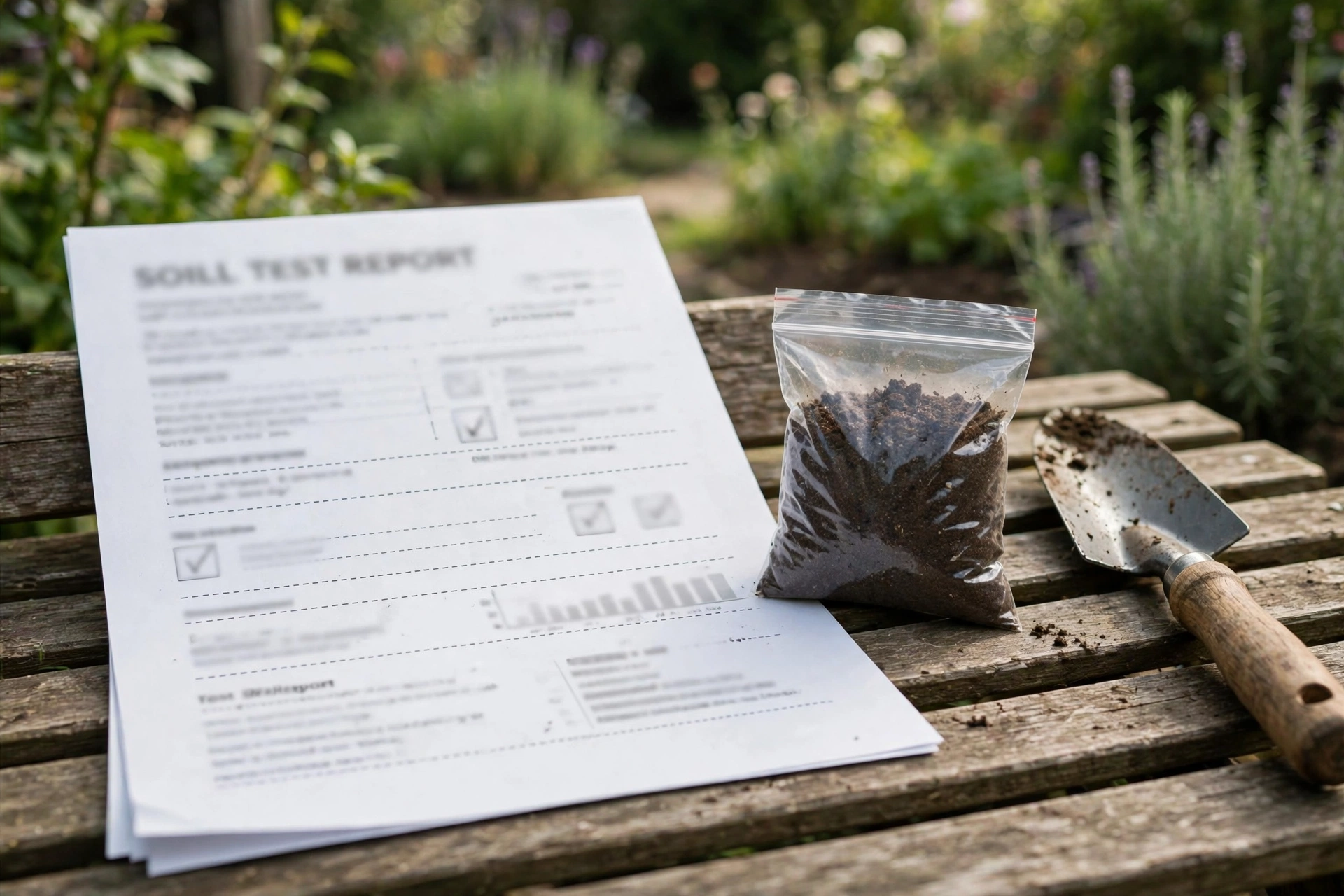
5.8. If that is the pH at the top of your soil test report, stop there before you look at anything else.
A lawn at 5.8 is too acidic for most grasses to use fertilizer well, so the numbers below pH matter less until it moves. This guide walks through a report line by line, in fix order.
Start with pH, because it controls everything else
pH measures how acidic or alkaline your soil is, on a scale from 0 to 14. Most lawn grasses do best between 6.0 and 7.0, with 6.5 a good middle target for fescue, bluegrass, and ryegrass.
Below 6.0, phosphorus gets tied up and roots take in less of it, even when a test shows plenty present. Above 7.5, iron becomes harder to absorb, and you can see pale growth that extra fertilizer does not fix.
If pH is low, lime raises it slowly over several months. If pH is high, elemental sulfur lowers it, also slowly. Neither works in a weekend, which is why pH goes first.
Buffer pH tells you how much lime you actually need
Many lab reports list a second number called buffer pH. That number estimates how strongly your soil resists a pH change, and labs use it to calculate a lime rate in pounds per 1,000 square feet.
Two lawns at 5.8 can need very different lime rates — 25 pounds per 1,000 square feet on sand, 50 or more on clay. Follow the report’s rate over the bag’s directions.
At-home capsule kits do not measure buffer pH. That gap is one of the clearest differences covered in our soil test kit vs lab soil test comparison.
Read N-P-K as three separate questions
The three familiar numbers stand for nitrogen, phosphorus, and potassium, always in that order. A bag marked 24-0-11 and a soil report are talking about the same three nutrients, but the report tells you what is already in the ground.
Nitrogen is the tricky one. It moves through soil quickly and changes within weeks, so use the report for phosphorus and potassium, then set nitrogen by grass type and season.
Phosphorus supports root growth and new seeding. Potassium supports stress tolerance. When either rates low, a fertilizer containing it makes sense; when both rate high, a nitrogen-only product is usually the better buy.
Watch the units. Reports may show parts per million or pounds per acre, and the rating words — low, medium, optimum, high — are the part to act on.
The quieter lines: organic matter, CEC, and micronutrients
Organic matter is reported as a percentage. For most home lawns, 3 to 5 percent is healthy, and getting there comes from leaving clippings and topdressing with compost, not a single product.
CEC, or cation exchange capacity, is how well soil holds nutrients instead of letting rain wash them past roots. Sandy soils often sit below 10; clay soils can run above 20.
Micronutrients such as iron and manganese rarely need action on a home lawn. Treat a flagged one as a prompt to check pH first.
What each report line means, at a glance
| Report line | What it measures | Healthy range | Fix if off |
|---|---|---|---|
| Soil pH | Acidity or alkalinity | 6.0–7.0 for most lawns | Lime to raise, sulfur to lower |
| Buffer pH | Resistance to pH change | Lab uses it to set lime rate | Follow the report’s lime rate |
| Phosphorus (P) | Available phosphorus for roots | Medium to optimum rating | Phosphorus fertilizer if low |
| Potassium (K) | Available potassium for stress tolerance | Medium to optimum rating | Potassium fertilizer if low |
| Organic matter | Decayed plant material in soil | 3–5% | Clippings, compost topdressing |
| CEC | Ability to hold nutrients | 10–20 typical for loam | Smaller, more frequent feeding if low |
A worked example, line by line
Take a sample report for a front lawn: pH 5.8, buffer pH 6.1, phosphorus rated low, potassium rated medium, organic matter 2.6 percent, CEC 9.
First fix: lime, at the report’s rate, split into two applications if it tops 50 pounds per 1,000 square feet.
Second fix: phosphorus, because it rated low and the homeowner plans to overseed in fall. A starter fertilizer at seeding puts phosphorus where new roots can reach it.
Third: organic matter at 2.6 percent is slightly low, and CEC at 9 points to sandy soil. Leave clippings all season and plan a thin compost topdressing after aerating. Retest in two years, following the timing in when to test your soil.
Which test gives you a report worth reading?
A mail-in lab kit gives you the full set of lines above. An at-home capsule kit gives pH and rough N-P-K ranges, enough for a quick check between lab tests. See our roundup of the best soil test kits for lawns and the broader best soil test kits for home lawns and gardens guide.
MySoil Soil Test Kit — full lab numbers by mail
MySoil is a mail-in kit: you scoop soil, seal it in the prepaid envelope, and get lab results for pH plus 13 nutrients in about 6 to 8 days. The report includes a custom amendment recommendation tied to your results and lawn size.
Pros: lab-measured values rather than color ranges, clear ratings, and a specific rate to follow. Cons: you wait about a week, and it costs more per test than a reusable capsule kit.
MySoil Soil Test Kit
Mail-in lab test for pH and 13 nutrients, with results in 6–8 days and a custom amendment plan.
Soil Savvy Soil Test Kit — recommendation-led report
Soil Savvy also works by mail and reports pH plus 14 nutrients. Its strength is the fertilizer recommendation built from your results, which tells you what to apply and how much, in product terms a homeowner can follow.
Pros: one more nutrient than MySoil, and a recommendation that translates ratings into a shopping decision. Cons: turnaround is similar to other mail-in kits, and the report is more prescriptive than detailed.
Soil Savvy Soil Test Kit
Mail-in lab test for pH and 14 nutrients, with a custom fertilizer recommendation for your lawn.
Luster Leaf Rapitest 1601 — the at-home contrast
The Rapitest 1601 uses color-changing capsules and a chart, with enough capsules for 40 tests across pH, nitrogen, phosphorus, and potassium. Results come in minutes, and the per-test cost is the lowest here by a wide margin.
Pros: instant results, 40 tests in the box, and a low price for spot-checking. Cons: results are color ranges, not lab numbers, with no buffer pH, CEC, or micronutrients.
Luster Leaf Rapitest 1601
Capsule kit for 40 at-home tests of pH and N-P-K, with results in minutes from a color chart.
One product to skip
Cheap 3-in-1 probe sticks, the kind you push into the ground for a needle reading, do not measure soil nutrients. The probe reacts to moisture and light around it, and its pH reading shifts with how wet the soil is that day.
As a soil test, it cannot tell you phosphorus, potassium, or a lime rate, and buying fertilizer based on its dial is guesswork.
Fix order, in one pass
Correct pH first, then any nutrient rated low, then build organic matter. If your report shows pH inside 6.0 to 7.0 and phosphorus and potassium at medium or better, your next dollar is better spent on seed, mowing height, and water than on fertilizer.
Start with a mail-in lab test if you have never tested, or if your last report is more than three years old. The full panel gives you a baseline every later quick check can be measured against.